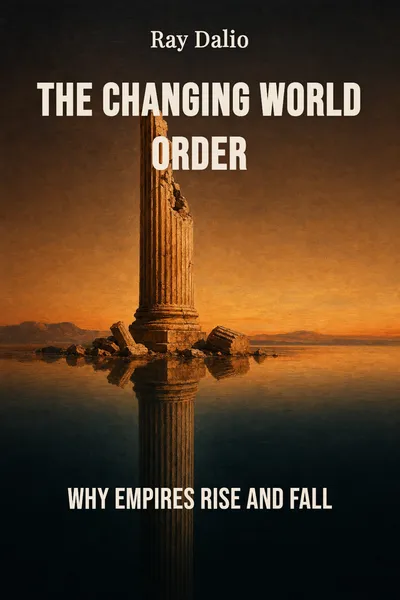
The Changing World Order
Why empires rise and fall
Description
A few years ago, the investor Ray Dalio sat with a set of conditions that didn't quite fit anything he'd traded through in fifty years. Interest rates near zero across the world's three biggest reserve currencies, central banks printing money at a scale that should have alarmed everyone, the widest wealth and political gaps inside the United States in roughly a century, and a rising power in the East pressing against the established one in the West. Each piece, on its own, was familiar enough. Together, they rhymed with something. The trouble was that the last time all of them lined up at once was between 1930 and 1945 — and Dalio, born in 1949, had never lived through it.
So he did what a man who runs the world's largest hedge fund does when his own experience runs out: he went looking further back. Not five years, not fifty, but five hundred. He pulled apart the rise and fall of the Dutch, the British, and the American empires, traced the Chinese dynasties, and tried to measure the things that usually go unmeasured — education, innovation, military strength, the share of world trade, the status of a currency. What he found was not a forecast but a shape. The same sequence, recurring, with a regularity that made the present look less like a crisis and more like a chapter.
Dalio called that shape the Big Cycle, and built Principles for Dealing with the Changing World Order around it. The book is part economic history, part field manual, written by someone whose money is genuinely on the line when he's wrong. It is also, quietly, an unsettling argument: that the order we were born into is not permanent, that it has a life expectancy, and that the signs of where we sit on the curve are readable if we're willing to look.
The question we’re asking : What recurring sequence governs how empires rise, peak, and decline — and where on that arc does today's world actually sit?What we’ll see : How a half-century investor read five centuries of empires to find the machinery behind shifting wealth and power.
Table of contents
01 Chapter 1 — The pattern that kept showing up
The starting point for Dalio is almost embarrassingly practical. He is not a historian by training, and he says so. He's a man who has spent decades betting on what economies will do next, and his method is to find relationships that repeat — cause and effect that holds across many cases — so he can act before the crowd does. When the conditions of the early 2020s stopped matching his own lifetime, his instinct wasn't to panic. It was to find a bigger sample.
The bigger sample meant measuring empires the way you might measure a company. Dalio and his team scored the major powers of the last five centuries on eight rough strengths: education, competitiveness, innovation and technology, share of world trade, military power, economic output, the weight of their financial centers, and the reserve status of their currency. Plotted over time, these readings didn't wander randomly. They rose together and they fell together, in arcs that lasted somewhere between one and three centuries. The Dutch curve, the British curve, the American curve — different countries, different eras, the same silhouette.

02 Chapter 2 — The anatomy of a Big Cycle
The heart of the book is the Big Cycle itself, and Dalio breaks it into a recognizable life story. A new order tends to begin after a major conflict that settles, for a time, who's on top. The winner sets the rules, controls the dominant currency, and enjoys a stretch of peace and prosperity. People work hard, save, invest, and trust their institutions because those institutions just delivered a win. This is the rising phase — productive, broadly fair-feeling, and outwardly confident.
Then success does its slow damage. Prosperity breeds borrowing. The country that once saved becomes the country that spends, often funding its lifestyle with debt denominated in its own reserve currency, which feels free because the rest of the world is happy to hold it. Wealth concentrates. A gap opens between those who own the assets and those who don't, and it tends to open along lines of geography, education, and values. The shared story that held the country together starts to fray, even as the empire looks, from the outside, more powerful than ever. This is the top — the moment of greatest strength and the seed of decline planted in the same soil.
03 Chapter 3 — Money, debt, and the long ride down
If the Big Cycle is the body, money and credit are the bloodstream, and Dalio spends much of the book on what he calls the long-term debt cycle. The idea is straightforward once you accept that credit is just spending power borrowed from the future. As long as borrowers can service their debts, credit fuels growth and everyone feels richer. But debts pile up faster than incomes for decades, and eventually the burden of paying them back outweighs what new borrowing can add. That turning point is the start of the painful part.
When debts become too large to repay in real terms, governments and central banks face a narrow set of options, none pleasant: austerity, default, transferring wealth from haves to have-nots, or printing money. Historically, Dalio argues, they reach for the printing press, because it's the least immediately visible. Interest rates fall to zero, the central bank buys up debt with newly created money, and the currency's value is quietly diluted. It buys time. It also marks a late stage of the cycle — the phase the world entered after 2008 and deepened in the early 2020s.
04 Chapter 4 — Reading the present against five centuries
Step back from the mechanics and the larger claim of the book comes into view: empires, like people, have life cycles, and no power has yet found the exemption. Dalio scores the United States today as a strong but mature empire — still leading in most of the eight measures, still holding the reserve currency, but past its peak on several and carrying internal divisions and debts that look, statistically, like late-cycle symptoms. China he reads as a rising power climbing the same ladder the West once climbed, narrowing gaps in trade, technology, and education faster than most expected.
What makes this more than gloom is the posture Dalio takes toward it. He's not predicting collapse on a date, and he's explicit that decline can be slow, manageable, and even partly reversible if a society invests in education, keeps its debts in check, and resists letting internal conflict tip into disorder. The cycle is a tendency, not a sentence. The Dutch and the British declined without vanishing; they ceased to be the center while remaining prosperous places to live. The question a society faces, in his telling, is not whether the cycle exists but how gracefully it handles its own position on it.
05 Conclusion
Dalio went looking for the present and came back with five hundred years. The confluence that unsettled him — the debts, the printed money, the internal divisions, the rising rival in the East — turned out not to be a freak of his lifetime but a recognizable point on a cycle the Dutch and the British had passed through before, each in their turn losing the trade, the wealth, and finally the reserve currency that had defined their dominance. The machine, in his account, keeps running whether or not anyone is watching it.
Related books