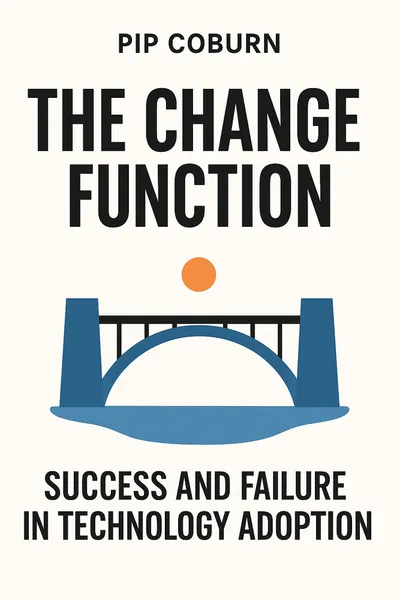
The change function
Success and failure in technology adoption
Description
The success of new technologies in the market isn't just about technical superiority; it hinges on the developers' mindset. While many focus on a supplier-centric approach, believing that users will flock to well-built products, the most successful products come from a user-centric perspective.
This approach prioritizes understanding and solving actual consumer problems over merely advancing technology. Companies that invest in grasping consumer needs rather than pushing technology for its own sake are more likely to create products that consumers are willing to purchase.
Table of contents
01 Fundamental change function principles
In the realm of technology development, a significant challenge persists, largely overlooked by the industry. Annually, a staggering 75% of the billions invested in creating new technologies is squandered, as these innovations fail to reach the market. This inefficiency not only represents a colossal waste of resources but also misses opportunities to bolster the global economy through more effective allocation of funds.
Moreover, adopting a change function approach could aid in discerning which emerging technologies merit early-stage investment, serving as a crucial indicator for potential investors.
Clayton Christensen, in his work "The Innovator's Solution," highlights a grim reality: the majority of new product development endeavors are doomed to failure. Specifically, over 60% of these projects are abandoned before market introduction, and of the remaining 40% that do debut, 40% fail to turn a profit and are subsequently withdrawn. This means that three-quarters of the expenditure on product development is invested in ventures that ultimately fail to achieve commercial success.
The high-tech industry has traditionally accepted failure as an integral part of innovation, with many arguing that the success of breakthrough products justifies the overall system. This perspective is bolstered by reliance on two foundational principles: Gordon Moore's Law, which posits that electronic devices will continually become more affordable and powerful, and Andy Grove's Law, which suggests that a technology that is ten times better than its predecessors will find market acceptance.

02 Comparative case studies: tech successes and failures
Applying the concept of change function thinking helps us understand the success or failure of various technologies in the market. This approach has accurately predicted the commercial outcomes of numerous technologies, offering insights into future trends.
For instance, technologies like Picturephones, Interactive TV, Iridium/Globalstar, Tablet PCs, and Webvan failed to address significant consumer needs, leading to their market exit. On the other hand, innovations such as Flat Panel TVs, Mobile Enterprise Email, Business Intelligence Software, and Satellite Radio succeeded by solving real problems and offering convenience, thereby gaining widespread acceptance.
03 Top ten questions for tech developers
To effectively gauge the potential success of a company, entrepreneur, or management team in developing a commercially viable product, it's essential to ask and evaluate answers to ten critical sets of questions. These inquiries help determine the likelihood of an entrepreneur building a successful business, a company commercializing new technology, and whether an investment is advisable.
A reliance on Moore's Law and Grove's Law as strategies to reduce costs and drive sales is a red flag, whereas a focus on addressing the current crisis and reducing the total perceived pain of adoption indicates a promising approach.
A concerning sign is when individuals cannot acknowledge that less than 5% of new technologies achieve commercial success, indicating a naive optimism. Similarly, attributing failures to inferior technology rather than ease of use for consumers is problematic.
A willingness to discontinue a product based on poor sales rather than user experience or its effectiveness in solving a customer crisis reveals a lack of customer-centric focus. Conversely, considering product withdrawal if it fails to meet user experience expectations or solve the intended problem signifies a proper orientation towards technology development.
Statements about the necessity of "executing better" for product success suggest a misplaced belief in the supremacy of technology over consumer preferences, which is a misconception. The portrayal of products as disruptive without considering user experience, and an overemphasis on achieving a certain price point, are indicative of a flawed approach focused on product features rather than user needs.
04 Implementing the change function strategy
The high technology industry is currently facing a significant challenge due to its long-standing focus on engineering and technical feasibility, often at the expense of understanding and meeting the actual needs and desires of consumers. This approach has led to a situation where the development of new technologies is driven more by what is technically possible rather than what people genuinely want or need.
To address this issue and foster a more user-centric approach, it is essential for organizations to shift their focus towards creating user experiences that people truly desire, rather than merely those that are technically feasible. One effective strategy to achieve this shift is by employing iteration and consumer co-design extensively. This involves trying out small and inexpensive ideas through rapid prototyping to quickly identify what doesn't work before committing significant resources.
By involving real users in real-world situations early in the development process, companies can avoid costly mistakes and ensure that the final product meets the actual needs of consumers. This approach not only shortens the time between idea creation and the development of a working prototype but also encourages a culture of continuous improvement and customer involvement.
Furthermore, companies should focus on identifying and addressing the underlying consumer crises that their products aim to solve. This requires a deep understanding of the consumer's pain points and the challenges they face with current solutions. By developing products that offer real solutions to these problems, companies can increase their chances of success in the market.
Related books