The Botany of Desire
How plants shape human desire
Description
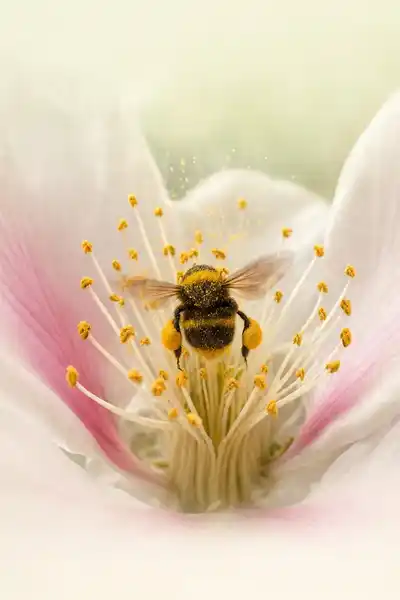
Michael Pollan spent a spring afternoon in his Connecticut garden, planting potatoes and watching bumblebees work his apple blossoms, when a small heresy occurred to him. He had always assumed he was the one doing things to the garden — choosing, sowing, weeding, deciding. But the bee moving from flower to flower did not think of itself as being used by the apple tree, and yet that is exactly what was happening. The flower had, over millions of years, evolved color and scent and sugar precisely to recruit the bee into its reproductive project. So Pollan asked himself the question that would become a book: what if he, kneeling in the dirt, was no more the master of that garden than the bee was master of the tree?
Published in 2001, The Botany of Desire took that inversion and ran with it across four plants and four human wants. The apple and sweetness, the tulip and beauty, cannabis and intoxication, the potato and control. In each case Pollan flipped the usual story. We tend to narrate agriculture as human conquest — we domesticated the wheat, we bred the rose. He proposed reading it the other way, from the plant's point of view, as a strategy these species used to get clever, mobile, world-spanning primates to spread them across the planet.
It is a playful idea, and Pollan writes it playfully, but underneath sits a genuinely unsettling proposition about who is running the show in the long partnership between people and the plants they eat, grow, and crave. The book also happens to be the one that turned a garden columnist into the writer America would later trust to explain where its dinner comes from.
The question we’re asking : What happens when we tell the story of domestication from the plant's side of the deal rather than our own?What we’ll see : Four familiar species, four human appetites, and one quiet reversal of who has been cultivating whom.
Table of contents
01 Chapter 1 — The bee never thinks it chose
The organizing conceit of the book is a swap of perspective that sounds simple and turns out to be slippery. A bumblebee visits a flower for nectar; the flower, in the same transaction, gets its pollen carried off to another plant. Both parties come away with something, but only one of them thinks it is in charge. The bee experiences desire — go there, that one is sweet — and follows it, never suspecting that the desire itself was shaped by the flower's long evolutionary campaign to be found irresistible. Pollan's wager is that we might be closer to the bee than we like to admit.
This is co-evolution, and it is not a metaphor Pollan invented so much as a lens he borrowed and pointed at the garden. Species that learn to satisfy the wants of another species get help surviving and multiplying. The grasses that became grain, the flowers that became orchards — they did not passively submit to human breeding. They offered us things we could not resist, and in exchange we cleared forests, hauled water, fought off their pests, and carried their seeds to every continent we settled. From a potato's point of view, that is a spectacularly good deal.

02 Chapter 2 — The apple that was never about apples
The first desire is sweetness, and its agent is the apple — though not the apple most of us picture. Pollan begins with the historical John Chapman, the barefoot nurseryman remembered as Johnny Appleseed, and immediately dismantles the schoolbook version. Chapman was not scattering the crisp, sweet eating apples of a modern supermarket. He was planting seeds, and an apple grown from seed does not come true to its parent; each one is a genetic wild card, mostly producing small, sour, astringent fruit. What those orchards were really for, across the American frontier, was cider. The apple's ticket into the New World was not the lunchbox. It was alcohol.
This matters to Pollan's argument because it shows the apple bending to human desire while quietly serving its own spread. By growing from seed rather than grafting, the apple kept generating new variety, and that variety was exactly what let it adapt to the strange soils and climates of a continent it had never seen. Sweetness — the trait we selected for once we found a good apple worth cloning — was the plant's way of buying a permanent human escort. We liked the sugar; the apple got planted from Vermont to the Pacific.
03 Chapter 3 — Tulips, weed, and the trouble with beauty
The second desire is beauty, and Pollan hands it to the tulip. He rewinds to the Dutch Republic of the seventeenth century, where a flower with no smell, no taste, and no use beyond being looked at drove one of history's most famous financial manias. At the peak of what came to be called tulipomania, in the winter of 1636 to 1637, single rare bulbs reportedly changed hands for the price of a good Amsterdam house before the market collapsed almost overnight. The flowers that fetched the wildest sums were the flamed and feathered varieties — beauty that, we now know, was produced by a virus infecting the bulb.
Pollan uses the tulip to probe what beauty is even for. In flowers, the whole gorgeous apparatus of petal and color evolved to summon pollinators — beauty as a lure, aimed originally at insects. The tulip simply expanded its client list to include a primate who would build glasshouses, wage lawsuits, and cross oceans on its behalf. To be found beautiful by humans turned out to be one of the great survival strategies a plant could stumble into. The tulip did not need to feed us or heal us. It only needed to be desired.
04 Chapter 4 — What it means to be domesticated by a plant
The fourth desire is the one that ties the others together and turns the book's charm into something with teeth: the desire for control. Pollan's plant here is the potato, and his scene is the arrival of genetically engineered varieties in the late 1990s, when he planted a patch of Monsanto's NewLeaf potatoes, bred to manufacture their own pesticide inside every cell. The potato is the crop that lets him ask what happens when the human wish to master nature reaches its logical end — when we stop selecting from what the plant offers and start writing its code directly.
Behind that scene stands the great cautionary tale of the potato, the Irish famine of the 1840s, when a population had come to depend on a single genetically uniform variety and a blight erased it, killing roughly a million people. Monoculture is control's shadow. The tighter we engineer a crop to do exactly what we want, the more we strip away the messy genetic variety that let plants defend themselves — and the more the whole edifice leans on us to keep it standing with chemicals, patents, and vigilance. Control, pursued far enough, produces dependence, and it is not always clear which party ends up more dependent on the other.
05 Conclusion
Pollan ends more or less where he began, back in the garden, the potatoes in the ground and the bees working the blossoms, but the scene no longer looks the same. The gardener who thought he was imposing his will on a plot of earth has come to see himself as one more creature enrolled in the plants' designs, spreading and tending them in exchange for sweetness, beauty, a change of mind, a sense of control. The reversal that started as a passing heresy has quietly rearranged the whole picture.
Related books