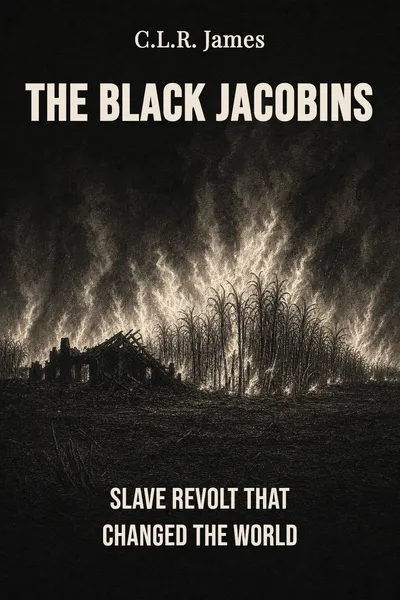
The Black Jacobins
Slave revolt that changed the world
Description
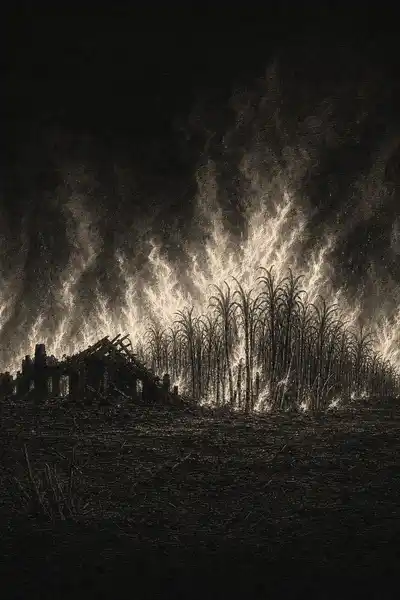
In August 1791, on a plantation in the north of San Domingo, a group of enslaved men and women met at night in the woods of Bois Caïman and decided to burn the richest colony on earth. Within weeks, the whole northern plain was on fire — sugar works, cane fields, the great houses of the planters. The colony that produced two-thirds of France's overseas trade, the single most profitable piece of ground in the Atlantic world, was being torn apart by the people whose unpaid labor had made it profitable. What followed was twelve years of war against the armies of France, Spain, and England, and at the end of it stood something no European had thought possible: a state governed by former slaves.
In 1938, a Trinidadian writer named C.L.R. James published the book that made this story impossible to ignore. The Black Jacobins was written in the shadow of the coming war and in the heat of the movements then stirring across colonized Africa, and James wrote it with a purpose. He wanted to show that the Haitian Revolution was not a footnote to the French one, not a spasm of violence in a distant colony, but a genuine revolution with its own leaders, its own logic, and a place in the front rank of modern history. At its center he put a man born into slavery who taught himself to read late in life and went on to outmaneuver the finest generals in Europe.
That man was Toussaint L'Ouverture, and James's book is at once his biography and the biography of a whole people learning that they could act. The story is brutal, and James does not spare the reader the cruelty of the slave system that produced it. But it is also, in his telling, a story about intelligence, timing, and the way ideas cross oceans and change the people who receive them.
The question we’re asking : How did enslaved people in a French sugar colony build the first independent nation in the Caribbean — and why did C.L.R. James insist their revolt belonged at the center of modern history?What we’ll see : A colony, its slaves, the strategist who led them against three empires, and the long echo of what they made.
Table of contents
01Chapter 1 — The richest colony in the world
By the 1780s, San Domingo — the French half of the island of Hispaniola — was the most valuable colony anywhere. Its plantations supplied a large share of the sugar and coffee that Europe consumed, and the wealth it generated ran through the ports of Nantes, Bordeaux, and Marseille into the whole French economy. James opens his account by insisting on this scale. The revolution to come was not a marginal event on the edge of empire. It happened at the beating commercial heart of the eighteenth-century Atlantic, and everyone with money in France had a stake in it.
That wealth rested on roughly half a million enslaved Africans, worked so hard that the population had to be constantly replenished from the slave ships. The mortality was appalling by design: it was cheaper, planters calculated, to work a person to death and buy another than to let people live long enough to raise families. James catalogs the tortures that kept this system running — the whip, the branding, the mutilations invented and refined by men who had grown bored of ordinary cruelty. He does this not for shock but to establish the terms. The violence of the revolution, when it came, was answered violence.

02Chapter 2 — The slaves who read the Declaration
The extraordinary thing James documents is how quickly the enslaved population grasped what the revolution in France meant for them. Word traveled through the plantations — carried by domestic servants who overheard their masters, by the drivers who moved between estates, by the drums at night. The abstractions of the National Assembly did not stay abstract. They became a rumor that the King had freed the slaves and that the planters were hiding it, and that rumor was enough. When the north rose in August 1791, it rose with a coherence that terrified the whites, who had told themselves their slaves were incapable of organization.
James is careful here, because a lazier account would make the revolt a blind explosion of rage. He shows instead a movement with leadership, coordination, and political calculation. The men who planned the rising chose their moment, synchronized their attacks across estates, and understood that they were bargaining with a state, not merely destroying property. They watched the factions of whites and mulattoes tear at each other and read the openings this created. This was politics, conducted by people the entire system had defined as incapable of it.
03Chapter 3 — The general who out-thought three empires
Over the next several years, Toussaint did something the powers of Europe found humiliating. Commanding an army of former slaves, poorly supplied and largely untrained, he defeated in turn the Spanish, the English, and the internal rivals who contested his leadership. The English expedition, mounted to seize San Domingo for the British crown, ended in a withdrawal after years of fighting and tens of thousands of deaths, most from yellow fever, but many at the hands of an army that fought with a conviction the invaders could not match. James narrates these campaigns as the work of a mind, not an accident of geography.
By 1801 Toussaint governed the colony in all but name. He drew up a constitution that made him governor for life, kept San Domingo nominally within the French empire while running it as an autonomous state, and set about the hardest problem of all: rebuilding the economy without slavery. Here James's portrait grows more complicated and more honest. Toussaint forced the former slaves back onto the plantations as paid laborers, tied to the land under military discipline, because he believed the revolution could not survive if the sugar economy collapsed. The people who had freed themselves found their liberator insisting they return to the cane.
04Chapter 4 — The revolution that would not stay local
Toussaint's capture did not save the French. When Napoleon's intention to reimpose slavery became undeniable, the war resumed with a ferocity that his removal had, if anything, unleashed. His lieutenants, Dessalines above all, understood that there could be no compromise with a power that meant to re-enslave them, and they fought accordingly. Yellow fever destroyed the French army from within; the insurgents destroyed what the fever left. On the first day of 1804, Dessalines proclaimed independence and gave the country back its indigenous name: Haiti. It was the first modern nation founded by former slaves, and the second independent state in the Americas.
What James does with this outcome is the real argument of his book. He refuses to treat Haiti as a curiosity. He places it inside the story of the age of revolution alongside France and America, insisting that the enslaved of San Domingo were not passive recipients of European ideas but active agents who took the Declaration of the Rights of Man more seriously than the men who wrote it. The title carries the claim: these were Jacobins, participants in the same world-historical drama, black ones, and their revolution ran further than the French because it abolished not just a monarchy but slavery itself.
05Conclusion
The colony that met in the woods to burn itself free ended as an independent country, poor, encircled, and unforgiven by the powers whose most profitable possession it had destroyed. Toussaint died in a French cell before he saw it, betrayed by the republic whose emancipation decree he had defended against all of Europe. Dessalines finished the work he had begun. The richest colony on earth became Haiti, and the Atlantic order that had run on its sugar never fully recovered its confidence.
Related books