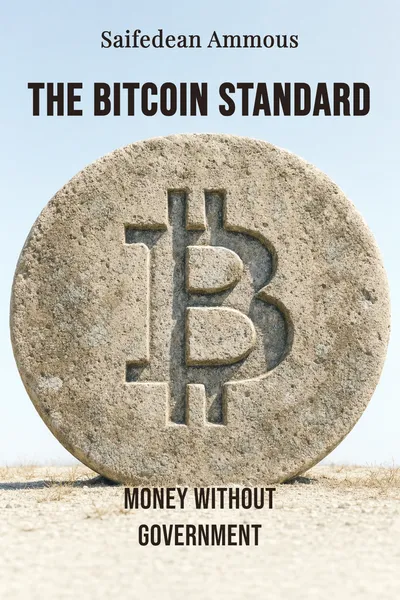
The Bitcoin Standard
Money without government
Description
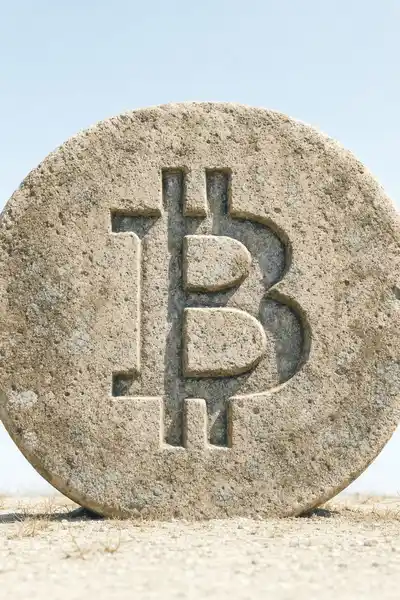
For most of the twentieth century, the Yap islanders in the western Pacific used enormous limestone discs called rai as money — some taller than a person, too heavy to move. What made a rai valuable wasn't that you could carry it home; it was that everyone on the island agreed who owned it, even when the stone stayed exactly where it was, even when one had famously sunk to the bottom of the sea and was never seen again. Ownership was a shared record. The stone itself barely mattered. Saifedean Ammous opens his 2018 book The Bitcoin Standard with stories like this because they set up the question he spends the rest of the book chasing: what makes something good money in the first place?
Ammous, an economist trained in the Austrian tradition, is not interested in Bitcoin as a get-rich scheme or a tech curiosity. He treats it as the latest chapter in a very old story — the long human search for a form of money that holds its value across time. His argument runs against the grain of how most of us were taught to think about money. We tend to assume money is something governments issue and manage, a lever central banks pull to keep economies humming. Ammous flips that: for him, money issued and managed by governments is the historical anomaly, and the trouble that comes with it is predictable.
The book moves from seashells and cattle to gold, from gold to the paper currencies we use now, and finally to a piece of software released in 2009 by someone who has never been identified. Along the way it makes a claim large enough to be provocative: that the kind of money a society uses quietly shapes how far into the future that society is willing to think.
The question we’re asking : What makes money "sound," and why does Ammous think Bitcoin is the first form since gold that qualifies?What we’ll see : How Ammous reads the whole history of money as a contest between the hard and the easy, and where he places Bitcoin in it.
Table of contents
01 Chapter 1 — Why hard money outlasts soft money
Ammous builds his whole case on one property he calls the stock-to-flow ratio. The stock is how much of a thing already exists; the flow is how much new supply gets added each year. When the stock is large and the flow is small, no one can flood the market and dilute what everyone else is holding. That, for Ammous, is what makes money hard. When new supply is easy to produce, the money is soft — and soft money, he argues, always loses the competition eventually, because whoever can make more of it will.
History gives him plenty of examples. The Yap stones worked until an Irish-American trader named David O'Keefe showed up in the late nineteenth century with modern tools and started quarrying rai in bulk; the sudden flow destroyed their value. West African societies used aggry glass beads as money until Europeans, who could manufacture glass cheaply, shipped beads over by the barrel and traded them for goods and people. In both cases the money didn't fail because it was primitive. It failed because someone found a way to make the flow explode.

02 Chapter 2 — The century of the printing press
The gold standard, for Ammous, was a kind of quiet golden age. Under it, currencies were claims on gold, and because governments couldn't conjure gold from nothing, they were disciplined by it. He points to the decades before 1914 — a stretch of relatively stable prices, heavy long-term investment and cross-border trade — as evidence of what sound money makes possible. Then came the First World War. Governments that had promised to redeem their notes in gold suspended that promise so they could print the money to fund the fighting. The war, Ammous argues, was prolonged and made vastly more destructive precisely because states no longer had to raise the cost honestly from taxpayers.
What followed was a long unwinding. The interwar attempts to restore gold were half-hearted and unstable. The 1944 Bretton Woods arrangement pegged currencies to the dollar and the dollar to gold, which held together until the United States had printed far more dollars than it had gold to back. In 1971, Richard Nixon closed the window and severed the last formal link. From that point on, every major currency in the world became what economists call fiat — money that has value because a government says so, backed by nothing you can weigh.
03 Chapter 3 — What Bitcoin actually solved
Every earlier attempt at digital money had crashed on the same rock: how do you stop someone from spending the same digital coin twice? A physical coin can only be in one pocket. A digital file can be copied endlessly. The usual answer was a trusted middleman — a bank, a company — keeping the master ledger. But a middleman is a point of control, and control can be pressured, corrupted, or simply switched off. When Bitcoin appeared in 2009, released under the name Satoshi Nakamoto, it offered a way to keep the ledger without anyone in charge of it.
The mechanism is what Ammous finds beautiful. Thousands of computers around the world hold copies of the same record and compete, through a process called mining, to add the next block of transactions. Faking the record would mean out-computing the entire honest network at once — prohibitively expensive, and pointless, since the attacker would be destroying the value of the very thing being attacked. Trust is replaced by cost. No official has to be believed; the math and the electricity do the vouching.
04 Chapter 4 — Money as the ledger of civilization
Beneath the economics, Ammous is really making an argument about time. His recurring idea is what he calls low time preference — the human capacity to delay gratification, to forgo something now for something greater later. Sound money, he contends, rewards that instinct: when the money you save today will still hold its value in thirty years, saving becomes rational, and saving is what funds the long, patient projects a civilization is built from. Soft money does the opposite. When holding cash is a slow loss, the sensible move is to spend, borrow and speculate, and the horizon collapses.
This is where the book reaches for its most ambitious claim. Ammous ties the flourishing of art, science and craftsmanship in the eras he admires to the presence of hard money underneath them. Cathedrals that took generations to complete, the enduring works of the pre-war period, the accumulation of family capital passed down across lifetimes — these, he suggests, are the visible fruit of societies whose money let people think in decades and centuries. The shortening of attention spans and the churn of the modern economy, in his reading, are downstream of a currency that punishes patience.
05 Conclusion
The Yap islanders knew who owned each stone even when the stone was underwater, because the record was shared and no one could forge it. Ammous's whole book circles back to that intuition. Money, in his account, is not the thing you hold but the ledger everyone agrees to keep — and the entire history he traces, from limestone discs to gold to fiat to Bitcoin, is a history of that ledger getting captured, diluted, and, he believes, finally set beyond capture.
Related books