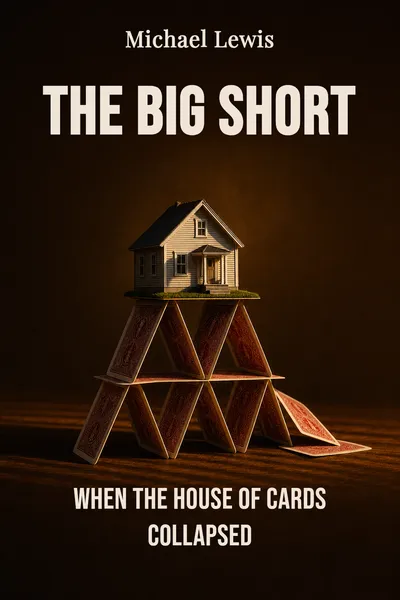
The Big Short
When the house of cards collapsed
Description
In early 2005, a one-eyed former neurologist named Michael Burry sat alone in a Silicon Valley office, reading the prospectuses of mortgage bonds line by line — documents that ran to hundreds of pages and that, by his own reckoning, almost nobody on Wall Street had actually read. What he found in the fine print was not a healthy market. It was a pile of home loans handed to people who could not plausibly repay them, bundled together and sold as if the pile were sound. Burry did something strange with this discovery. He called the big banks and asked them to invent a way for him to bet that the bonds would fail.
The banks were happy to oblige, because from where they sat the bet looked like free money. Housing prices had risen for decades. The idea that a broad swath of American mortgages would default all at once struck the smartest people in the room as absurd. So a handful of outsiders — a hedge fund run out of a garage, a socially awkward money manager in San Jose, a pair of angry traders who trusted no one — quietly took the other side. They were not insiders. They were people who looked at the same numbers everyone had and refused to look away.
Michael Lewis, who had worked at Salomon Brothers in the 1980s and written about it in Liar's Poker, came back to Wall Street two decades later to tell the story of how it nearly destroyed itself. The Big Short is his account of the 2008 collapse told through the few who saw it coming. It is less a book about markets than about the peculiar blindness of a system too complicated for the people running it to understand.
The question we’re asking : How did a few outsiders see a financial catastrophe that the entire industry, its regulators and its rating agencies somehow missed?What we’ll see : We follow the men who bet against the housing market, the machinery that hid the risk, and what their improbable trade exposed about modern finance.
Table of contents
01 Chapter 1 — The men who read the fine print
The people at the center of Lewis's story share one trait: they were temperamentally unable to accept a claim just because everyone around them accepted it. Michael Burry, who had lost an eye to childhood cancer and would later understand he had Asperger's, ran a fund called Scion Capital. He had no finance pedigree. He simply read, obsessively, and in the mortgage bonds he read something the market had priced as safe was in fact a slow-moving disaster. In 2005 he began pressing Goldman Sachs and Deutsche Bank to sell him insurance on bonds he expected to blow up.
That insurance was the credit default swap — a contract where you pay a small annual premium and collect a large payout if a particular bond fails. Burry was buying, in effect, fire insurance on a house he was convinced would burn. The banks wrote the contracts gladly. For them it was steady income on an event they considered impossible.

02 Chapter 2 — A machine built to not understand itself
To grasp why the bet was possible, Lewis walks the reader through the machinery — and the machinery is where the real story lives. It began with the subprime mortgage: a home loan given to a borrower with poor credit, often with a low teaser rate that would jump after two years to a level the borrower could never afford. On its own, one such loan was a small, obvious risk. The trick was what happened next.
Thousands of these loans were pooled together into a mortgage bond, on the theory that even if some borrowers defaulted, most would pay, and the pool as a whole was safe. To make it safer still, the bond was sliced into layers, or tranches, ranked by who got paid first. The top layers were declared low-risk and stamped with a triple-A rating — the same grade as government debt — by Moody's and Standard & Poor's, the agencies paid by the banks whose bonds they were rating.
03 Chapter 3 — The trade that felt like madness
Being right early, Lewis shows, is nearly indistinguishable from being wrong. Burry began buying credit default swaps in 2005, and for the next two years the market did the opposite of what his analysis predicted. Housing prices kept climbing. The premiums on his swaps drained his fund month after month while the bonds he had bet against refused to fail. His own investors turned on him, accusing him of recklessness and demanding their money back. At one point Burry took the extraordinary step of freezing withdrawals, cutting off the people who had trusted him, because he could not afford to unwind the trade before it paid off.
Eisman's team lived through the same disorientation, though they at least had each other. They flew to conferences and heard subprime executives describe their loan books with a confidence that seemed either delusional or dishonest. At a dinner in Las Vegas in early 2007, Eisman met a man who managed CDOs and realized that the man was, in effect, betting on the same garbage Eisman was betting against — and did not understand the danger. The scale of the ignorance frightened him more than it reassured him.
04 Chapter 4 — What a bet against a bond reveals
Step back from the individual trades and The Big Short becomes a book about a structural feature of modern finance: complexity as a place to hide. Lewis's deeper argument is that the mortgage machine did not fail despite being sophisticated. It failed because the sophistication was doing a job — it separated the people making decisions from the consequences of those decisions, layer by layer, until no single person could be held responsible for the whole.
The credit default swap is the clean expression of this. It let a handful of outsiders profit precisely because the insiders had lost track of what they owned. But the same instruments meant that when the losses came due, they landed nowhere and everywhere at once. The banks that had written the bets could not pay them without collapsing, and their collapse threatened the entire economy — which is why the government stepped in to cover losses that private firms had generated in private pursuit of private gain. The people who read the fine print got rich. The people who never saw the fine print lost their homes.
05 Conclusion
By the time the smoke cleared, the men who had bet against the house of cards had been vindicated in the most expensive way imaginable. Burry closed his fund not long after, worn down by the fight with his own investors even as his call proved historic. Eisman kept his contempt but softened at the edges, having watched the industry he despised confirm his worst suspicions in real time. The trade had paid, and none of them seemed to feel much like celebrating.
Related books