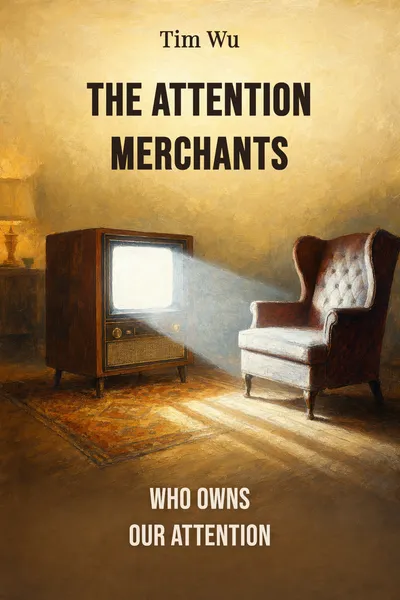
The Attention Merchants
Who owns our attention
Description
In 1833, a printer named Benjamin Day launched a New York paper called the New York Sun and priced it at a single penny — a fraction of what the established six-cent papers charged. He wasn't losing money on every copy out of generosity. Day had understood something the older publishers hadn't: the paper itself didn't need to turn a profit. What Day was actually selling wasn't news to readers. It was readers to advertisers. Assemble a big enough crowd of eyeballs with cheap, lurid stories, and you could rent that crowd's attention to anyone who wanted to reach it.
That small commercial trick — give people something for almost nothing, then resell their attention — is the seed of an industry that Tim Wu, in his book The Attention Merchants, traces across nearly two centuries. From the penny press to radio jingles, from television's captive family evening to the phone that now sits in every pocket, the same logic keeps reappearing in more powerful form. The tools change. The deal doesn't. Something arrives free, and we pay with the one thing we can't manufacture more of: the hours we spend awake and looking.
Wu's book is less a history of media than a history of a harvest. He wants to know how our attention became a commodity that companies mine, package, and sell — and what it costs us to live inside a system engineered to keep taking it. The story runs through moments we'd recognize as landmarks and moments we've forgotten, but they all answer to one blunt question about the world we've built.
The question we’re asking : Who actually owns our attention once it becomes something companies can buy and sell?What we’ll see : How a single commercial trick, repeated across two centuries of newspapers, radio, television and screens, turned our waking hours into inventory.
Table of contents
01 Chapter 1 — The penny paper that sold its readers
Wu opens the story with Benjamin Day because the New York Sun makes the mechanism visible before it gets buried under a century of refinement. Day's insight was simple and a little cynical. If the sale of the paper only had to cover a sliver of the cost, he could price it low enough to reach an enormous audience — and that audience was the real product. Advertisers would pay for access to it. The reader, thinking he was the customer, was in fact the merchandise. It is a reversal that Wu returns to again and again, because once you see it, you see it everywhere.
To gather a crowd that large, the Sun leaned on content that had nothing to do with civic duty. Crime stories, human oddities, a famous 1835 hoax about life discovered on the moon — whatever held the eye. This is Wu's second point: the business of harvesting attention has a built-in pull toward whatever is most reliably arresting, not whatever is most true or most useful. The incentive isn't to inform. It's to capture.

02 Chapter 2 — How the attention business learned to industrialize
If the newspapers proved attention could be sold, the early twentieth century turned the selling into a science. Wu tracks the rise of modern advertising through figures like Claude Hopkins, who treated ad copy as something to be tested and measured rather than merely composed. The industry began to think of persuasion as engineering — coupons to track response, claims calibrated to trigger desire, campaigns designed to manufacture wants people hadn't known they had. Attention stopped being something you happened to catch and became something you deliberately farmed.
Then came broadcasting, and with it a genuinely new frontier. Radio, and later television, could reach into the home during the evening — a stretch of time that had previously belonged to families and no one else. Wu describes this as the colonization of hours that had never before been for sale. The great insight of commercial broadcasters was that programming existed to deliver audiences to advertisers, and the programs themselves were, in a sense, the bait between the messages that paid for everything.
03 Chapter 3 — The screen that followed us home
The internet arrived promising liberation from the old broadcast masters, and for a moment it delivered something like it. Then the familiar logic reasserted itself. Wu shows how the web's early free-for-all hardened into a small number of enormous platforms that discovered the oldest trick in the trade: give away a service, gather an audience of unprecedented size and detail, and sell that audience's attention. Google and Facebook became, in his framing, the largest attention merchants in history — not despite being free, but precisely because being free was how they assembled the crowd.
What changed was the intimacy and the reach. Earlier merchants rented your evening. The smartphone rents your entire day, following you from the bedside table to the commute to the dinner table and back. Wu emphasizes how much better the new tools are at their job. They don't broadcast blindly; they measure each of us, learn what holds us, and adjust in real time. The feed is engineered, click by click, to keep the eye moving down the page.
04 Chapter 4 — Attention as a resource we keep spending
Step back from the parade of newspapers, radios and phones, and Wu's real argument comes into focus. Underneath the whole history sits a single claim: attention is finite, extractable, and increasingly treated as inventory. Each of us has only so many waking hours, and the attention merchants have built their fortunes by capturing as many of those hours as possible and reselling them. What looks like a story about media technology is really a story about a resource — ours — being quietly harvested at a scale no earlier era could imagine.
That reframing changes the stakes. When attention becomes a commodity, the question stops being which channel we choose and becomes what our lives are made of. Wu points out that the hours given to the merchants are hours not given to anything else — to thinking, to other people, to boredom, to the slow work of forming our own judgments. He worries, with meticulous care rather than alarmism, about what happens to a society's capacity for reflection when its attention is under continuous commercial siege.
05 Conclusion
The line runs unbroken from Benjamin Day's penny paper to the phone glowing on the nightstand. The medium keeps upgrading; the bargain stays the same. Something arrives at no apparent cost, a crowd gathers, and the crowd's attention is sold to whoever wants it. Wu's achievement in The Attention Merchants is to make that continuity impossible to unsee, to show that the feed we scroll at midnight belongs to the same lineage as the moon hoax of 1835 — the same appetite for whatever reliably holds the eye, refined into a machine that measures us one by one.
Related books