The Ascent Of Man
How science made us human
Description
In 1973, a Polish-born mathematician who had spent the war doing operations research on bombing raids stood in front of a BBC camera in the Auschwitz mud and pushed his hand into a pond where the ashes of his own relatives had been flushed. Jacob Bronowski was sixty-five, near the end of a life that had run from Blake's poetry to nuclear statistics, and he was filming the thirteen-part series that became The Ascent of Man. The scene was not scripted. He knelt, he touched the water, and he said that this is what men do when they think they have absolute knowledge — that the gas chambers were built by dogma, not by science.
That single gesture holds the whole argument of the book that grew out of the series. Bronowski was not writing a tidy history of inventions. He was making a case about what kind of animal we are. Every other species fits into its landscape and stays there; we are the creature that refuses to fit, that reshapes the world with tools, that imagines a future and then builds toward it. He called that long refusal the ascent — not a smooth climb, but a series of leaps of the imagination, each one made by a person who saw something nobody had seen before.
What ties a flint hand-axe to Einstein's equations, in his telling, is a single faculty: the human gift for finding hidden likenesses, for reasoning from the evidence in front of us to the pattern behind it. Science, for Bronowski, was not a cold instrument bolted onto humanity. It was the most human thing we do — and the most fragile, because it lives or dies on our willingness to be shown wrong.
The question we’re asking : What is the faculty that turned one primate into the creature that remakes the world — and where does it come from?What we’ll see : How Bronowski reads the long climb from stone tools to relativity as a single human story, and why he ends it with a warning.
Table of contents
01Chapter 1 — A face turned toward the tools
Bronowski begins where the fossils begin, in East Africa, with a skull. The early hominids were not the strongest animals on the savanna, nor the fastest, and they were losing their forest to a drying climate. What set them apart was not a bigger body but a face and a hand that had begun to work together in a new way. He lingers on the anatomy because he thinks it matters that the human line evolved forward-facing eyes, a mobile hand, and above all a growing brain that arrived helpless and stayed dependent for years. That long childhood, he argues, is not a weakness. It is the window in which everything human gets learned.
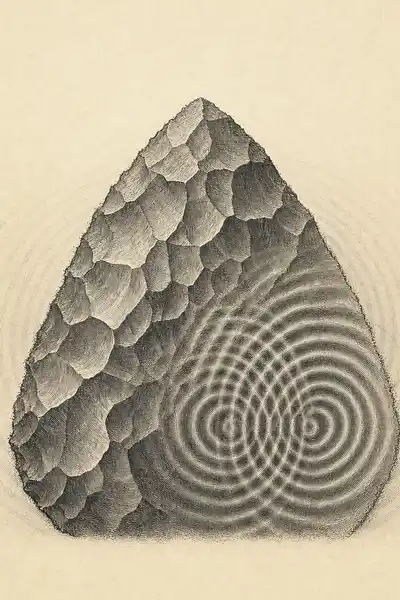
The first tool is the pivot of the chapter. A pebble chipped on one edge to make a cutting surface looks trivial until you notice what it implies: someone held the stone, pictured the shape hidden inside it, and struck toward that image. The tool is a plan made solid. Other animals use objects, but they do not carry a design in the mind and impose it on the material. Bronowski calls this the beginning of the human method — the flint axe and the theory of relativity sit at two ends of the same reach.

02Chapter 2 — The hand that reasons
If the tool is where the human method starts, the hand is where Bronowski keeps returning to explain it. He was fascinated by the idea that we do not think in the abstract and then use our hands to carry it out; rather, the hand and the mind educate each other. A craftsman working metal, a stonemason cutting an arch, a smith folding a Japanese sword blade — each is reasoning through the fingers, testing what the material will and will not do. Knowledge, in this reading, is something you do before it is something you know.
He builds the case through the history of working with matter. Fire was the first tool for transforming a substance rather than merely shaping it, and metallurgy is the long story of coaxing hidden structure out of ore. When Bronowski handles the way copper is alloyed with tin to make bronze, or iron is worked and quenched, he is showing that early metalworkers were running experiments they could not have described in words — they had a practical grasp of the atomic architecture of matter centuries before anyone could name it. The theory came later to explain what the hand already knew.
03Chapter 3 — When the private image becomes public knowledge
The turn from craft to science, in Bronowski's account, is the turn from the workshop to the shared page. A blacksmith's skill dies with him unless he trains an apprentice; a law of motion, once written down and tested by strangers, belongs to the world. The scientific revolution was not simply the discovery of new facts. It was the invention of a new social act: publishing your reasoning so that others could check it, repeat it, and prove you wrong.
He tells this through people rather than through abstractions, because he thinks discovery is always personal before it is general. Copernicus quietly moving the Sun to the center; Galileo turning a homemade telescope on Jupiter and watching four moons circle it, evidence that not everything orbits the Earth; Newton seeing that the fall of an apple and the orbit of the Moon obey one and the same law of gravity. Each began with a private image — a hidden likeness glimpsed by one mind — and each became knowledge only when it was offered up for the world to test.
04Chapter 4 — The knowledge that cannot be certain
Step back from the parade of names and a single claim comes into focus, the one Bronowski built the whole series to make: science is not a body of gadgets or a store of facts, it is a self-portrait of the human animal. The forward-facing eyes, the planning hand, the long childhood, the compulsion to find hidden likenesses — everything the fossils showed in chapter one comes back transformed into equations and cathedrals and periodic tables. To trace the ascent of man is to trace the one faculty no other creature has: the imagination that reaches past the present moment.
But the portrait has a shadow, and Bronowski refuses to leave it out. The same twentieth-century physics that reached deepest into the atom also proved that certainty is not available to us. He anchors this in Heisenberg's work, which he preferred to call the principle of tolerance rather than uncertainty: there is a limit, built into nature, on how exactly we can know any two things at once. Knowledge is real, it is powerful, and it is always approximate. To pretend otherwise is not science; it is dogma wearing science's clothes.
05Conclusion
Bronowski died in 1974, a year after the series aired and just as the book reached readers. He had spent his last strength arguing that the story of science was really the story of what it means to be human — not a catalogue of clever machines, but the record of a creature that learned to picture what was not yet there and then reach for it. From the pebble struck toward an imagined edge to the equation that reordered space and time, the thread never breaks: it is always someone finding a hidden likeness and daring to make it public.
Related books