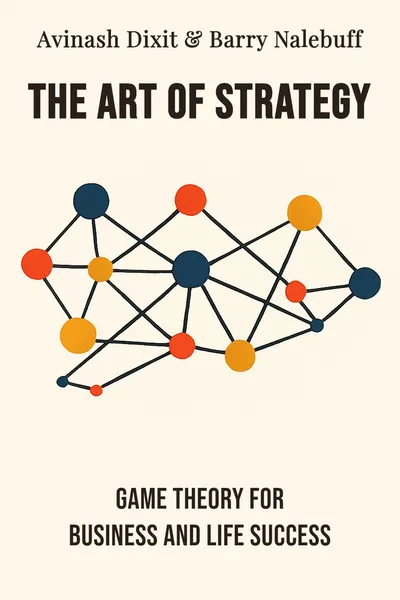
The art of strategy
Game theory for business and life success
Description
To excel in strategic thinking and truly master strategy, it's essential to grasp the fundamentals of game theory, a key academic field. Game theory is crucial for making sound strategic decisions in both business and personal contexts. It involves understanding others through their actions rather than their words, predicting and countering others' reactions by presenting choices, and using it as a tool to encourage cooperation, even when faced with selfish motives.
Ultimately, while strategic thinking remains an art, knowledge of game theory's principles enhances one's ability to think strategically. Strategic thinking involves outsmarting opponents who are equally intent on outsmarting you, finding cooperative solutions amidst self-interest, persuading others and oneself, interpreting and disclosing information, and empathizing with others to foresee and shape their actions.
Table of contents
01 Exploring game theory
Game theory is a fascinating and intricate field that explores the strategic interplay between decision-makers, known as "players." It revolves around the concept of "games," which are scenarios where one's decisions are influenced by the actions of others. These players make "moves," which can be sequential or simultaneous. Sequential games involve a clear progression of actions, while simultaneous games involve players making decisions at the same time without full knowledge of others' actions.
In game theory, "zero-sum games" represent situations where one player's gain is balanced by another player's losses. However, in the business context, pure zero-sum scenarios are relatively uncommon. There are areas where all players can benefit, as well as areas of fierce competition where any strategy may be detrimental to all involved parties. These players in competition are called "rivals."
When analyzing a sequential game, constructing a "game tree" is beneficial. It outlines potential choices at each decision point, and as the game progresses, the number of potential outcomes multiplies. For simultaneous games, compiling a matrix that displays potential outcomes for every combination of choices is the most effective approach.

02 Understanding game theory fundamentals
Game theory is a field of study that provides a structured approach to strategic thinking. It enables individuals to make informed decisions and effectively follow through with them. At the core of game theory is a sequence of moves, each contingent upon the other. It involves projecting into the future to see where initial decisions are likely to lead and using backward reasoning to determine the optimal decision in the present. Constructing a game tree can aid in this process. It outlines the choices available at each juncture and provides insight into potential future events. However, game trees can become complex in real-world scenarios, and strategic decisions often require a blend of backward reasoning, personal judgment, and experience. Additionally, game trees are less practical in the early stages of negotiations when the rules of engagement are still forming.
An example of looking forward and reasoning backward is Robert Campeau's takeover attempt of Federated Stores, which owned Bloomingdales. Campeau proposed a two-tiered tender offer but modified it after legal issues arose. This illustrates the concept of adapting strategies based on future outcomes. A "dominant strategy" is one that surpasses all other options, providing a universally superior outcome. If such a strategy is available, it should be utilized without hesitation. Conversely, if a rival possesses a dominant strategy, it is prudent to assume they will employ it and prepare the best possible counteraction. Strategic decisions often require commitment before observing competitors' moves, so being vigilant for dominant strategies is crucial.
03 Leveraging game theory in strategy
Understanding and applying the principles of game theory to real-world business scenarios is a nuanced process that transcends the boundaries of exact science, venturing into the realm of art. To truly master the strategic application of game theory, one must immerse themselves in the study of past examples, drawing from a wealth of experience and practice. The most effective way to enhance one's strategic acumen is by analyzing historical applications of strategy in similar contexts and adapting those insights to meet specific, current needs.
In the complex landscape of business, certain players often possess an informational advantage, having deeper insights into the true state of affairs. This environment is ripe for the strategic manipulation of information, where actions invariably speak louder than words. Observing the actions of individuals and organizations often reveals more about their intentions and strategies than their spoken words. Similarly, it is crucial to be mindful that others will scrutinize your actions to decipher the information they convey.
To leverage business information strategically, one should employ two key strategies: signaling and screening. Signaling involves taking deliberate actions that disclose information beneficial to your interests, while screening entails creating scenarios where others reveal their true intentions through their actions rather than their words. Both strategies are invaluable in a variety of contexts.
For instance, screening can be instrumental in maximizing revenue by enabling businesses to discern the price sensitivity of different customer segments. This can be achieved by offering multiple versions of a product at varying price points, allowing customers to self-select based on their willingness and ability to pay. This approach is exemplified by practices such as book publishers charging more for hardcover editions than paperbacks, software companies offering "lite" versions at reduced prices, and manufacturers introducing artificially differentiated product versions to cater to different market segments.
Related books