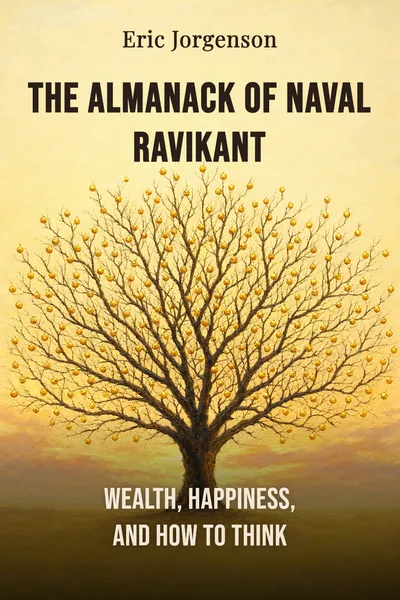
The Almanack of Naval Ravikant
Wealth, happiness, and how to think
Description
In 2020, a product manager and writer named Eric Jorgenson published a book he had assembled almost entirely from someone else's words. The someone else was Naval Ravikant — the founder of AngelList, an early investor in Uber, Twitter and hundreds of other startups, and a man who by then had become better known online for one-line aphorisms than for any single company. Jorgenson had spent years combing through Ravikant's tweets, podcast appearances and interviews, pulling out the passages that stuck, and stitching them into eleven themed chapters. He released it free as an ebook. It went on to sell hundreds of thousands of copies in print anyway.
The result is a strange kind of book. Ravikant did not write it, in the ordinary sense — he wrote pieces of it, over a decade, mostly 280 characters at a time, without knowing they would end up between two covers. What holds it together is not a narrative or an argument built chapter by chapter. It is a sensibility: a way of thinking about money, work and the mind that treats all three as engineering problems with knowable solutions. Get wealth right, the book suggests, and you free up the attention to get happiness right, and both come down to the same underlying move — figuring out what is actually true and acting on it.
That compression is the appeal and the risk at once. A tweet that lands as a small revelation can also flatten a hard thing into a slogan. Reading the Almanack straight through, we keep bumping into that tension — a line that feels earned by experience sitting next to one that sounds like it wants to be printed on a mug.
The question we’re asking : What does the Almanack actually claim about wealth, happiness and clear thinking — and how much of it holds up once the aphorisms are unpacked?What we’ll see : How Ravikant redefines getting rich, why he thinks happiness is trainable, and what it means that his philosophy reached us through someone else's edit.
Table of contents
01 Chapter 1 — Wealth is not the money in your bank account
The Almanack opens its longest section on a distinction Ravikant returns to constantly: wealth is not the same as money, and neither is the same as status. Money, in his framing, is how we transfer time and value between people — a set of credits for work already done. Status is your ranking in a social hierarchy, and it is zero-sum: for you to rise, someone has to fall. Wealth is the thing worth chasing, and he defines it as assets that earn while you sleep — a business, equity, a piece of code, a media property. The point of the distinction is a warning. Chasing status feels like chasing wealth, but it is a different game with worse odds, and most people confuse the two.
From that split follows the book's most quoted piece of advice: seek wealth, not money or status, and get it by owning equity — a stake in something — rather than selling your time. Ravikant is blunt that you will never get rich renting out your hours, because hours do not scale and an employer can always find more. Renting time caps your upside at what one person can do in a day. Owning a piece of a business that keeps running without you removes that cap. He is not moralizing about work; he is doing arithmetic about which structures compound and which do not.

02 Chapter 2 — Specific knowledge and the leverage that pays you while you sleep
If wealth is the goal, the Almanack's engine for reaching it is a pair of ideas Ravikant borrows and sharpens: specific knowledge and leverage. Specific knowledge is the stuff you cannot be trained for through a course or a certificate — it feels like play to you and like work to everyone else, it is often found by following genuine curiosity rather than a career plan, and because it is hard to teach, it is hard to replace. His examples are deliberately un-corporate: a knack for storytelling, an obsessive interest in some niche, a native feel for markets or machines. The advice that falls out of it is to build a body of skill so specific to you that the market has to route around you rather than through you.
Specific knowledge tells you what to sell. Leverage tells you how to multiply it. Ravikant sorts leverage into three kinds. There is labor — other people working for you, the oldest form and, he argues, the worst, because it requires managing humans. There is capital — money that goes to work on your behalf, powerful but gated behind track record and trust. And there is the newest kind, which he calls products with no marginal cost of replication: code and media. A piece of software or a podcast or a book can serve one person or a million at the same cost, and it works while you are asleep or on holiday. This, more than anything, is the Almanack's practical heart — the observation that a laptop and an audience now offer a form of leverage that once required a factory.
03 Chapter 3 — Happiness is a skill you build, not a prize you win
Roughly halfway through, the Almanack pivots, and the pivot is the reason the book outsold its niche. Having laid out how to get rich, Ravikant spends the second half arguing that money was never the point — that financial freedom is worth having mostly because it clears the runway for the harder project, which is a peaceful mind. His central claim about happiness is that it is not a set of circumstances to be arranged but a skill to be developed, closer to fitness than to fortune. You do not find happiness the way you find a good deal; you train it the way you train a muscle, and, like fitness, it decays if you stop.
What he prescribes is less a routine than a set of subtractions. Much unhappiness, in his telling, comes from desire — a contract you make with yourself to be unhappy until you get a specific thing. So he counsels holding desires deliberately, picking the one big want at a time rather than living in a permanent state of lack. He is drawn to the idea that the present moment, examined honestly, rarely contains a real problem; most suffering is memory or anticipation, the mind time-traveling into regret or fear. The remedies are unglamorous and familiar — meditation, which he describes almost mechanically as doing nothing and watching what the mind coughs up, plus exercise, sleep and time outdoors — but he treats them as the actual work rather than as wellness garnish.
04 Chapter 4 — A philosophy assembled from tweets
Step back from the advice and the object itself becomes the interesting thing. The Almanack of Naval Ravikant is not a book Ravikant sat down to write. It is a book a reader built out of him — Jorgenson gathering a decade of tweets, podcast transcripts and interview clips and arranging them into chapters the author never planned. Ravikant blessed the project and wrote a short note for it, but the structure, the sequencing, the decision about which throwaway line deserved to become a heading — that editorial hand belongs to someone else. The wisdom is Ravikant's; the shape is Jorgenson's.
That form is not incidental to what the book is. A philosophy delivered in tweets is a philosophy optimized for portability — each unit built to survive being screenshotted, quoted out of context, remembered in isolation. It is what lets a line like seek wealth, not money or status travel across millions of feeds. But the same compression that makes an idea spreadable strips out the caveats and the conditions. A tweet cannot hold the exception, the counterexample, the this-worked-for-me-and-may-not-for-you. The Almanack inherits both the reach and the flatness of its source material, and reading it is partly an exercise in supplying the nuance the format had to leave out.
05 Conclusion
The Almanack circles back, in the end, to the distinction it opened with. Wealth was never the destination; it was the thing that buys the freedom to work on the mind, which is where the real difficulty lives. The book's arc runs from arithmetic to equanimity — from equity and leverage and the mechanics of getting rich, to desire and attention and the harder mechanics of being content once you are. And the through-line, the sensibility holding the eleven chapters together, is a stubborn faith that both halves are trainable: that clear thinking about what is true can be applied to a balance sheet and to a restless mind with the same tools.
Related books