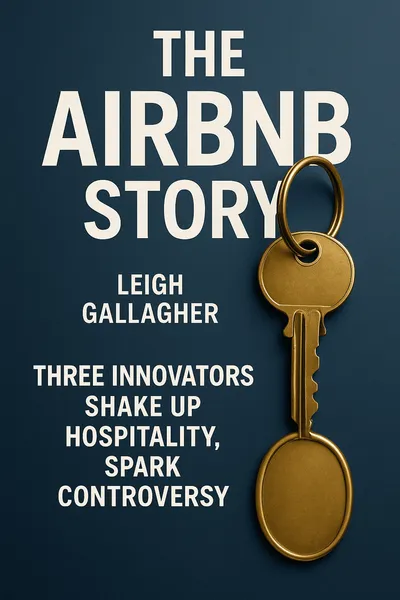
The airbnb story
Three innovators shake up hospitality, spark controversy
Description
The Airbnb story began in Providence, Rhode Island in 2004. Brian Chesky had just graduated from the Rhode Island School of Design and his friend Joe Gebbia was in the fourth year of a five-year dual degree in industrial and graphic design at the same school. They teamed up for a project competition, pitching a shirt made of soap among other ideas, which didn't impress the judges but sparked their collaborative spirit.
Chesky moved to Los Angeles and Gebbia to San Francisco, but they kept in touch. In 2007, Chesky moved to San Francisco to join Gebbia, and facing the need to cover rent, they came up with the idea of renting out air mattresses in their apartment. This idea evolved into AirBed & Breakfast, launching a website to advertise their concept. Their initial success at a design conference led them to pursue the idea further, eventually attracting significant investment and growing into the global platform Airbnb is today.
Table of contents
01 Searching for innovation
The story of Airbnb began in Providence, Rhode Island, during the summer of 2004. Brian Chesky had just completed his studies at the Rhode Island School of Design, and his friend Joe Gebbia was pursuing a dual degree in industrial and graphic design at the same institution. They collaborated on a project competition for Conair Corporation, proposing innovative ideas like a soap-made shirt, which, despite not impressing Conair executives, solidified their partnership.
After graduation, Chesky moved to Los Angeles, while Gebbia settled in San Francisco. In 2007, Chesky joined Gebbia in San Francisco, where they faced the challenge of covering Gebbia's rent. This predicament led to the creation of their bed-and-breakfast concept for a designers' congress in San Francisco, utilizing air mattresses and offering breakfast, which they advertised on design blogs. Their initial success, hosting three guests and earning about $1,000, encouraged them to further pursue the idea.

02 Cereal side hustle
Initially, AirBed & Breakfast struggled to gain momentum, and co-founder Nathan Blecharczyk considered pursuing his own startup. However, a renewed vision to make booking a home as simple as a hotel room reinvigorated the team. Despite facing rejections from over ten angel investors, the founders relaunched their website in August 2008, coinciding with the Democratic National Convention in Denver. The site's crash following a TechCrunch feature and the subsequent flatlining of traffic post-convention marked a challenging period.
To spark interest, the founders created collectible cereal boxes themed around the presidential candidates, which raised over $20,000, albeit not enough to sustain the business. With finances dwindling, Brian Chesky and Joe Gebbia resorted to eating unsold Cap'n McCains cereal. Their fortunes changed when they met with Michael Siebel, who advised them to apply to Y Combinator. Despite a rocky interview, they impressed Paul Graham with their cereal box funding strategy, earning them a spot in the program and $20,000 in seed funding.
03 Gaining momentum
Sequoia Capital recognized that Airbnb founders had achieved a significant milestone known as "product/market fit," where they had successfully identified a lucrative market and developed a product that met its needs. By August 2009, Airbnb was rapidly expanding, generating around $10,000 weekly from bookings exceeding $100,000. The challenge ahead was scaling the business significantly. Initially, the three founders were the sole workforce, putting in eighteen-hour days, seven days a week.
Anticipating future hiring, they penned ten core values for new hires, which included unique qualities like "Hard-working Olympic animal" and "Passionate about Airbnb." Hiring began in late summer 2009, and by the following year, Airbnb had grown to twenty-five employees operating from a cramped apartment. The founders conducted interviews in unconventional spaces, including stairwells and rooftops, as the apartment transformed into an office space.
04 Launch to success
Airbnb's journey from a simple idea to a global phenomenon is a testament to entrepreneurial spirit and innovation. Initially perceived as a budget-friendly option for millennials, Airbnb has transformed into a diverse marketplace, offering everything from modest air mattresses to luxurious villas. The company's rapid evolution is a story of agility and adaptability, with founders who had little experience but managed to create a high-performing growth machine in just a few years.
The essence of Airbnb's success lies in its ability to offer authentic, personalized travel experiences. Unlike traditional hotels, Airbnb enables travelers to immerse themselves in local communities, staying in unique properties that offer a sense of place and connection. This approach to travel has resonated with a wide audience, from those seeking affordable accommodations to those desiring high-end, curated experiences.
05 Expansion challenges
Airbnb has faced significant challenges due to the unpredictable nature of human behavior. Incidents ranging from accidents within rentals, property damage, to more severe cases like carbon monoxide poisoning and assaults have drawn public attention. To mitigate these issues, Airbnb introduced a $1 million guarantee to cover damages, which has been rarely needed, exemplified by the fact that in 2015, damages occurred in only 0.002 percent of bookings. This guarantee offers reassurance to both hosts and guests that Airbnb will address any problems that arise, even for those without personal property insurance.
Additionally, the company established a 24/7 hotline and a Trust and Safety division, employing 250 people across Portland, Oregon, Dublin, and Singapore. This team focuses on identifying suspicious activities, conducting spot checks, collaborating with law enforcement, and includes specialists in various fields such as victim advocacy and cybersecurity. Airbnb has also enhanced its verification processes for both guests and hosts.
06 Regulatory spotlight
Airbnb's journey has been marked by significant challenges, particularly in New York City, where local laws have created a complex regulatory environment for short-term rentals. The company's founders, unprepared for such legal hurdles, were advised to engage lobbyists to navigate the intricate political landscape. Despite the unfamiliarity with such practices, Airbnb hired a prominent New York lobbying firm, Bolton–St. Johns, to address a law that threatened its operations and was on the fast track to being passed.
New York City, a major market for Airbnb, generating an estimated $450 million annually for hosts, passed a law in 2010 that effectively restricted Airbnb's activities. The situation escalated in late 2016 when Governor Andrew Cuomo signed a law making it illegal to advertise short-term rentals without the owner present, affecting the majority of Airbnb's listings in the city. Airbnb's response was to file lawsuits against the city and state, which were eventually settled.
07 Confronting traditional hotels
Initially, the hotel industry largely ignored Airbnb, but as the platform's growth became undeniable, it was recognized as a disruptive force operating under different regulations. This has led to a complex dynamic where hotels are both opposing and engaging with Airbnb, exploring ways to capitalize on the short-term rental trend. Christopher Nassetta, CEO of Hilton Worldwide, believes that while Airbnb is a strong business, it is distinct from traditional hotels, which offer consistent quality, service, and amenities that Airbnb cannot replicate.
The hotel industry is particularly concerned about Airbnb's impact on compression pricing, a significant revenue source during high-demand periods such as major events. Unlike hotels, Airbnb can instantly increase supply to meet demand without resorting to compression pricing, thanks to its near-zero marginal costs.
08 Airbnb's future path
Airbnb's journey from a struggling startup to a multi-billion-dollar enterprise is a testament to the leadership of its founders, Brian Chesky, Joe Gebbia, and Nathan Blecharczyk, who have navigated the company's rapid growth without traditional management backgrounds.
Chesky, known for his voracious learning appetite, employs a "going to the source" approach to leadership, seeking advice directly from experts.
Gebbia, at the helm of Airbnb's innovative projects, has expanded the company's offerings to include local experiences, while Blecharczyk's technical prowess has been crucial in developing early growth hacks and maintaining hands-on involvement with the company's technology.
Related books