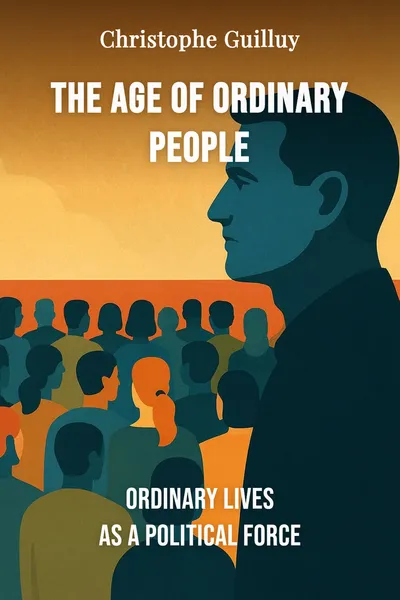
The Age of Ordinary People
Ordinary lives as a political force
Description
For decades, the geography of who mattered in a Western democracy seemed settled. The big cities drew the jobs, the money, the media and the young graduates; everything else was a kind of waiting room, a place people were supposed to leave. Then, somewhere in the 2010s, the waiting room started answering back. Yellow vests on French roundabouts, Brexit in the English shires, populist swings across small-town America and provincial Europe — a scattered set of revolts that governing classes read, at first, as noise. Christophe Guilluy, a French geographer who spent years mapping where people actually live and work, reads them as something else: a signal that the center of political gravity has quietly moved.
His argument in The Age of Ordinary People is deceptively simple. The metropolises that produce most of a country's wealth have also, over one generation, stopped producing a shared social world. They run on globalization, and globalization needs winners and an invisible support staff. Meanwhile a majority of the population has been pushed out to what Guilluy calls the periphery — smaller towns, exurbs, rural zones — not by catastrophe but by cost, quietly, house price by house price. That majority kept working, kept the lights on, and kept being told it no longer counted.
What interests Guilluy is not the anger itself but the shift underneath it: a governing class that mistook its own map for the whole country, and a population that has slowly stopped waiting to be recognized by it. The revolts, on this reading, are less a demand than an announcement — of a legitimacy that has changed address.
The question we’re asking : What happens to a democracy when its governing class and its majority no longer live in the same country?What we’ll see : How a geographer reads a decade of scattered revolts as the sound of the political center quietly changing hands.
Table of contents
01Chapter 1 — The map that stopped matching the territory
Guilluy's method is unusually literal for a book about politics: he starts with a map. Where are the jobs that pay? Where do people who hold them live? Where does everyone else go? For much of the twentieth century, the answer held together. Industry spread work across a whole territory, and a factory town and a capital city belonged, however unequally, to the same economy and roughly the same culture. A worker in a mid-sized town and a manager in the city were reading the same national story.
Globalization broke that arrangement, and it broke it geographically. The high-value work — finance, tech, media, the creative and administrative professions — concentrated in a handful of large metropolises. Those cities became extraordinarily productive and, at the same time, extraordinarily expensive. Property prices did the sorting that no one voted for: the people who ran the new economy could afford to stay, and much of the working and lower-middle class could not. They left, or never arrived, moving to the towns and rural belts beyond the metropolitan reach.

02Chapter 2 — The invisible majority
The sharpest move in Guilluy's book is a reframing of who the marginal actually are. The dominant story of recent years has been about visible minorities — groups defined by identity, whose grievances are named, debated and, at least rhetorically, taken up by institutions and media. Guilluy does not dismiss those struggles. He points out that alongside them sits a much larger group that has no comparable voice: the ordinary working and lower-middle classes of the periphery, a numerical majority that has become socially invisible.
Their invisibility is not an accident of attention; it is structural. The metropolis runs on their labor — the delivery drivers, care workers, cleaners, warehouse staff, the people who commute in from the edges to keep the productive city functioning — but it does not house them, does not represent them, and does not really see them as part of itself. They are essential and absent at once, present in the economy and missing from the picture the economy tells about itself.
03Chapter 3 — When the periphery stops asking
The revolts of the last decade look, from the metropolis, like eruptions of resentment. Guilluy reads them differently. What changed, he argues, is not the level of hardship — the periphery had absorbed decline for years without much protest — but the disappearance of a hope. For a long time, ordinary people accepted their marginalization because they still believed the system might eventually turn back toward them, or at least toward their children. When that belief drained away, the terms of the relationship changed.
The French yellow-vest movement of 2018 is his central illustration, and it is instructive precisely because it did not fit. It had no leaders, no party, no clear program the political class could negotiate with. It began over a fuel tax — a cost that lands hardest on people who must drive because they live far from everything — and spread across exactly the peripheral geography Guilluy had been mapping. The movement was not asking to be integrated into the metropolitan project. It was asserting that it existed.
04Chapter 4 — The center that moved without permission
Step back from the roundabouts and the fuel tax, and Guilluy's book is really about where legitimacy lives. Modern democracies were built on an implicit deal: the governing class earns its authority by being seen to speak for the whole nation. What his geography exposes is that this class now speaks, quite genuinely, for a place — the connected metropolis — and mistakes that place for the nation. The authority is still exercised, but the thing that once grounded it, a felt sense of shared belonging, has drained out from underneath.
This is why he frames the era as the age of ordinary people rather than the age of revolt. The decisive change is not that the periphery has grown loud but that it has grown independent — culturally, if not economically. It no longer measures itself against the values of the metropolis, no longer accepts being defined as the residue of progress. A center of gravity is not a place where power is concentrated; it is the point everything else orients toward. And ordinary lives, in Guilluy's telling, have stopped orienting toward the elite. That is the migration that matters.
05Conclusion
The book closes the loop it opened on the roundabouts and in the provincial towns. The scattered revolts that governing classes filed under noise were, on Guilluy's reading, the audible edge of a deeper shift: a majority that had quietly stopped waiting to be seen and started acting as though its own life was already the norm. The center of political gravity did not so much collapse as relocate — from the connected metropolis to the ordinary lives it had learned to overlook.
Related books