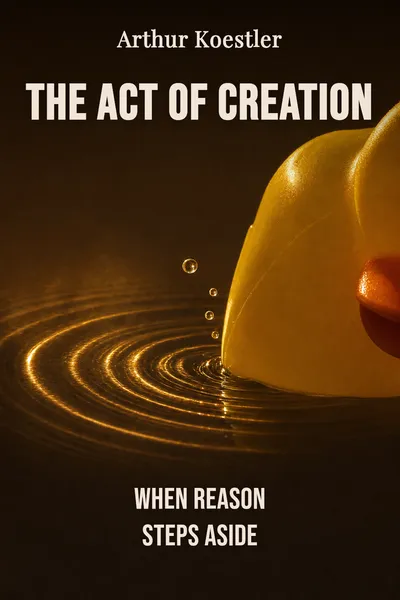
The Act of Creation
When reason steps aside
Description
In 1964, a Hungarian-born writer named Arthur Koestler published a seven-hundred-page book that no discipline had asked for. Koestler was not a laboratory psychologist. He had been a science journalist, a political prisoner under Franco, a former communist who broke with the party, and the author of novels that made him famous. Then, in mid-life, he turned to a question that the working psychology of his day had mostly set aside: where does a genuinely new idea come from? He called the book The Act of Creation, and he meant the title broadly — not the special gift of a few artists and scientists, but a capacity he believed runs through all living things, usually buried under the routines that get us through the day.
His starting point was almost a provocation. The dominant psychology of the time, behaviorism, explained the mind as a bundle of learned responses to stimuli — useful for training pigeons, thin on the moment when Archimedes shouts in the bath. Koestler thought that model had quietly written creativity out of the story. Worse, he suspected the reason we are so rarely creative is that the same machinery that lets us walk, read, and speak without thinking also runs on autopilot when we least want it to. The mind's great labor-saving trick, habit, is also its cage.
So he went looking for the moment the cage opens. And he found it, oddly, in the places where reason lets go its grip — in the punchline of a joke, in the half-sleep before an idea arrives, in dreams and reverie and trance. His claim was that the comic, the scientific, and the artistic all draw on the same underlying act, and that this act happens most freely when the tidy, rule-following part of the mind steps aside.
The question we’re asking : Where does a genuinely new idea come from, and why does it so often arrive when we stop reasoning?What we’ll see : How Koestler traced laughter, discovery, and art back to a single hidden mechanism — and why he thought habit was its enemy.
Table of contents
01Chapter 1 — The joke and the discovery share a spring
Koestler opens where nobody expects a theory of creativity to begin: with a joke. He walks through the mechanics of humor at length, and the choice is deliberate. A joke, he argues, is the one creative act we can catch in slow motion, because its effect is instant and involuntary — we laugh before we decide to. Something in the structure produces the reaction on its own, and if we can name that something, we have a foothold on the larger question.
What happens in a joke, on his reading, is a collision. A story runs along one line of thought, following one set of rules, and the punchline suddenly forces it onto a second line that had been there all along but hidden. The two frames are each perfectly coherent; the shock is that a single situation belongs to both at once. The tension built up along the first track has nowhere to go when the second appears, and it discharges — as laughter.

02Chapter 2 — Bisociation, or two planes at once
Koestler needed a word for the mechanism, and the existing ones would not do. "Association" already meant the ordinary linking of ideas within a single frame of reference — bread with butter, thunder with rain, the well-worn grooves of habitual thought. That is exactly what creation is not. So he coined bisociation: the act of perceiving a situation on two self-consistent but normally incompatible planes at the same time.
The distinction matters more than it sounds. Routine thinking, he argued, runs along a single plane, obeying its own fixed rules — what he called a matrix of thought, a codified skill or habit that handles a whole class of situations without our attention. Most of what we do lives inside one matrix at a time: we read, we drive, we make small talk, each on its own track. Association shuffles items around within a track. Bisociation makes two tracks touch, and something crosses over that could never have arisen inside either one alone.
03Chapter 3 — Why the ripe mind hides in the dark
Here Koestler makes his most striking move. If creation means escaping the rules of a single matrix, then the disciplined, rule-following mind is precisely the wrong tool for the job. Rational thought is superb at running fast and clean inside a matrix. It is almost useless at leaving one. So the decisive work, he argued, tends to happen when that controlling intelligence loosens its grip — when we are not, in the ordinary sense, thinking at all.
He gathered the testimony of the discoverers themselves, and it pointed the same way with unusual consistency. The mathematician Henri Poincaré described a solution arriving as he stepped onto a bus, his mind on other things entirely, after weeks of fruitless conscious effort. The chemist Kekulé, according to his own account, glimpsed the ring structure of benzene while drowsing by a fire, dreaming of a snake seizing its own tail. Time and again the breakthrough comes not at the desk but away from it — in the bath, in half-sleep, in the drift of reverie.
04Chapter 4 — The habit that keeps us from thinking
Step back from the punchlines and the dreaming chemists, and Koestler's real subject comes into view. It is not the rare genius. It is the ordinary mind running most of its hours on automatic, and the price we pay for that convenience. The matrix — the fixed skill, the settled habit, the reliable routine — is what lets us live at all; we could not relearn how to tie a shoe every morning. But the same automatism that frees us also closes us. It keeps each activity sealed inside its own plane, and a mind that never leaves its planes never creates anything.
This is why Koestler insisted the creative capacity is not the property of a gifted few but a latent power in everyone, "frequently suppressed," as he put it, by the routines that dominate our lives. The difference between the discoverer and the rest of us is less a difference of endowment than of what the routines are allowed to swallow. Every skill we automate is a plane we stop questioning. The comedian and the scientist are simply people who, for a moment, saw two planes where the rest of us saw one — and who did not let habit smooth the collision away before it could register.
05Conclusion
Koestler had begun with a joke and ended somewhere far heavier: a claim about what the human mind is for. Laughter, discovery, and art were never really three subjects. They were three windows onto a single act — the collision of two frames that ordinary thought holds apart — and that act, he argued, belongs to everyone, not to a chosen few. The book's long detour through comedy was its way of catching, in miniature and in slow motion, the same motion that produces movable type and the structure of benzene.
Related books