

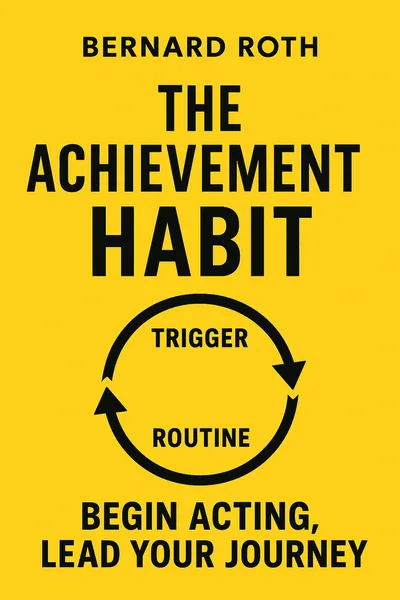
The achievement habit
Begin acting, lead your journey
Description
To cultivate achievement as a habit in both personal and professional spheres, it's essential to adopt the design thinking approach consistently. This involves prioritizing action over contemplation, ensuring you give your all in every endeavor.
Don't be deterred by unfavorable odds, as they are a common obstacle. Take immediate action, mindful of life's inevitable endpoint, and strive to be a catalyst for positive outcomes rather than a bystander to your circumstances.
Table of contents
01Embrace design thinking
Design thinking is a methodology developed by engineers to tackle design challenges effectively. It's a process that has been refined over the years and is not only applicable to external problems but can also be used internally to enhance personal growth and development.
The concept of design thinking was first introduced by David Kelley, co-founder of IDEO and a professor at Stanford, to describe the approach engineers use to solve design problems. This methodology is based on five core principles that guide the entire process.
The first step in design thinking involves empathizing with the user or client. This means understanding their needs, desires, and the issues they face from their perspective. Without this understanding, it's challenging to create solutions that truly address the user's needs.
Following empathy, the next step is to define the problem clearly. Often, problems are complex and layered, so it's crucial to pinpoint the specific issue you want to solve.
Once the problem is defined, the ideation phase begins, where multiple potential solutions are brainstormed. This can involve techniques such as mind mapping, sketching, or any other method that helps generate a wide range of ideas.

02Prioritize action always
The essence of progress lies not in the intentions or attempts but in the actions we take. The distinction between trying and doing is profound. Trying implies a willingness to accept failure, while doing embodies commitment and perseverance. When we try, we may back down when faced with challenges. In contrast, doing means pushing through obstacles with determination until the goal is reached.
People often confuse trying with doing, which can lead to giving up too easily. The world will always present reasons to quit when pursuing something new and valuable. If you're just trying, these reasons become excuses for not reaching your objective. However, if you're doing, you view these challenges as opportunities to adapt and find new paths to success.
Adopting a bias towards action is a powerful approach to life. It's about making a concerted effort to do things, to start now on something you've always wanted to do or to solve a problem in your life. This proactive stance is exemplified by Mark Zuckerberg and his Harvard dorm mates, who didn't wait for graduation to launch Facebook. They dove in and figured things out along the way.
Action is superior for several reasons. Research can mislead due to biases, and hypothetical scenarios often don't match real-life actions. Personal experience gained through doing allows for informed decision-making, rather than relying on secondhand theories. Moreover, statistics can't predict individual outcomes; only through action can you truly separate what's possible from mere theory.
03Overcome daunting odds
The language we use and our communication style are pivotal in shaping how others perceive us and how we perceive our own potential for success. The words we choose can either open doors to opportunities or close them. For instance, when people habitually say "no" to opportunities, they limit their experiences. Conversely, saying "yes" more often can lead to a wealth of benefits and new possibilities.
Similarly, replacing "but" with "and" can transform our mindset to be more inclusive and collaborative. It's a subtle shift that encourages open-mindedness and a willingness to consider additional perspectives.
When we say "have to," it often carries a tone of obligation and negativity. On the other hand, "want to" expresses enthusiasm and positivity, which can be infectious and inspiring to others.
The distinction between "can't" and "won't" is also significant. "Can't" suggests a lack of ability or power, whereas "won't" indicates a deliberate choice. This choice of words can empower us to take responsibility for our actions and decisions.
In the context of offering support, the term "assist" implies a more empowering and dignified approach than "help," which can sometimes be perceived as treating someone as inferior.
04Act without delay
Embracing new opportunities can be a daunting prospect, but it's essential to approach them with a positive mindset. Life's finite nature means that each problem we encounter is a chance to learn and grow, a reminder that we should be grateful for these challenges. They push us to think, work hard, and evolve. Life is a continuous problem-solving journey, and every problem is an opportunity in disguise.
When a new opportunity arises, it's important to reflect on personal experiences and express genuine feelings. Speaking from the heart, using phrases like "I know" or "I think," helps to take direct responsibility for one's actions and thoughts. This approach is far more effective than hiding behind generalizations.
In tense situations, it's crucial to avoid being judgmental. Simply stating your own emotions without imposing them on others can foster a more understanding environment. It's also important to acknowledge that others have their own genuine issues. Listening to them without interruption and fully immersing oneself in their perspective can lead to a deeper understanding and connection.
When communicating, clarity is key. It's better to be concise and direct, ensuring that the core message is understood, even if it means repeating or clarifying to avoid misunderstandings. It's equally important to understand others, asking questions and restating what you've heard to confirm your grasp of their intentions.
05Initiate positive outcomes
Embracing the role of being the cause in any situation rather than a passive observer waiting for external forces to act is a powerful stance that can significantly alter one's life and outcomes.
This concept, as illustrated by Bernie Roth, emphasizes the importance of taking full responsibility for our actions and decisions, thereby actively shaping our future rather than being shaped by circumstances. Roth's anecdote about cleaning the windows on a train ride in China serves as a vivid example of this mindset. Instead of lamenting the dirty windows, he chose to take action, thereby improving his own experience and perhaps even inspiring others.
This proactive approach is not just about solving minor inconveniences; it's a philosophy that can be applied to all aspects of life, including how we approach problems and challenges.
Design thinking, a methodology Roth advocates for, embodies this proactive and solution-oriented mindset. It's a process that goes beyond mere knowledge of principles; it requires application and experimentation. The essence of design thinking lies in its practical application, which involves a series of steps that encourage a deeper understanding of problems from the perspective of those affected, defining these problems in a way that leads to effective solutions, exploring a wide range of potential solutions, and prototyping to test these solutions in the real world.