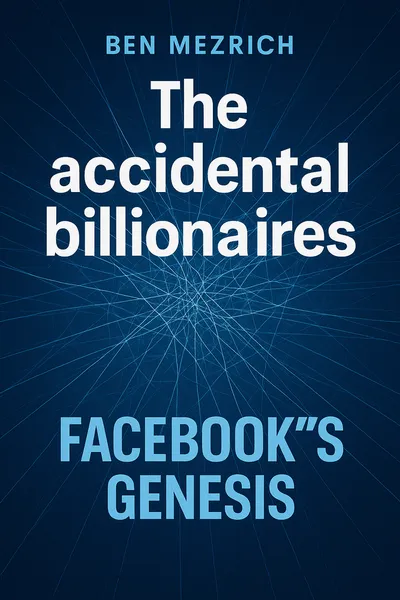
The accidental billionaires
Facebook's genesis
Description
Eduardo Saverin co-founded Facebook with Mark Zuckerberg during their time at Harvard. Initially, Saverin invested in the company and was promised a significant share. However, as Facebook grew, Zuckerberg and others restructured the company, diluting Saverin's stake.
Feeling betrayed, Saverin sued for his original share. The lawsuit was settled, and Saverin was reinstated as a co-founder, though the financial details remain confidential. Despite this, Facebook's expansion continued, reaching over two hundred million users by 2009.
Table of contents
01 The facemash initiative
In October 2003, Harvard undergraduates Eduardo Saverin and Mark Zuckerberg, who were not part of the popular student groups, became friends.
Zuckerberg, a computer science major, had previously turned down a two-million-dollar offer from Microsoft for a software program he developed. Saverin, a business major, had earned $300,000 by investing in oil futures. Both sought acceptance; Saverin aimed to join Harvard's exclusive Phoenix club, primarily to meet girls.

02 The winklevoss siblings
Facemash.com's short-lived operation on a Harvard afternoon drew significant attention and criticism. Women's organizations on campus were outraged, the computer science department was frustrated by the site's bandwidth consumption, and legal concerns were raised about the use of personal photos.
The Crimson, Harvard's student newspaper, reported extensively on Facemash and its creator, Mark Zuckerberg. Many featured students expressed their displeasure through emails, letters, and personal confrontations.
When Zuckerberg faced Harvard's administrative disciplinary council, he admitted his guilt and offered to help fix the security flaws his site had exposed. He argued that the site's viral spread was unintentional and akin to an out-of-control beta test. His social awkwardness may have influenced the decision not to expel him; instead, he was put on probation with a vague warning of consequences for any future misconduct.
03 Facebook's early days
In the winter of 2003, after returning to Harvard from a two-week break, Mark Zuckerberg was filled with excitement about a new idea for a website. This concept was an evolution of his previous project, Facemash, aiming to create an exclusive online social network where users could create profiles, upload pictures, and express their interests.
Zuckerberg envisioned a platform that would allow users to invite friends, effectively moving their social networks online. This idea combined the best aspects of Facemash and Friendster, along with elements from Course Match, a project that let students see others' class schedules.
04 Initial expansion
TheFacebook.com experienced rapid growth, attracting over 900 Harvard students within its first four days and reaching nearly 85 percent of the undergraduate population in two weeks. It quickly became a staple in students' daily routines, facilitating social interactions and connections. Unlike Friendster or MySpace, which were used to meet strangers, TheFacebook focused on connecting users with people they already knew, such as classmates or friends of friends.
Eduardo Saverin saw the site's addictive nature as a potential goldmine for advertisers, despite it being a costly novelty initially. However, the site's success soon led to legal challenges.
05 Meeting sean parker
TheFacebook's initial growth was nothing short of remarkable, attracting 50,000 students from prestigious universities like Harvard, Stanford, Columbia, and Yale within just eight weeks of its launch. This rapid expansion was particularly enticing to advertisers, given that a significant 67 percent of users returned daily.
Despite this, Eduardo's efforts to secure advertising deals in New York were undermined by Mark's casual attire and disengagement during meetings, leading to a lack of serious interest from potential advertisers.
06 Formalizing facebook
As the school year drew to a close, Mark Zuckerberg and Eduardo Saverin realized the need to organize themselves better to manage TheFacebook's growth. The platform was becoming a round-the-clock operation, necessitating significant upgrades and maintenance. Additionally, they needed to attract advertisers to start generating revenue.
On April 13, 2004, they officially incorporated TheFacebook LLC in Florida, Eduardo's home state. The ownership was divided as agreed: Mark held 65%, Eduardo 30%, Dustin Moskovitz 5%, with a portion reserved for Chris Hughes.
With summer approaching, Eduardo secured an internship at a New York investment bank, facilitated by his father. This position would also allow him to court New York advertisers for TheFacebook.
07 The move to california
In a twist that seemed like fate, Mark Zuckerberg's move to California led him to unexpectedly reunite with Sean Parker. Zuckerberg had just rented a house in Palo Alto, coincidentally close to where Parker's girlfriend's parents lived. Their chance encounter happened as Parker was moving furniture for his girlfriend, who was finishing her senior year at Stanford.
This serendipitous meeting quickly turned into a professional opportunity when Zuckerberg learned Parker was between homes and invited him to stay and work on TheFacebook. Parker, having been impressed by TheFacebook from the start, eagerly accepted the offer, seeing it as a chance to be involved in something groundbreaking.
08 Disagreements emerge
Eduardo Saverin's brief stay in California lasted only three days before he returned to New York, continuing his search for advertisers for TheFacebook.
Upon updating Mark Zuckerberg about a week later, he found Mark's response dismissive, urging Eduardo to return to California where all necessities for TheFacebook's growth were present.
Unconvinced, Eduardo drafted a letter emphasizing their original agreement: Eduardo would handle the business aspects, while Mark focused on coding in California. He also highlighted his 30% ownership, granting him significant decision-making power.
09 Paths diverge
In April 2005, Facebook's growth was skyrocketing, having surpassed two million members and aiming for three million. It was present in over 500 campuses and was a hot topic in media.
Mark Zuckerberg invited Eduardo Saverin to California for a crucial business meeting, hinting at potential venture capital investments and the possibility of selling some of their stock. However, upon Eduardo's arrival, he was blindsided by a legal maneuver that aimed to dilute his shares significantly, reducing his stake in the company. Feeling betrayed, Eduardo refused to sign the documents that would diminish his ownership and left, deciding to sue for his rightful share.
Related books