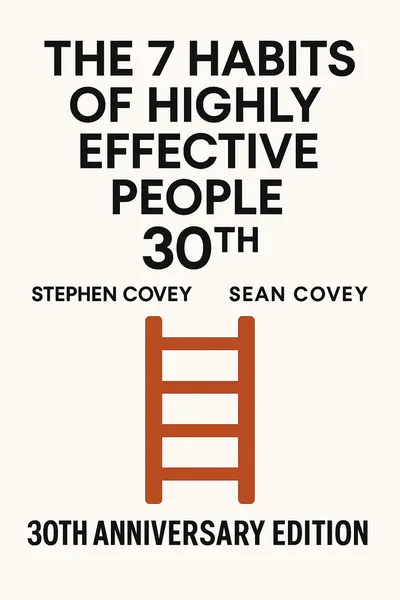
The 7 habits of highly effective people 30th
Powerful Lessons in Personal Change
Description
The 7 Habits of Highly Effective People teaches us that we have the power to choose how we respond, regardless of external conditions. By mastering Habits 1-3, we achieve personal victories. This moves us from dependence on others to independence and self-reliance.
When we also master Habits 4-6, we achieve public victories through collaboration. But true effectiveness comes from Habit 7, where we become interdependent. This paradigm combines our talents to create something greater together. The 7 Habits show success comes from inner growth first. Private victories come before public ones. Character development enables us to move from dependence to independence to interdependence.
Table of contents
01Overview of the 7 key behaviors
The 7 Habits of Highly Effective People offers a comprehensive framework for enhancing personal and professional effectiveness through a deep understanding of paradigms, principles, and personal habits.
It emphasizes that our character, essentially a composite of our habits, can be developed to move us from dependence to independence, and ultimately to interdependence, through a systematic approach.
At the core of this methodology are paradigms, which are the mental maps influencing our perception and understanding of the world. These paradigms shape our attitudes, behaviors, and relationships, and if they are flawed, efforts to change attitudes and behaviors will be futile. Therefore, recognizing and updating our paradigms is crucial for true transformation.
Principles, on the other hand, are timeless guidelines for human conduct that have demonstrated their value and permanence over time. Unlike practices or values, principles are fundamental truths that remain constant, serving as the foundation for effective living.
Habits, the intersection of knowledge, skill, and desire, are pivotal in this framework. They are the routines of behavior that are repeated regularly and tend to occur subconsciously. To develop a new habit, one must focus on enhancing knowledge (what to do), skills (how to do it), and desire (motivation to do it).
The 7 Habits approach is rooted in an inside-out, principle-centered, character-based strategy for personal and interpersonal effectiveness, contrasting sharply with the superficial success literature of the past 50 years that often prioritized social image and quick fixes over genuine character development. This approach harks back to the character ethic of over 150 years ago, which emphasized virtues like integrity, humility, and the Golden Rule.

02Personal success – behaviors
Achieving true success requires internal growth and self-mastery before it can manifest externally. The first three habits focus on personal victories that lay the foundation for future achievements in the public sphere. Without nurturing these internal victories first, seeking external success is akin to expecting a harvest from seeds that were never planted.
Proactivity extends beyond merely taking initiative; it involves making a conscious choice in how to respond to situations, rather than reacting without thought. Unlike other creatures who respond based on instinct, humans have the unique ability to control our thoughts, learn new mindsets, and make decisions based on our values. This self-awareness allows us to act intentionally, rather than being passively influenced by external factors.
Stanford professor Carol Dweck's research over the past thirty years has highlighted the distinction between a "fixed" mindset and a "growth" mindset. Individuals with a fixed mindset believe their talents and intelligence are immutable traits set at birth, leading to a reactive approach that accepts external limitations. Conversely, those with a growth mindset believe in the potential for abilities to develop through effort and persistence, adopting a proactive stance that embraces the possibility of self-improvement.
03Shared success – behaviors
True independence is the bedrock upon which interdependence is built, with habits 4, 5, and 6 embodying the essence of public victories in teamwork, cooperation, and communication.
Achieving success in collaborative environments necessitates first achieving personal success, as only those who are independent can truly engage in interdependent relationships. The most effective way to work with others is to adopt a mindset that promotes mutual success, encapsulated in the philosophy of "I can win and so can you." This approach is not merely a tactic but a fundamental belief in pursuing solutions that are beneficial to all parties involved.
Human interactions can be categorized into six paradigms:
- Win/Lose, where one dominates; - Lose/Win, which involves surrendering to the other's interests; - Lose/Lose, where both parties are harmed; - Win, focusing solely on personal gain; - Win/Win or No Deal, where parties agree to disagree if no mutual solution is found; and - Win/Win, which seeks mutual benefits.
While Win/Win or No Deal may seem ideal, Win/Win is more practical and sustainable. It requires integrity, maturity, and a belief in abundance. An illustrative example of this was when a city and a cable company, initially at an impasse, found a win/win solution by including extra capacity in the cable for future competitors, benefiting all stakeholders involved.
The habit of "seek first to understand" may appear counterintuitive in a world where the instinct is often to give advice and solve problems immediately. However, understanding and validating others through empathetic listening is a more effective approach. This skill is rarely taught, making it unfamiliar, yet it yields more accurate information and reduces the need for correcting misunderstandings later. By appreciating different perspectives, one can uncover valuable insights. This principle is evident in various professions, from sales to law to engineering, where understanding the situation is critical before offering solutions.
04Personal effectiveness
Habit 7, as part of a holistic approach to personal development, emphasizes the importance of self-renewal to maintain and enhance our ability to be productive and creative.
This habit suggests that by dedicating time to refine and improve ourselves in the four essential dimensions of life—physical, spiritual, mental, and social/emotional—we access deeper wellsprings of energy and motivation, which in turn fuel our capacity to achieve and create.
The physical aspect focuses on the well-being of our body, advocating for balanced nutrition, regular exercise, and sufficient rest. Engaging in at least 30 minutes of vigorous physical activity daily is recommended to boost overall health, increase vitality, and improve our stress management capabilities.
The spiritual dimension is about introspection and connecting with our core values and purpose. Through practices such as meditation, prayer, or journaling, we can align ourselves with our innermost beliefs and direction.
Mental self-renewal involves stimulating and nurturing our intellect. This can be achieved by reading widely, visualizing our goals, planning our next actions, and documenting our insights. Such focused learning activities broaden our horizons and enhance our cognitive clarity.
Meanwhile, the social/emotional dimension is about fostering positive relationships and emotional health. Engaging in acts of service, practicing empathy, building mutually beneficial partnerships, and cultivating a sense of inner security are all ways to replenish our emotional energy and reinforce our social bonds.
Related books