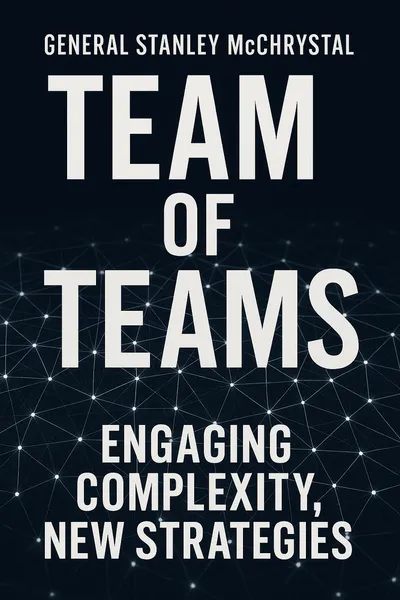
Team of teams
Engaging complexity: new strategies
Description
The U.S. Army's experience in Afghanistan and Iraq showed that hierarchies fall short against networks.
Success came when they embraced a network approach. This lesson applies broadly: today's organizational success hinges on building resilient, adaptable networks aligned with strategic goals. Efficiency matters, but so does adapting to constant change.
Success isn't about comfort or avoiding criticism; it's about achieving goals, even if that means change, as General Stanley McChrystal emphasizes.
Table of contents
01 Necessity of change
The United States' military engagement in Iraq presented an unexpected challenge when faced with Al Qaeda in Iraq (AQI). The U.S. military, equipped with the world's most advanced and elite forces, anticipated a swift victory over what appeared to be a disorganized group of insurgents. However, the reality of the conflict defied expectations, as the U.S. struggled to adapt to a new kind of warfare against an unconventional foe. AQI's structure was a stark contrast to the traditional military hierarchy of the U.S. Army. Instead of a clear chain of command, AQI operated as a network of small teams, often comprising just two or three individuals. These cells utilized the Internet and social media to broadcast their actions, making it difficult for the U.S. to identify and target influential leaders within the group. The claim that the U.S. Army had repeatedly killed AQI's "number three" became a running joke, highlighting the futility of such a strategy against a network where everyone could be considered a "number three."
The insurgents' tactics of blending into the civilian population and using common vehicles further complicated the U.S. military's efforts. Traditional large-scale operations proved ineffective, prompting a shift to smaller, more targeted sorties, often conducted at night from helicopters. Despite these efforts, the AQI network demonstrated a remarkable ability to reorganize and continue its activities, rendering the U.S. Army's increased efficiency moot. In response, the U.S. Army turned to a "Big Data" approach, gathering live video feeds from drones and cameras on the ground. However, the rapidly changing battlefield conditions meant that by the time the data was analyzed and a response formulated, the situation had already evolved, making it impossible to predict AQI's movements with any certainty.

02 Group dynamics
Managing complexity in organizations often involves creating teams, which is effective but can be challenging to scale. Trust and a shared purpose are the glue that holds small, effective teams together. Unlike hierarchies, which excel at optimization and executing plans, networks are more adaptable, capable of reconfiguring to meet new challenges. Amy Edmondson of Harvard Business School notes that great teams are made up of individuals who trust each other and understand one another's strengths and weaknesses, allowing them to function as a cohesive unit. This was demonstrated by the crew of US Airways Flight 1549, which landed on the Hudson River in 2009. Captain Chesley Sullenberger was lauded for his piloting, but he credited his crew's instinctive and well-trained response for the successful outcome.
Similarly, Navy SEAL teams undergo rigorous training not just to test physical and mental strength but to build trust and teamwork, teaching them to rely on each other and adapt quickly in dangerous situations. In real-world scenarios, teams are messy and constantly evolving. They thrive on horizontal connections, where members collaborate and leverage each other's strengths. This was exemplified by Flight 1549's crew, who improvised in an unforeseen situation, succeeding as a team rather than following top-down commands. General McChrystal compares great teams to organisms, adaptable and effective due to their inefficiencies, such as overlaps and redundancies, which foster adaptability. When dealing with large groups, such as a Task Force of 7,000, the challenge is to foster a 'team of teams' approach. This doesn't require every individual to know each other but rather relies on interconnected relationships between teams. General McChrystal emphasizes the importance of sharing information across teams to build trust and break down silos.
03 The art of sharing
Building a resilient and adaptable network hinges on savvy communication and complete transparency, fostering a shared consciousness that leads to extraordinary outcomes in large groups. Trust is the cornerstone of such a network, and the challenge lies in creating it. General McChrystal emphasizes the importance of forming a "team of teams," where different units like the SEALs, Army Special Forces, and the CIA work together with a common purpose. This requires a shift from traditional information sharing and decision-making to a more collaborative approach. Hierarchies often struggle against networks because they react to past problems rather than anticipating new ones. Teams that understand the big picture and can adapt on the fly are more effective in unpredictable environments. However, teams in many organizations work in silos, becoming efficient but slow to respond due to a lack of broader organizational insight.
04 Embracing release
General McChrystal's experience with the Task Force illustrates a transformative approach to leadership and decision-making within organizations. The concept of "Eyes On – Hands Off" became a pivotal mantra, emphasizing the importance of senior leaders to oversee operations without micromanaging. This shift allowed for on-the-spot judgments by those most informed about the situations at hand, fostering a culture of empowered execution. By authorizing officers to act in support of the mission, provided their actions were ethical and legal, the Task Force could leverage the shared consciousness developed through consistent communication and information sharing.
The results of this empowered execution strategy were remarkable. Not only did decision-making accelerate, crucial in scenarios where speed could mean the difference between success and failure, but the quality of these decisions also improved. Contrary to the initial belief that a quick 70 percent solution was preferable, the Task Force found that they were achieving 90 percent solutions immediately. This decentralization of decision-making also had the unexpected benefit of increasing personal investment in outcomes, as individuals who make decisions are more committed to the results.
05 Future perspectives
In an era where adaptability is as crucial as efficiency, organizations that foster trust, a shared purpose, shared consciousness, and empowered execution are well-positioned for future success. This was exemplified by the transformation of the US-led Task Force by 2007, which evolved into an entity unlike any traditional military force. It transitioned from a hierarchical structure to a dynamic, networked organization, or a "team of teams," characterized by a radical sharing of information and decentralized decision-making. This shift from a conventional military machine to an adaptable, complex organism highlights the importance of adaptability in addressing the complexities of the modern environment.
The journey of the Task Force from a hierarchical organization to a network offers valuable lessons for navigating today's complex business landscape. The foundation of such a network is trust and a common purpose, essential elements for building a cohesive team of teams. Providing context is crucial for adaptability, enabling individuals to make informed decisions. This was achieved through comprehensive daily briefings that ensured every team member had a solid information base, fostering a shared consciousness.
Related books