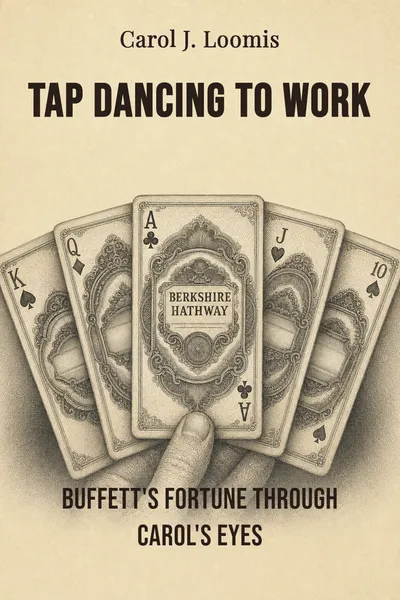
Tap Dancing to Work
Buffett's fortune through Carol's eyes
Description
In 1966, a Fortune writer named Carol Loomis put a young Omaha investor into a magazine story about hedge funds. She spelled his name wrong — Warren Buffet, with one t — and moved on. It was a small thing, the kind of typo that happens on deadline. But the two of them kept talking, and the talking turned into one of the longest documented friendships in American business journalism, the sort where the reporter ends up editing the subject's most famous prose while insisting, every year, that she remain free to write about him without pulling punches.
Loomis spent almost six decades at Fortune, and for much of that time she had a seat most financial writers would trade a limb for: close enough to Warren Buffett to understand how he thought, far enough to keep her byline honest. She edited his annual letter to Berkshire Hathaway shareholders. She played bridge with him. She also wrote pieces that questioned his moves and printed the years the numbers disappointed. In 2012 she gathered the Fortune archive — her own articles and others' — into a single book, adding running commentary that reads like a guided tour of a fortune being built in real time.
The result is not a biography and not a hagiography. It is closer to a scrapbook kept by someone who was in the room, arranged so the reader can watch an ordinary-looking man in a mid-century office turn a failing textile mill into one of the strangest and most valuable companies on earth. The pieces were written as the events happened, which means nobody knew yet how the story would end.
The question we’re asking : What does it look like to watch a great fortune assembled from the inside, by someone who was both a friend and a working journalist?What we’ll see : How Loomis's front-row vantage — the letters, the numbers, the awkward standard of writing straight about a friend — turns Buffett's record into something we can actually read.
Table of contents
01 Chapter 1 — A friend at the typewriter
Carol Loomis joined Fortune in 1954, at a moment when the magazine had almost no women writing its major features. She stayed for around sixty years, long enough to become one of the most respected financial journalists in the country and a name that investors read before they read the companies she covered. Her specialty was the hard stuff — balance sheets, accounting sleight of hand, the places where a firm's story and its ledgers quietly disagreed. She was not a cheerleader by temperament, which is part of what makes her closeness to Buffett interesting.
The friendship began with that misspelled name in 1966 and deepened over decades of dinners, bridge games, and phone calls. At some point the arrangement acquired a rule, one Loomis is careful to spell out. She would edit Buffett's annual shareholder letter, free of charge, because she found the writing worth improving and enjoyed the work. In exchange she kept the right to write about him at Fortune with no special favor, and he kept the right to be criticized in print by a friend. Both of them treated this as a feature, not a bug.

02 Chapter 2 — The letters that taught America to invest
The centerpiece of Buffett's public voice is the annual letter to Berkshire Hathaway shareholders, and Loomis had a hand in shaping it for decades. These letters became something no other corporate document had been: reading that people looked forward to, quoted, and used to learn how markets actually work. Buffett wrote them the way a patient friend explains a hard idea over coffee — no jargon for its own sake, plenty of jokes, and a stubborn refusal to hide behind the fog that most executives use to say nothing at length.
What the letters taught, year after year, was a way of thinking. Buy a business, not a ticker. Understand what you own. Treat the stock market as a moody neighbor offering prices, not as an oracle telling you what a company is worth. Ignore the noise about quarterly earnings and pay attention to the long-run economics of the thing. Loomis's book collects the moments where these ideas first appeared in Fortune's pages, and the effect is to show a philosophy hardening into shape rather than arriving fully formed.
03 Chapter 3 — What the numbers actually showed
Berkshire Hathaway started as a struggling New England textile operation, the kind of business Buffett would later warn people never to buy. He took control in the 1960s and slowly turned it into a holding company — a structure that owns other companies and shares of companies — funded in large part by the cash that flows through insurance. Insurers collect premiums today and pay claims later, which leaves money sitting in the meantime. Buffett grasped early that this float, invested well over long stretches, could compound into something enormous.
Loomis's collected articles track the results as they came in, without the flattering smoothness of hindsight. Over the decades Berkshire's book value grew at a rate that outran the broad market by a wide margin, turning early believers into very wealthy people. A modest stake bought in the 1960s became a fortune. The book lets the reader feel how implausible this looked in the moment — a former textile mill in Omaha quietly beating Wall Street's best, run by a man who did not trade often and seemed to spend most of his time reading.
04 Chapter 4 — The record and its limits
Step back from the individual triumphs and the book raises a quieter question: what actually builds a reputation that lasts fifty years? Buffett's answer, as Loomis documents it, is almost boring. Patience. Plain language. A willingness to look wrong for years rather than abandon a discipline. The most striking thing about the record is not any single decision but how few decisions there were — how much of the fortune came from waiting, holding, and declining to act when everyone else was busy.
This is where Loomis's vantage earns its keep. Because she watched the whole arc, she can see that the durable part of Buffett was never the stock picks, which anyone can copy after the fact. It was the temperament that let him ignore a booming market for years and keep saying, in print, that he did not understand it. A record built that way is hard to reduce to a formula, which may be why so many people study Buffett and so few reproduce him. The behavior is simple to describe and extraordinarily hard to sustain.
05 Conclusion
The title comes from Buffett's own line about heading to the office: he was so happy in his work that he felt like he was tap dancing to it. Loomis borrows the phrase for a book that is finally about that pleasure — the joy of a man who loved the game he was good at, and the pleasure of a writer who got to watch him play it up close and write it down straight. The misspelled name in 1966 turned into a document no other journalist could have produced.
Related books