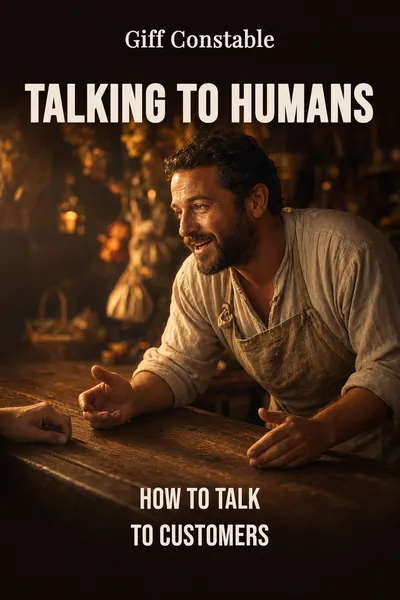
Talking to Humans
How to talk to customers
Description
Somewhere right now, a founder is describing a product that does not exist yet, and the person listening is nodding along. It feels like validation. It usually isn't. The nod is polite, the enthusiasm is free, and the moment the meeting ends the idea goes right back to living only inside the founder's head. This is the everyday texture of building something new: a lot of certainty, a lot of spreadsheets, a lot of conviction, and almost no contact with the actual humans the whole thing is supposed to serve. Giff Constable wrote a short book about closing that gap, and its title is also its entire argument — Talking to Humans.
Published in 2014 with a foreword by Steve Blank, the man who turned customer development from a hunch into a method, the book is barely a hundred pages. That is deliberate. It is not a theory of entrepreneurship; it is a field manual for the least glamorous and most decisive part of it — the qualitative work of leaving the office and asking real people about their real lives before betting a year of yours on a guess. Constable had lived through enough startups to know the failure mode intimately: brilliant plans, no evidence, and a market that never showed up.
What makes the book stick is that it treats a soft skill as a craft with rules. Who to talk to, how to reach them, what to ask, what to ignore, and how to keep the flattering lies from poisoning the well. Beneath the how-to sits something bigger — a way of holding one's own ideas at arm's length long enough to find out whether they're true.
The question we’re asking : How do we find out whether an idea is worth building before we've built it — by asking the people we're building it for?What we’ll see : We follow the discipline of customer development from the empty office to the awkward conversation, and watch it reshape how a company thinks.
Table of contents
01 Chapter 1 — The problem with the building you never leave
Steve Blank has a line that runs underneath the whole book: there are no facts inside your building, so get outside. It sounds obvious until you notice how rarely anyone does it. The natural rhythm of building a company pulls inward — toward the product, the code, the deck, the internal debate about which feature ships first. All of that feels like progress. None of it tells you whether a stranger will care. Constable's starting point is that the riskiest assumptions in any new venture are almost never technical. They are assumptions about people: that they have the problem you think they have, that they want it solved, that they'll change what they do to solve it, and that they'll pay.
Those assumptions tend to hide because they feel like knowledge. A founder is usually a version of their own customer, or was once, and so the inner voice sounds like market research when it's really just autobiography. The plan gets more detailed, the confidence compounds, and the gap between what's assumed and what's known quietly widens. By the time a product launches to silence, the expensive lesson arrives — the thing that could have been learned in a week of conversations for the price of some coffees instead got learned in a year of engineering.

02 Chapter 2 — The people worth finding, and how to find them
Before the first question comes the harder problem: whom do you ask? Constable is blunt that talking to the wrong people is worse than talking to no one, because it produces confident nonsense. The trap is convenience. Friends, family, colleagues, and the person next to you at an event are all easy to reach and all systematically unreliable — they like you, they want to encourage you, and their answers are shaped by that warmth rather than by their actual behaviour. The people you need are the ones who genuinely live inside the problem, whether or not they're pleasant to reach.
So the book asks you to sketch a target before you start: a rough profile of who you believe has the pain worth solving. That profile is itself a hypothesis, and part of the work is discovering it was wrong — that the real sufferer of the problem isn't the buyer, or that a group you'd ignored turns out to care far more than the one you'd centred everything on. Constable points to segments that are easy to overlook, like people who've tried to solve the problem already and cobbled together an ugly workaround. A homemade spreadsheet held together with tape is one of the strongest signals you'll ever find: it means someone cared enough to act.
03 Chapter 3 — The conversation, and why most of them go wrong
The interview is where good intentions go to die, and Constable spends the heart of the book on the specific ways they fail. The first and largest: people pitch. They get someone in front of them and can't resist describing the product, at which point the conversation stops being research and becomes sales, and the other person, being polite, starts telling them what they want to hear. The rule is simple and constantly broken — ask about their life, not your idea. Keep the solution in your pocket for as long as you possibly can.
The second failure is the leading question. Ask someone whether they'd use a service that saved them time and they'll say yes, because who wouldn't. It costs nothing to agree and it flatters the asker. So Constable steers everything toward the past and the concrete: not would you, but do you, and when did you last, and what did you do about it, and walk me through the last time this happened. Stories about actual behaviour are worth ten opinions about hypothetical behaviour. What people say they'll do and what they've actually done are different data, and only one of them is real.
04 Chapter 4 — What a habit of listening does to a company
Read cover to cover, Talking to Humans is a manual about interviews. Held at arm's length, it's about something less tidy — what happens to an organisation when it decides that its own convictions don't count as evidence. Customer development, in Constable's hands, isn't a phase you complete before building. It's a posture: treating the business itself as a stack of hypotheses, each of which could be false, and building the muscle to keep testing them long after the first flush of certainty has passed. That's a strange thing to ask of founders, because founders are selected for conviction. The book's quiet radicalism is insisting that conviction and inquiry have to coexist.
This is why the skill is so easy to fake and so hard to keep. A team can run a batch of interviews, collect some quotes that flatter the plan, declare the idea validated, and go right back to building what it always meant to build. Constable's whole method is designed to make that self-deception harder — the behaviour-not-opinion questions, the separation of observation from conclusion, the search for the answer that stings. The technique is really scaffolding for a kind of intellectual honesty that doesn't come naturally when your money and your identity are riding on being right.
05 Conclusion
The founder from the opening is still out there, describing a product that doesn't exist to someone who's nodding along. Talking to Humans doesn't tell them to stop building or to trust their gut less. It tells them to go find the humans first — the ones who actually have the problem, not the ones who are easy to reach — and to ask about their lives rather than pitch their solution. The whole book fits in a coat pocket precisely because the hard part was never the information. It's the willingness to hear an answer you didn't want.
Related books