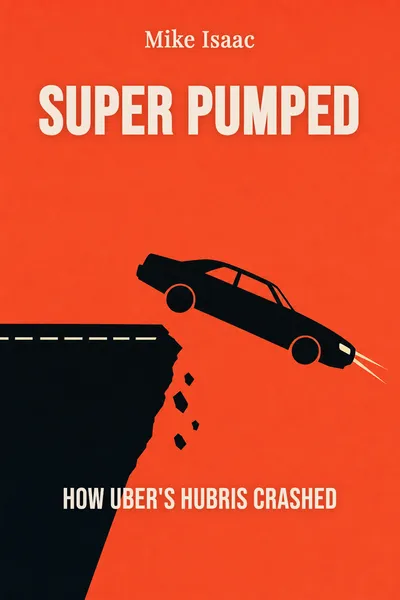
Super Pumped
How Uber's hubris crashed
Description
On a Sunday night in June 2017, in an office in Los Angeles, Travis Kalanick sat across from the venture capitalists who had helped make him rich. They handed him a letter. Five of Uber's biggest investors were demanding he resign as chief executive of the company he had built into a colossus valued at roughly $68 billion. He argued for hours. By the early morning he had given up. The founder who had turned a black-car app into one of the most valuable private companies on earth was out, forced from the top of a business that had grown, in less than a decade, into a presence in hundreds of cities across six continents.
How Uber got to that room is the subject of Mike Isaac's Super Pumped. Isaac, a technology reporter at the New York Times, had covered Uber through its most turbulent years, and his book is built on internal documents and interviews with the people who lived inside the machine. It tells the story of a company that treated regulation as an obstacle to be routed around, competitors as enemies to be starved, and its own drivers as a cost to be minimized. For a long time, the strategy worked spectacularly. Money poured in. Cities capitulated. Then it stopped working.
What Isaac decodes is less a business scandal than a way of operating that a whole industry had come to admire. Uber didn't break because it ran out of money or lost a market. It broke because the very qualities that made it grow — the aggression, the sense that rules were for lesser companies — curdled into something that couldn't survive contact with daylight. The company was, in Isaac's account, the purest test of a Silicon Valley idea about how the world should work.
The question we’re asking : How did the qualities that built Uber into a global giant turn into the ones that brought its founder down?What we’ll see : The rise of a company that made rule-breaking a strategy, and the year that strategy came apart in public.
Table of contents
01Chapter 1 — The mantra was always be hustlin'
Travis Kalanick did not start out as the confident king of Silicon Valley. Isaac's early chapters trace a founder shaped by defeat. His first real company, Scour, a file-sharing service, was sued into bankruptcy by the entertainment industry. His second, Red Swoosh, limped along for years before he sold it. By the time he co-founded what became Uber around 2009 with Garrett Camp, Kalanick was a man who had been on the losing side of powerful institutions and had come away convinced that winning meant fighting harder than everyone else.
That conviction became a whole ethos. Uber's internal values, pinned up like commandments, celebrated qualities that most companies would have kept quiet about: "principled confrontation," "toe-stepping," and the phrase Isaac takes for his title, being "super pumped." Employees were told to hustle, to be "champion's mindset," to treat every day as a war for the next city. The culture rewarded people who bent the rules and pushed back on anyone — a manager, a mayor, a regulator — who stood in the way.

02Chapter 2 — Growth as a weapon
Once Uber decided that speed was the whole game, everything became an instrument of growth. Isaac documents how the company entered cities in defiance of the rules and then dared officials to shut it down, knowing that riders and drivers who liked the service would become a political constituency. When regulators tried to catch Uber operating illegally, the company deployed a software tool known internally as Greyball, which identified officials trying to hail cars in sting operations and served them a fake version of the app, so the cars they ordered never came.
Competition was treated the same way. Uber and its American rival Lyft fought a war of subsidies and recruitment, with each side spending to lure the other's drivers. Isaac describes tactics that went well beyond hard bargaining, including efforts to disrupt rivals' operations. Overseas, the fight was even more expensive. In China, Uber burned through billions of dollars trying to beat the local giant Didi Chuxing, a contest it eventually conceded, trading its Chinese business for a stake in the winner.
03Chapter 3 — The year the culture ate the company
For years the aggression stayed largely invisible to the public, buried under the convenience of the app. Then, in early 2017, it surfaced all at once. On a February Sunday, a former engineer named Susan Fowler published a blog post describing her year at Uber: a manager who had propositioned her, a human-resources department that protected high performers, and a culture where complaints from women went nowhere. The post spread across the internet within hours and gave a name to what many had suspected.
What followed was a cascade. A dashboard video surfaced of Kalanick berating an Uber driver who complained about falling fares, telling him that some people "don't like to take responsibility" for their own problems. The Greyball program was exposed in the press. Google's self-driving unit, Waymo, sued Uber, alleging that a former engineer had stolen trade secrets. Reports emerged of executives obtaining the medical records of a woman who had been raped by an Uber driver in India, apparently to question her account. Each story reinforced the last.
04Chapter 4 — When disruption meets the rest of us
Isaac's larger argument is that Uber was not an aberration but the fullest expression of an idea that Silicon Valley had spent a decade celebrating. The playbook — raise vast sums, grow at any cost, treat rules as friction, and trust that a visionary founder's will justifies the collateral damage — had made other companies rich, and Kalanick simply ran it more relentlessly than anyone else. Uber was the model taken to its logical end, which is why its unraveling implicated more than one man's temperament.
The framework rested on a particular reading of the word disruption. In the founder's telling, the taxi industry was inefficient and protected, so tearing it apart was progress, and the laws standing in the way were obstacles rather than legitimate expressions of public choices. That story is seductive because it is partly true; the old system genuinely served riders poorly. But it quietly assumed that a company gets to decide which rules deserve respect, and that whatever grows fastest must be what people want. Uber tested that assumption at global scale.
05Conclusion
The Sunday night in Los Angeles closed a chapter that had opened with a founder convinced the world had cheated him out of his earlier ventures. Kalanick built Uber as an answer to that grievance: a company that would never again lose to slower, more powerful institutions, that would move first and apologize never. For a long stretch that answer looked like genius. The same instincts that filled the room with hostile investors were the ones that had made the room worth fighting over in the first place.
Related books