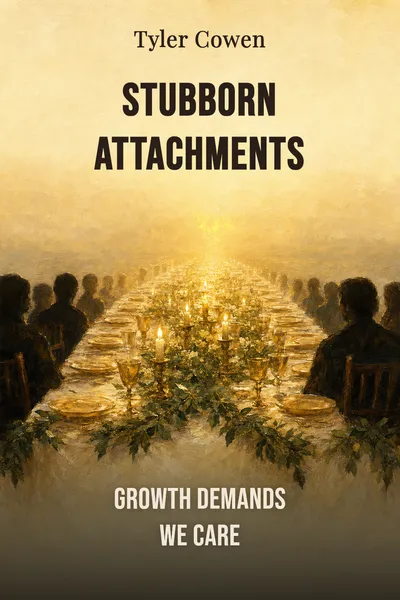
Stubborn Attachments
Growth demands we care
Description
In 2018, Tyler Cowen — a George Mason University economist better known for a wide-ranging blog and a near-inhuman reading appetite than for slim works of moral philosophy — published a short book called Stubborn Attachments. It runs to barely more than a hundred pages, and it reads less like an economics treatise than like a letter from someone who has decided to say the quiet part out loud. The quiet part is this: economic growth is not merely useful. It is, Cowen argues, a moral imperative — something we owe to people who do not yet exist and cannot thank us.
That claim sits oddly in an era that has grown suspicious of growth. We have learned to associate it with emptied oceans, warming skies, and a treadmill of consumption that leaves nobody happier. Cowen knows all of this. He is not a cheerleader waving a GDP flag. His book spends a good part of its length worrying about the environment, about inequality, about the limits of what any number can capture. And yet he keeps circling back to a stubborn conviction: that a society which grows, steadily and sustainably, over the long run, is a society that heals more of its people, frees more of them, and hands its descendants a wider set of choices.
The surprise is where the argument goes. Cowen starts with cold aggregates and ends somewhere far warmer — with the case that caring about growth turns out to require caring, quite personally, about the strangers around us and the ones who will follow. The economics, pushed hard enough, dissolves into something like an ethics.
The question we’re asking : If economic growth has done so much to relieve human suffering, what exactly do we owe to the future — and how should that obligation change the way we live now?What we’ll see : How a spare little book by an economist turns a familiar defense of prosperity into a demanding moral claim, and what it asks of us once the accounting stops.
Table of contents
01 Chapter 1 — A philosopher walks into an economics problem
Cowen did not write Stubborn Attachments to teach economics. He wrote it to answer a question most economists are trained to dodge: what is the good, and what should we actually do about it? These are philosopher's questions, and the discipline has spent decades avoiding them by hiding behind the word efficiency, as if efficiency were a neutral tool rather than a smuggled-in judgment about what matters. Cowen wants to drag the judgment into the open.
His starting move is to insist that the future counts. Standard economics discounts it — a dollar next year is worth less than a dollar today, and by the same logic a life a century from now seems to matter less than a life tonight. Cowen finds that intuition almost monstrous when applied to human welfare rather than money. Why should someone born in 2124 matter less than we do, simply because they arrived after us? Strip out that discount, treat future people as morally real, and the arithmetic of the present changes completely.

02 Chapter 2 — Why compound growth swallows every other argument
The historical case is where Cowen's argument gets its muscle, and he tells it without triumphalism. For most of human existence, life was short, sick, and precarious. Then, over the last two centuries, something changed. Sustained economic growth pulled billions out of the kind of poverty that had been the default condition of the species. Child mortality collapsed. Life expectancy roughly doubled in much of the world. Famine, once a recurring visitor, became in most places a political failure rather than a natural fact.
The link is not sentimental. Wealthier societies fund the research that produces vaccines and antibiotics. They can afford clean water, sanitation, and the institutions that keep both running. They buy their citizens something subtler too: autonomy. A person with material security has choices a person on the edge of survival simply does not — what work to do, whom to marry, whether to leave, what to believe. Growth, Cowen argues, is among the great engines of human freedom, not its enemy.
03 Chapter 3 — The rules that keep growth from eating us alive
If growth were the only value, Cowen concedes, the argument would be dangerous. A single-minded pursuit of tomorrow's prosperity could be used to excuse almost any sacrifice today — the classic trap of every utopian project that treated living people as raw material for a better future. He has no interest in building that machine. So he bolts constraints onto it.
The first is that human rights are close to absolute. Whatever growth might gain, it does not license torturing the innocent, breaking basic freedoms, or treating individuals as mere inputs. Cowen plants rights as a firm side-constraint precisely because he distrusts the seductive logic of "the ends justify the means." A society that violates its members to enrich its heirs has already lost the plot; the flourishing it claims to pursue was supposed to be for people, not against them.
04 Chapter 4 — When the numbers run out, character takes over
For all its talk of aggregates and growth rates, Stubborn Attachments is quietly doing something the economics profession spent a century learning to avoid: it is asking us to be better people. Beneath the graphs sits an old-fashioned claim that had become almost embarrassing to state plainly — that we have real obligations to strangers, including strangers not yet born, and that a serious life takes those obligations seriously.
This is the book's deeper move, and it is why the title lands where it does. Our stubborn attachments — to our families, our nations, our particular loyalties — are not obstacles to morality that a clear-eyed calculator should dissolve. Cowen thinks they are load-bearing. We cannot care about everyone equally and abstractly; we are built to care through the concrete ties we already have. The task is not to transcend those attachments but to let them widen, so that the circle of people whose welfare shapes our choices grows outward toward the future.
05 Conclusion
Stubborn Attachments arrives at a strange and bracing place for a book by an economist. It begins with discount rates and compounding curves and ends with a plea for decency, patience, and the courage to care about people we will never meet. The path between the two is what makes the argument hard to shrug off: if the future is morally real, and if sustained growth is the surest thing we know for widening human freedom and easing human suffering, then indifference to either is a failure we cannot dress up as sophistication.
Related books