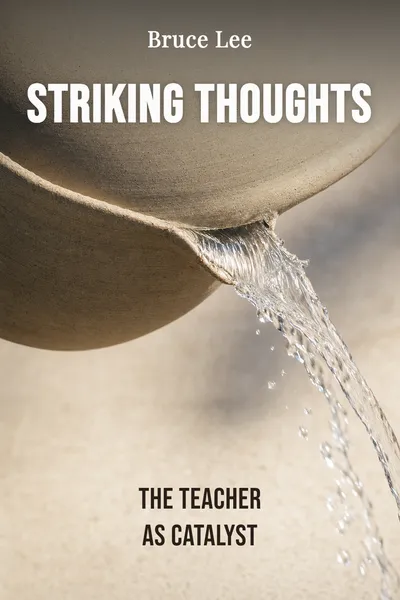
Striking Thoughts
The teacher as catalyst
Description
Bruce Lee died in July 1973, at thirty-two, with a body of writing that almost nobody had read. He is remembered as a fighter and a film star — Enter the Dragon opened weeks after his death and made him a global icon. But in the margins of scripts, on hotel stationery, in private notebooks, he had been jotting down aphorisms for years: short entries on fear, on ego, on how a person actually changes. His widow, Linda Lee Cadwell, kept the papers. Decades later the editor John Little gathered roughly eight hundred of these fragments into a single volume, Striking Thoughts, published in 2000.
What surfaces from those pages is not the martial-arts guru the posters promised. It is someone who spent his life suspicious of teachers who hand down answers — including, pointedly, himself. Lee had trained in Wing Chun under Yip Man in Hong Kong, then walked away from the style that made him. He built his own approach, Jeet Kune Do, and then spent years warning students not to turn it into another rigid school. The through-line of the book is a single, stubborn conviction about how understanding arrives, and where it cannot come from.
That conviction is easy to quote and hard to live. It cuts against almost everything a school, a dojo, or a self-help shelf promises to deliver. And it is strange coming from a man whose whole public image was mastery — the one who clearly knew, demonstrating to those who didn't. We come back to that tension because the book keeps circling it, and because it changes what a teacher is even supposed to be.
The question we’re asking : If a teacher can't hand you the truth, what is a teacher actually for?What we’ll see : How Lee turned a lifetime of fighting and thinking into a case against being told, and toward finding out.
Table of contents
01 Chapter 1 — The man who mistrusted his own answers
Lee's biography reads like a straight climb toward authority, which is what makes his writing so odd. Born in San Francisco in 1940, raised in Hong Kong, he learned Wing Chun as a teenager under Yip Man, one of the most respected teachers of the style. He was good — good enough that, by his twenties, he was correcting other people's form. The natural arc would have been to inherit a lineage and pass it down intact. He did the opposite.
What he distrusted was the very thing a style offers: a finished set of answers. A classical system tells you where to put your foot, how to hold your hand, what the correct response is to a given attack. Lee came to see that certainty as a trap. The moment a movement becomes a rule, he argued, it stops responding to the actual person in front of you. The map replaces the territory, and the fighter is left performing a tradition instead of meeting a situation.

02 Chapter 2 — Emptying the cup before filling it
Lee liked to retell an old teaching story that had circulated in Zen circles for generations. A learned professor visits a master to ask about enlightenment. The master pours tea into the visitor's cup and keeps pouring after it is full, until it spills across the table. The professor protests. The master answers that the visitor, like the cup, is already so full of his own opinions that nothing new can enter. First, empty your cup.
The image runs through the book because it names the real obstacle to learning as Lee saw it. The problem is rarely a lack of information. The problem is that people arrive already convinced — of what a punch should look like, of who they are, of what a given experience means. Their prior knowledge doesn't help them absorb the new thing; it filters it, distorts it, and finally rejects whatever won't fit. Fullness feels like competence. It is actually the thing blocking the door.
03 Chapter 3 — Water, and the refusal of a fixed shape
The most quoted line in all of Lee comes from this book's family of ideas: be water. Empty your mind, he wrote, be formless and shapeless like water — poured into a cup it becomes the cup, poured into a bottle it becomes the bottle. Water can flow, or it can crash. The instruction is not poetry for its own sake. It is a description of the state that learning and combat both demand: responsive, unattached to any single form, ready to become whatever the moment requires.
The enemy of water is rigidity, and rigidity is what a style eventually produces. Lee argued that any fixed method, however good, freezes you into responses chosen in advance for situations that no longer exist. The classical stylist is prepared for the textbook attack and helpless against the one the textbook never described. Life, and a real fight, refuse to hold still long enough to be answered by memory. What works is not a better catalogue of moves but the fluidity to meet the unforeseen without a script.
04 Chapter 4 — What a catalyst is for
Step back from the fighting and the aphorisms, and the same shape appears everywhere in Lee's thinking. He treated every discipline he touched — Wing Chun, then his own method, then philosophy, then acting and choreography — as a scaffolding meant to be climbed and discarded. The point was never to master the ladder. It was to reach the place where the ladder was no longer needed, and to notice most people confuse the two, spending their lives polishing the rungs.
A catalyst, in chemistry, changes what happens in a reaction without being consumed by it or ending up in the product. Lee's borrowing of the word is exact. The teacher makes the transformation possible, accelerates it, and is nowhere to be found in the result. The student who has genuinely learned does not carry the teacher around inside them like a voice to obey. They carry only their own understanding, arrived at through their own effort, which is the only kind that holds under pressure. Anything else is imitation wearing the costume of knowledge.
05 Conclusion
The papers Linda Lee Cadwell preserved were never meant to be a manual, and Little's edition wisely resists turning them into one. They read as a mind in motion, catching itself whenever it settles, refusing the comfort of a final answer. Coming from the most famous martial artist of the twentieth century, the effect is disorienting: the one figure the world was ready to treat as an oracle spent his private hours insisting that oracles are the problem. The image and the writing pull against each other, and the writing is the truer record.
Related books