

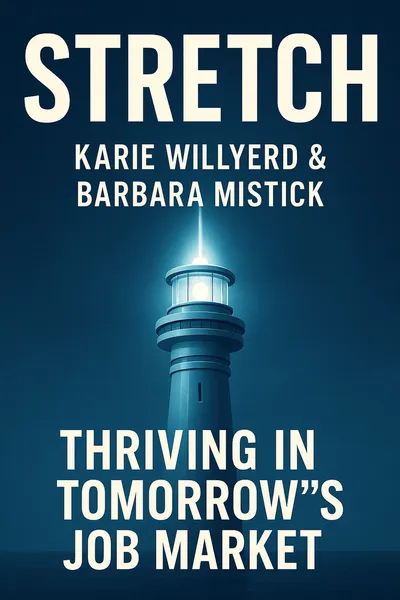
Stretch willyerd
Thriving in tomorrow's job market
Description
To ensure your career remains vibrant and future-proof, it's essential to continuously challenge yourself professionally. This proactive approach is crucial, as the responsibility for your career development rests solely with you. In a world of uncertainty, cultivating a range of options is key to navigating future possibilities.
Above all, aligning your career with your passions allows you to progress and fulfill your dreams.
Table of contents
01Embracing the stretch mandate
In today's rapidly evolving workplace, a series of significant trends are already shaping the future of employment. This means that individuals must continually adjust their career expectations to accommodate these emerging realities. The concept of the STRETCH imperative breaks down into three critical personal imperatives that are essential for career development in the current era.
Jim Clifton, the chairman and CEO of Gallup, provides a compelling overview of the current state of the American workforce. According to Clifton, out of approximately 100 million individuals in the United States who are employed full-time, 30 million, which equates to 30 percent, are engaged and find inspiration in their work, presumably due to effective leadership. On the opposite end of the spectrum, there are about 20 million, or 20 percent, of employees who are actively disengaged, largely due to poor management, and these individuals tend to spread their dissatisfaction within the workplace. The remaining 50 million, or 50 percent, of American workers are not engaged; they merely exist within their roles without feeling inspired by their work or their managers.
Contrary to the implications of Gallup's findings, the responsibility for managing one's career does not solely rest on the shoulders of one's boss. To maximize the potential of one's career, it is imperative that individuals take proactive steps to advance their career. By actively engaging in career development, individuals will soon encounter seven megatrends that will significantly influence the nature of future employment opportunities:
Globalization is rapidly transforming the global economic landscape. McKinsey estimates that within the next fifteen years, nearly two-thirds of the global population will belong to the middle class, and half of the world's largest companies will be based in emerging markets such as Brazil, India, and Eastern European countries.

02Key practices derived from stretch
In order to remain relevant and maintain a sense of engagement in one's career over the long haul, it is essential to embrace a quintet of practices that stem from the imperative to STRETCH oneself. These practices are foundational to ensuring employability both now and in the future, necessitating a commitment to lifelong learning beyond the traditional college years. One should reflect on the amount of time dedicated to training classes in the past year, the frequency of mentorship or collaboration with industry leaders, and the efforts made to establish ongoing learning opportunities, both formal and informal. The learning industry espouses a 70-20-10 model, where 70 percent of learning is acquired informally on the job, 20 percent through coaching or mentorship, and 10 percent from formal training programs. With this framework in mind, it is crucial to seize every informal learning opportunity that presents itself, as these experiences are vital for expanding one's potential in the future.
Enhancing one's ability to learn in the moment involves three key actions. Firstly, embracing a growth mindset is imperative, as it involves recognizing the capacity for learning and growth, thereby maximizing every learning opportunity that arises. Individuals with a fixed mindset may believe they are incapable of learning new things, whereas those with a growth mindset relish the chance to enhance their competencies. This mindset encourages one to take full advantage of workplace learning opportunities, to observe current company dynamics, and to anticipate the skills and competencies that will be valued in the future. Secondly, fostering curiosity is essential.
This involves actively seeking to understand current happenings and processes, continually asking "Why?" and supplementing one's background knowledge. Curiosity serves as the perfect counter to complacency and disengagement. Lastly, mastering the art of unlearning is crucial in an era where knowledge is rapidly expanding. What was learned in earlier educational or career stages may now be obsolete, and the ability to discard outdated ideas and information is necessary to assimilate new concepts. This process can be frustrating and may feel like regression, but it is a natural part of the journey to stretch and grow.
There are three learning pitfalls to avoid. First, do not mistake confidence for competence; instead, seek feedback from peers for a more realistic assessment of your skills. Second, avoid becoming overly reliant on automation, which can lead to a decline in manual skills. Lastly, do not excessively manage risks; become comfortable with ambiguity and uncertain settings. Brian Chesky, the founder of AirBnB, emphasizes the importance of learning how to learn, embracing the constant presence in uncharted waters, and becoming comfortable with ambiguity. Forward-thinking organizations can facilitate on-the-job learning by creating onboarding success maps for role transitions, defining clear competency expectations, curating relevant learning options, and providing access to on-demand learning resources. To manage one's career successfully, it is imperative to seize opportunities to try new things. Becoming complacent and resistant to change can lead to stagnation and being surpassed by those who recognize and capitalize on available opportunities.
03Future expansion through stretch
In today's rapidly evolving job market, it's crucial to continuously reflect on the trajectory of your career and consider ways to enhance your marketability. By anticipating future trends and proactively developing the skills that will be in high demand, you can safeguard your career against obsolescence. To ensure you remain competitive and relevant in the workplace of tomorrow, there are ten key capabilities you should focus on acquiring.
Firstly, achieving a high level of functional intelligence in your chosen field is essential. This means not only excelling in your specific area of expertise but also cultivating a broad knowledge base that allows you to adapt to various roles within your organization as needed. This dual focus on depth and breadth of knowledge will enable you to contribute effectively to high-performing teams and pivot to the most in-demand areas of your company's operations.
Secondly, emotional intelligence is paramount. This involves honing your ability to collaborate effectively and understand the perspectives of others. Empathy, a core component of emotional intelligence, should be coupled with a genuine enthusiasm for working with others. Possessing both functional excellence and emotional intelligence can propel you to remarkable achievements, as these skills together facilitate both individual performance and collaborative success.
Thirdly, personal advocacy is about mastering the art of self-promotion in a way that engages and persuades others to connect with you. By establishing a strong personal brand and sharing valuable content, you can attract meaningful connections and foster beneficial relationships, which are crucial for career advancement.