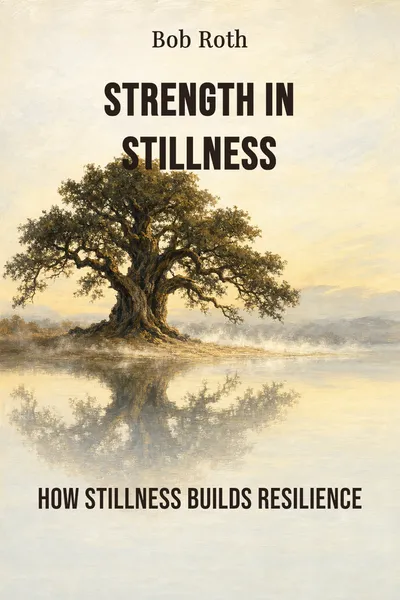
Strength in Stillness
How stillness builds resilience
Description
For a few decades now, a quiet, unassuming man in a dark suit has been one of the most sought-after people in American public life. His name is Bob Roth, and his job is to teach people how to do nothing — or, more precisely, how to sit still for twenty minutes twice a day. His students have included filmmakers, hedge-fund managers, senators, schoolteachers, soldiers returning from deployment, and a long roster of famous names who tend to describe the experience in almost identical terms: not as a spiritual awakening, but as relief. Roth has spent more than forty years teaching one specific thing, Transcendental Meditation, and his 2018 book Strength in Stillness is his attempt to explain why a method that sounds faintly absurd keeps producing the same effect on people who have, by every outward measure, already won.
The pitch is counterintuitive, and Roth knows it. We tend to treat calm as the thing we'll get to once everything is handled — after the inbox, after the deadline, after the kids are asleep. Roth's whole argument runs the other way. The stillness isn't the reward for managing the chaos; it's the thing that makes managing the chaos possible. He frames TM not as an escape from a demanding life but as the maintenance that a demanding life requires, the way an athlete treats recovery as part of training rather than a break from it.
What makes the book worth reading isn't the celebrity testimony, though there's plenty of it. It's the way Roth dismantles, patiently, almost everything we think meditation is supposed to be — the emptied mind, the lotus posture, the years of discipline before anything happens — and replaces it with something far more modest, and far harder to dismiss.
The question we’re asking : If calm is a capacity rather than a luxury, what does it actually take to access it, and why do so many of us find it so hard?What we’ll see : How a soft-spoken meditation teacher built a case for stillness — out of his own students, the research, and the brain itself.
Table of contents
01 Chapter 1 — The teacher who never empties his mind
Bob Roth did not arrive at meditation as a mystic. He came to it as a skeptical political-science student at Berkeley in the early 1970s, the kind of young man who wanted to change the world through legislation and assumed anyone teaching meditation was selling incense. He went to a free introductory talk mostly to argue. What changed his mind wasn't an argument but the practice itself — the unexpected, physical sense of settling that he hadn't known he was missing. He learned the technique, kept doing it, and never really stopped. The activist became a teacher, and over the following four decades he taught hundreds of thousands of people, eventually co-founding the David Lynch Foundation, which brought TM to veterans with post-traumatic stress, to students in underfunded schools, and to women leaving violent homes.

02 Chapter 2 — A technique with no white-knuckling
So what is the thing, mechanically? TM, as Roth describes it, is almost embarrassingly simple. You sit comfortably, eyes closed, and silently repeat a particular sound — a mantra, assigned by a trained teacher and meaningless by design, chosen precisely because it carries no concept for the mind to chase. You don't concentrate on it. You don't fight off other thoughts. When the mind wanders, which it will, you gently come back, without judgment, without effort. Twenty minutes, twice a day. That's the entire instruction.
The effortlessness is the whole point, and it's what separates TM from the kinds of meditation that ask you to focus hard or monitor your breath or observe your thoughts with vigilant attention. Roth divides the field, roughly, into three approaches: focused attention, which requires concentration; open monitoring, which asks you to watch the mind without engaging; and what he calls self-transcending, where the mind settles on its own toward quieter states without being forced. TM belongs to the third, and Roth's claim is that the absence of effort isn't a shortcut — it's the mechanism. The mind, given a settling sound and permission to do nothing, naturally moves toward calm the way water finds its level.
03 Chapter 3 — What the brain does when the body settles
Roth is not a neuroscientist, and he doesn't pretend to be. But a good part of Strength in Stillness is devoted to the research, because Roth came of age as a teacher during the decades when meditation moved from the fringe into university labs, and he treats that shift as central to his case. The body under chronic stress, he explains, runs on a near-permanent fight-or-flight setting: elevated cortisol, raised blood pressure, a nervous system braced for a threat that, in modern life, never quite arrives and never quite leaves. We're built to handle acute danger and recover. We are not built to marinate in low-grade alarm for years.
The studies Roth cites point, broadly, in one direction. Regular TM practice is associated with reduced anxiety, lower blood pressure, and meaningful reductions in the risk factors for heart disease — findings serious enough that some have appeared in cardiology journals and informed the cautious statements of professional bodies. He describes work with veterans showing drops in PTSD symptoms, and studies suggesting improvements in focus, sleep, and the kind of cognitive flexibility that creative work depends on. Roth is generally careful to frame these as evidence rather than miracle, though a reader holding the book to a strict standard will notice he leans on the encouraging results and spends less time on the studies' limits.
04 Chapter 4 — Stillness as a thing we lost, not a thing we lack
Step back from the mantra and the studies, and the deeper move in Roth's book is a reframing of the problem itself. We tend to assume that calm is a skill some people have and most don't — a personality trait, a temperament, something you're either born with or have to painstakingly build from scratch. Roth's whole stance suggests the opposite. The capacity for stillness isn't missing; it's buried. It's the default state of a nervous system that hasn't been kept on alert for years, and the work of meditation is less like learning a new ability than like clearing away the noise that's been sitting on top of one we already have.
This is why Roth's tone is so consistently un-strenuous, and why the book reads less like a training manual than like permission. The culture he's writing into treats rest as something earned — a vacation you accumulate, a break you've justified by suffering enough first. Strength in Stillness quietly refuses that economy. The twenty minutes aren't a reward subtracted from productive time; they're the thing that makes the rest of the time work. An athlete who skipped recovery to train more would get slower, not faster, and Roth applies the same logic to the mind. The strength in the title is not stoic endurance. It's the quieter strength of a system that gets to reset.
05 Conclusion
The young Berkeley activist who walked into that talk to argue ended up spending his life teaching the one thing he'd gone in to debunk. What Roth seems to have understood, somewhere across those four decades, is that the people who most need stillness are precisely the ones who have organized their lives to never have any — the high performers, the caregivers, the perpetually braced. His book makes its case not by raising the stakes but by lowering them: twenty minutes, no emptied mind, no posture, no decades of discipline. Just a settling that the body already knows how to do, given the chance.
Related books