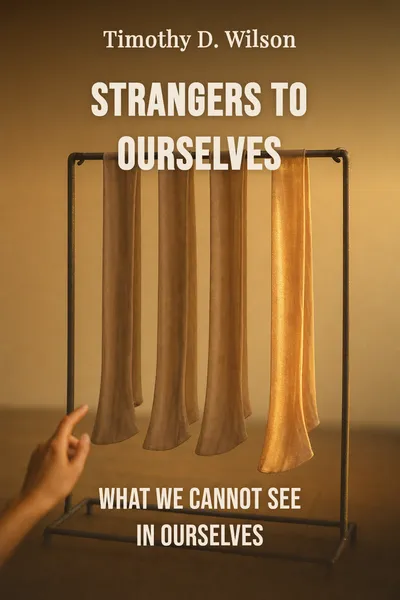
Strangers to Ourselves
What we cannot see in ourselves
Description
In the late 1970s, a puzzle kept turning up in psychology labs. People would be asked why they had done something — chosen this stocking over that one, felt more drawn to a photo shown on the right — and they answered without hesitation, offering reasons that were confident, coherent, and demonstrably wrong. The experimenters knew the real cause because they had rigged it: the position of the item, a word flashed too fast to register. The subjects didn't know, but they never said so. They produced an explanation anyway, and believed it. This wasn't lying. It was something stranger — a mind narrating its own workings from the outside, with no more access to the machinery than an observer would have.
Timothy D. Wilson, a social psychologist at the University of Virginia, spent decades gathering findings like these, and in 2002 he pulled them together in a book called Strangers to Ourselves. His argument is bracing. Most of what governs our judgments, feelings, and choices happens in a part of the mind he calls the adaptive unconscious — fast, sophisticated, and permanently sealed off from the conscious self that thinks it's in charge. The Freudian unconscious was a basement of repressed desires you might, with effort, drag into the light. Wilson's is different: not hidden because it's shameful, but inaccessible because that's simply how the equipment is built.
Which lands us in an awkward spot with one of the oldest pieces of advice ever handed down. Know thyself, said the inscription at Delphi, and centuries of introspection have taken it as an instruction to look inward and read off the answer. Wilson's research suggests the answer isn't in there to be read. So the question becomes what we're actually doing when we search ourselves — and whether there's a better route to the thing we're after.
The question we’re asking : If the mind that runs us is closed to inspection, how do we come to know who we really are?What we’ll see : A tour of the unconscious as modern psychology has redrawn it, and the surprising direction self-knowledge turns out to travel.
Table of contents
01Chapter 1 — The adaptive unconscious replaces Freud's
The word unconscious arrives loaded. For most of the twentieth century it meant Freud: a reservoir of forbidden wishes and buried traumas, kept down by repression, leaking out in dreams and slips of the tongue. Wilson doesn't so much argue against this picture as set it aside. The unconscious that experimental psychology kept bumping into wasn't a cauldron of suppressed drama. It was a set of mental processes doing ordinary, essential work — perceiving, interpreting, judging, deciding — quickly and out of view.
He calls it the adaptive unconscious, and the adjective matters. These processes are there because they help us function. A stream of information floods the senses every second, far more than awareness could ever handle, and something has to sift it, flag what's threatening, size up the people we meet, and set our bodies in motion before we've consciously caught up. That something is not a lesser mind. It's a highly capable one that happens to run without a window. Wilson likens consciousness to a small part of a large operation — useful, but not the head office it imagines itself to be.

02Chapter 2 — Why looking inward hits a wall
If the causes of our reactions are sealed off, what happens when we introspect? Wilson's answer is that we don't retrieve them — we can't — so we do the next best thing: we construct a plausible account. When those experimental subjects explained why they preferred a stocking or a face, they weren't reading a hidden record. They were reasoning about themselves the way they'd reason about anyone, drawing on what feels like a likely cause. Sometimes the guess is right. Often it isn't, and we have no way of telling which.
This reframes introspection entirely. It isn't a special channel of privileged access; it's inference dressed up as observation. And Wilson shows it can actively mislead. In a series of studies, people asked to analyze why they felt the way they did about something — a jam, a poster, a romantic partner — ended up with attitudes that predicted their later behavior less well than the attitudes of people who simply reported how they felt. Thinking about reasons pushed them toward whatever reasons were easy to put into words, which weren't necessarily the ones actually driving them.
03Chapter 3 — The stories we tell about ourselves
If we can't observe the machinery, we narrate it — and narration, Wilson argues, is where much of our self-understanding actually lives. We carry an ongoing story of who we are: our traits, our tastes, our reasons, the arc of our lives. This story is genuinely useful. It gives us continuity and a sense of agency. But it is a construction, assembled partly from real self-observation and partly from the explanations our culture makes available, and it can drift a long way from the adaptive unconscious it claims to describe.
The gap shows up most sharply when we predict our own feelings. Wilson and his collaborator Daniel Gilbert documented what they called affective forecasting errors: we're reliably bad at guessing how good or bad we'll feel after future events, and how long the feeling will last. We overestimate the sting of a setback and the glow of a triumph, because our conscious model of ourselves doesn't know about the quiet unconscious machinery that softens blows and metabolizes joy. We think we know our own emotional future. Mostly we're forecasting a stranger's.
04Chapter 4 — Behaving our way into knowing
Here is where Wilson turns the ancient instruction on its head. If the self we most want to know is hidden from inspection, then the way to reach it isn't to look harder inward — it's to look outward, at what we actually do. Our behavior is produced by the same adaptive unconscious we can't examine directly, which makes it a kind of external readout. We are, in this sense, better placed to learn about ourselves as anthropologists than as introspectors: watch the fieldwork, not the theory the subject offers about the fieldwork.
This is more than a research finding; it's a reversal of a very deep intuition. We assume knowledge of the self runs from the inside out — that we consult the interior first and act on what we find. Wilson's evidence points the other way. Notice which invitations you keep accepting and which you quietly decline, where your attention drifts, what you do when no one's assigning reasons. The pattern in the conduct is often a truer guide to the underlying disposition than any answer you'd give if asked why.
05Conclusion
The subjects who explained their rigged choices weren't fools. They were doing what all of us do all day: producing a confident account of a mind we can't actually see into, and mistaking the account for a report. Wilson's book gathers decades of that pattern and draws the uncomfortable conclusion — the adaptive unconscious does most of the work, and it doesn't file its records where consciousness can read them. What we experience as self-knowledge is largely a well-made inference, sometimes accurate, often not, and rarely aware of which.
Related books