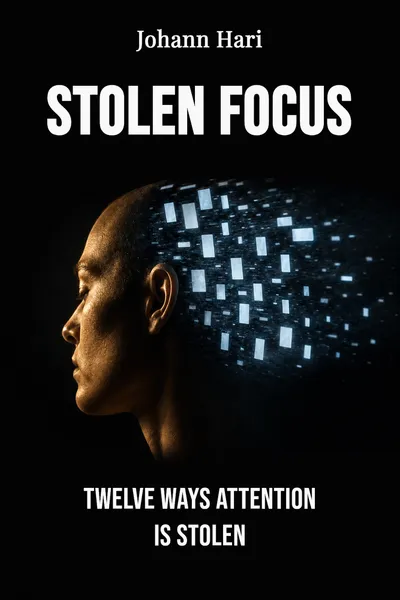
Stolen Focus
Twelve ways attention is stolen
Description
In 2019, the writer Johann Hari did something most of us have fantasized about and almost none of us dare. He drove to Provincetown, on the tip of Cape Cod, rented a small place by the sea, handed over his smartphone and laptop, and disconnected for three months. No email, no notifications, no scroll. He had become, by his own admission, someone who could no longer read a book without his hand twitching toward a phone that wasn't there. He wanted to know whether the focus he felt slipping away could come back if he simply removed the temptation. For a while, it did.
Then he went home, plugged back in, and watched it drain away again within weeks. That return is the real subject of the book that came out of the experiment. Because if the problem were just willpower, Provincetown would have been the cure, and the self-discipline he rebuilt there would have held. It didn't. The relapse told him something the digital-detox industry rarely admits: the individual fix doesn't stick, because the thing eroding our concentration is not really inside us. The average office worker, he found, now focuses on a single task for about three minutes before switching. Teenagers, even less. Something larger is at work.
Hari spent the next three years interviewing the scientists, designers, and former tech insiders who study this collapse for a living. What he came back with was not a productivity hack or a ten-step morning routine. It was an argument: that our attention has not weakened on its own, it has been actively degraded by forces that profit from the degradation — and that treating it as a personal failing is exactly the mistake that keeps us stuck.
The question we’re asking : If we can no longer hold a thought for three minutes, is the fault ours, or has something been done to us?What we’ll see : How a writer's failed escape to the sea turned into an inventory of the forces quietly pulling our minds apart.
Table of contents
01 Chapter 1 — The journey began with a vow of silence
Hari opens Stolen Focus with himself as the patient, which matters, because the book refuses the posture of the expert diagnosing everyone else. He describes a life that had become a haze of half-read pages and abandoned films, of conversations interrupted by the urge to check something. He is honest that he had blamed himself for years — that he carried the modern suspicion that he was simply weaker than his grandparents, less disciplined, more broken. The Provincetown experiment was, in part, a test of that suspicion.
The three months by the sea did real things to him. He read books cover to cover for the first time in years. He noticed his thoughts lengthening, his mind settling into the kind of slow, sustained attention that long-form reading requires. He slept better. He started to feel, as he puts it, more like himself. The lesson seemed obvious and reassuring: unplug, and the mind heals. Plenty of books would have ended there, with the screen-free retreat as the moral.

02 Chapter 2 — Twelve forces, not one bad habit
The structural claim of the book is in its architecture: Hari identifies twelve distinct causes of our shrinking attention, and he insists they are causes, plural, not symptoms of one personal flaw. Some are obvious, some are not. The increase in speed and switching. The flow state we keep interrupting. Physical and mental exhaustion from chronic lack of sleep. The collapse of sustained reading. The wandering mind that we have been taught to distrust but that does real cognitive work. The way technology is engineered to track and manipulate us. Stress and a state of constant vigilance.
Then come the causes that rarely make it into a productivity podcast. Deteriorating diets and the additives in processed food. Rising pollution. The epidemic over-diagnosis and over-medication of attention problems in children, which Hari treats with care rather than dismissal. The confinement of childhood itself — kids who no longer roam, play, and get bored outdoors. By the end, the list reads less like a self-help inventory and more like an indictment of how a whole society has organized itself.
03 Chapter 3 — The machines built to keep us hooked
The most charged section of the book is the one about technology, and Hari is careful not to flatten it into the familiar scolding about phones. His sources are the people who built the thing. He talks at length with Tristan Harris, a former design ethicist at Google, and with James Williams, another ex-Google insider who studies the attention economy. Their account is not that screens are inherently evil. It is that a particular business model — one that earns money by holding your gaze as long as possible and selling that gaze to advertisers — has every incentive to make its products as difficult to put down as it can.
The engineering, in this telling, is deliberate. Infinite scroll removes the natural stopping point a page once provided. Notifications are timed and colored to trigger you. Algorithms learn which content makes you angriest or most anxious, because outrage and fear keep you engaged longer than calm does. Hari's interviewees describe rooms full of brilliant people whose job is, in effect, to defeat your self-control. Calling this a fair fight, he suggests, is like calling a chess match against a grandmaster a fair fight because you both know the rules.
04 Chapter 4 — Food, air, and the slow erosion of stillness
Where Stolen Focus widens beyond the usual conversation is in treating attention as something physical and ecological, not just psychological. Hari devotes serious space to diet, drawing on researchers who link the additives and instability of processed food to children's ability to concentrate. He looks at air pollution and the early evidence that what we breathe affects how we think. He examines the steady disappearance of free, unstructured play from childhood, and the over-medication of kids whose restlessness might be, in part, a reasonable response to environments built to be unbearable for a child.
The thread running through all of this is that focus is a collective resource, like clean water or breathable air, and that it can be polluted by industries acting in their own interest. This is the step back the book is really making. We are used to thinking of attention as the most private thing we own — the one fortress inside our skulls. Hari's argument inverts that. Our attention, he says, has been treated as an extractable commodity, mined and sold, with the depletion left for each of us to absorb privately as guilt.
05 Conclusion
The book ends where it began, with Provincetown, but Hari reads the experiment differently by the close. The three months of recovered focus were not a recipe to be repeated alone; they were proof that the capacity was still there, waiting, beneath the noise. What had broken was never him. What had broken was the world arranged around him, and a single person fleeing to the sea cannot fix a world. The relapse, far from being a failure of character, was the most useful data he collected.
Related books