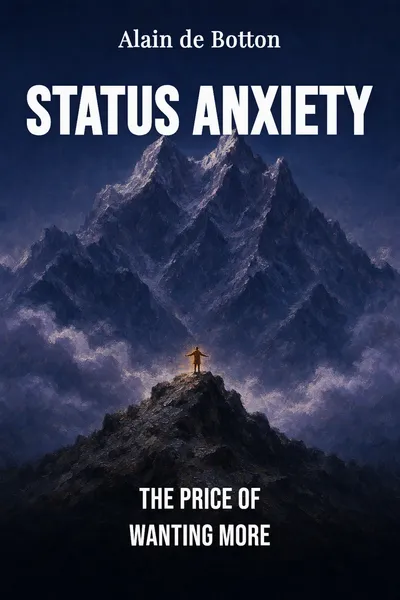
Status Anxiety
The price of wanting more
Description
There's a particular kind of unease that doesn't announce itself. It shows up at a school reunion, when someone mentions their new title. It shows up scrolling past a former classmate's holiday photos. It shows up at three in the morning, doing quiet arithmetic about where we've landed versus where we thought we'd be. Alain de Botton, the British writer and philosopher, gave this feeling a name in his 2004 book: status anxiety. His claim is that it isn't a private weakness or a symptom of vanity — it's one of the most widely shared experiences of modern life, and one we're oddly reluctant to admit to.
De Botton's argument is disarmingly direct. We worry about our place in a hierarchy because a society that treats worldly success as a measure of personal worth makes that place feel like a verdict on who we are. And here's the twist that runs through the whole book: this anxiety is not ancient. In many ways it's a modern invention, sharpened by the very ideas we're proudest of — equality, opportunity, the notion that anyone can rise. The more open the ladder, the more it stings to be low on it.
What makes the book more than a diagnosis is where it goes next. De Botton is less interested in scolding us for caring about status than in understanding why we do, and then asking what might loosen its hold. He reaches not for self-help but for philosophy, art, politics, religion — the older resources a culture keeps around for exactly this kind of trouble. The result is a book about a feeling most of us pretend we're above, treated with unusual seriousness.
The question we’re asking : Why does the pursuit of status make us anxious, and what, if anything, can quiet the feeling?What we’ll see : De Botton traces where this worry comes from, why modern life intensified it, and what centuries of thought have offered as relief.
Table of contents
01 Chapter 1 — The worry that follows us to bed
De Botton opens by defining his subject with care. Status anxiety, in his account, is the worry that we are failing to conform to the ideals of success laid down by our society — and that we may, as a result, be stripped of dignity and respect. It's not just about money, though money is often the currency. It's about standing in the eyes of others, the sense of being someone who counts. The anxiety bites hardest not when we lack things, but when we sense that our position invites contempt.
The reason it matters so much, he argues, is that we depend on others for our self-image. Very few of us can hold a stable sense of our own worth without external confirmation. A cold reception, a snub, a colleague's promotion — these register not as neutral facts but as evidence about our value. De Botton is blunt about the mechanism: love, in the broadest sense, is what we're after. The love of a partner, yes, but also the low-grade daily attention of being taken seriously, greeted warmly, treated as though we deserve a good seat at the table.

02 Chapter 2 — Why we started caring more, not less
The most counterintuitive move in the book is historical. We might assume that status anxiety was worse in rigidly hierarchical societies — feudal Europe, say, with its lords and serfs. De Botton argues the opposite. In a world where your place was fixed at birth and sanctioned by God, there was little point envying those above you; their position was simply the order of things, no more a personal reproach than the weather. A peasant did not lie awake wondering why he wasn't a duke.
What changed everything, in de Botton's telling, was the rise of a meritocratic ideal, gathering force from roughly the eighteenth century onward. The promise was liberating: birth need not be destiny, anyone could rise through talent and effort. It's one of the great moral achievements of the modern world. But it carried a hidden cost. If the system is fair and anyone can rise, then failing to rise stops being bad luck and starts looking like a personal failing. Poverty ceases to be a misfortune and becomes a verdict.
03 Chapter 3 — Five ways the anxiety turns into behaviour
Once the worry exists, de Botton shows, it doesn't stay tidily inside us. It leaks out into how we treat each other and how we spend our lives. Snobbery is the first and most familiar form. The snob, he observes, is simply someone who takes a small part of a person — their job, their accent, their address — and treats it as the whole. What makes snobbery so wounding is that it's the anxiety made social: the snob is often frightened himself, clinging to markers of status because he too fears being dismissed.
Then there's conspicuous consumption, the business of buying things not for their use but for what they signal. De Botton, drawing on a long tradition of writing about goods as messages, notes that much of what we acquire is a form of communication — an attempt to say to strangers, before we've spoken a word, that we are worth their regard. The house, the car, the watch: these are less objects than arguments about our place in the hierarchy, arguments we're not always aware we're making.
04 Chapter 4 — Art, philosophy, and the quiet corrections
Stepping back, the deeper argument of the book is that status anxiety is not a bug in our character to be fixed with willpower, but a predictable product of a society organised around a single, narrow scale of worth. De Botton's response is therefore not a technique but a widening of the frame — an attempt to multiply the ways a life can be judged valuable, so that no one measure holds total power over our sense of ourselves.
Philosophy offers one correction. De Botton returns to the thinkers who taught a certain independence from public opinion — the idea that other people's verdicts are often careless, self-interested, or simply wrong, and that a life examined by one's own conscience need not tremble before the crowd. To realise how confused most judgements of us actually are is already to loosen their grip. The point is not to stop caring what anyone thinks, but to stop treating collective opinion as an oracle.
05 Conclusion
We come back, in the end, to that three-in-the-morning arithmetic, the quiet tally of where we've landed. De Botton's achievement is to take a feeling most of us hide even from ourselves and treat it as a serious object of thought rather than a private embarrassment. The anxiety is real, widespread, and largely rational given the world we've built. It is also, he shows, historically produced — which means it is not simply the way things must be.
Related books