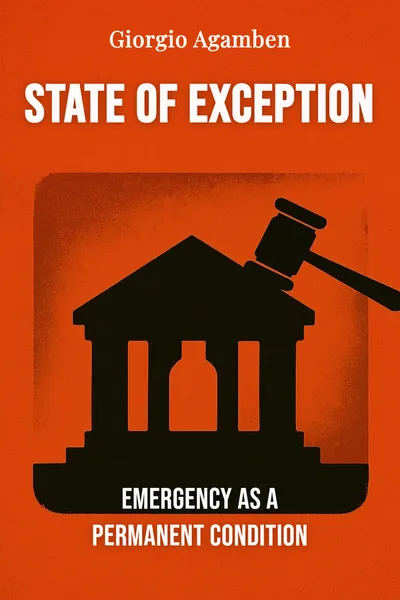
State of Exception
Emergency as a permanent condition
Description
On September 18, 2001, one week after the towers fell, President Bush signed an authorization for the use of military force. Two months later came a military order allowing the indefinite detention of non-citizens suspected of terrorism, held at Guantanamo Bay without charge, without trial, without the protection of the Geneva Conventions or of American criminal law. These men were not prisoners of war. They were not defendants. They existed in a legal void that the state had deliberately manufactured — bodies held by the law precisely by being placed outside it. It was this figure, produced in the months after 2001, that the Italian philosopher Giorgio Agamben took as the starting point for a short, dense book.
His argument was not that Guantanamo was an American aberration or a Bush-era excess. It was that the legal device behind it — the suspension of the normal order in the name of an emergency — has a long history, a precise structure, and a disturbing trajectory. Every modern constitution contains a provision for its own suspension: a clause that lets the executive set aside the usual rules when survival seems at stake. The problem is what happens when the emergency never quite ends, when the temporary measure quietly becomes the way things are done.
Published in 2003, State of Exception is the second volume of Agamben's Homo Sacer project, and it reads like a legal genealogy written by a philosopher who distrusts lawyers. It moves through Roman jurisprudence, German constitutional theory, and a bitter mid-century argument between two thinkers who watched a democracy collapse. What it describes is not an exotic problem but the hidden hinge of the state we live under.
The question we’re asking : What is the legal form that lets a state suspend its own law — and what happens when that suspension stops being temporary?What we’ll see : How a device meant for emergencies became, in Agamben's reading, the quiet operating logic of modern government.
Table of contents
01Chapter 1 — The zone where law suspends itself
The phrase itself is a paradox, and Agamben wants us to sit with it. A state of exception is a situation created by law in which the law no longer applies. The government does not break the constitution; it uses a provision within the constitution to suspend the constitution. The suspension is legal. What it produces is a zone where acts that would normally be crimes — detention without trial, censorship, the seizure of property, the killing of citizens — become permissible, not because a new law authorizes them but because the old law has been switched off.
This is what makes the exception so hard to think about clearly. It is neither inside the legal order nor fully outside it. Agamben calls it a threshold, a space of indistinction where the difference between law and violence, between the rule and its transgression, stops being legible. The sovereign, in this reading, is precisely the figure who stands on that threshold: the one with the power to decide that the normal situation no longer holds, and therefore to act in a space the law has emptied of its own content.

02Chapter 2 — Rome's dictator and the emperor's blank check
Modern commentators love to point to the Roman dictatorship as the ancestor of emergency powers, and Agamben spends real effort correcting the comparison. The Roman dictator was a magistrate, appointed by the consuls in a moment of crisis, granted extraordinary authority for a strictly limited term — traditionally six months, or the duration of the emergency, whichever came first. He held a specific office with a specific mandate. He did not suspend the law; he was a fully legal figure exercising a fully legal, if unusually broad, power. The dictatorship, in other words, was a magistracy, not a void.
The real Roman ancestor of the state of exception, Agamben argues, lies elsewhere — in an obscure institution called the iustitium. The word means, literally, a standstill or suspension of the law, on the model of a solstice where the sun appears to stand still. When the Senate perceived a mortal threat to the republic, it could issue a decree — the senatus consultum ultimum — calling on the magistrates and even the citizens to see that the state took no harm. What this produced was not a new office but a suspension of the entire legal order, a temporary emptying-out in which anyone might act to save the republic and no act could be measured against the ordinary law.
03Chapter 3 — Weimar's Article 48 and the state that never ended
The modern laboratory of the exception was the Weimar Republic, and its instrument had a number: Article 48 of the 1919 constitution. It allowed the president of the Reich, when public order and security were seriously disturbed, to take the measures necessary to restore them, including the temporary suspension of the core civil liberties the constitution otherwise guaranteed. It was written as a safety valve. It became the mechanism by which German democracy governed itself for years, and finally the door through which its own destruction walked in.
The numbers tell the story better than any argument. Between 1919 and 1933, the presidents of the Reich invoked Article 48 hundreds of times. Under Friedrich Ebert alone it was used well over a hundred times in the republic's early years. By the early 1930s, with the parliamentary system paralyzed, chancellors governed largely through presidential emergency decree rather than through laws passed by the Reichstag. The exception had ceased to be an interruption of normal government; it had become the normal mode of government, the ordinary way that decisions got made when the ordinary way had stalled.
04Chapter 4 — When the exception becomes the rule
Step back from the Roman standstill and the Weimar decree, and Agamben's larger claim comes into view. He is not cataloguing historical emergencies for their own sake. He is arguing that the state of exception has stopped being a bordered, temporary event and has settled in as the permanent structure of contemporary government. The West did not learn from Weimar to fence the exception more tightly. It learned to live inside it, to make the suspension routine and to stop noticing that it had.
The evidence he assembles is a series of measures that were declared as emergencies and never rescinded. France governed under a state of siege provision that outlived its wars. Britain and the United States expanded executive war powers that quietly hardened into ordinary practice. The point is not any single abuse but the cumulative drift: each emergency leaves behind a residue of extended power, and the residues accumulate until the extraordinary is simply the way the state operates. The exception no longer suspends the norm from outside; it has migrated inside, becoming the norm's hidden engine.
05Conclusion
The men held at Guantanamo were the image Agamben started from, and by the end of the book they look less like a scandal at the edge of the law than like its clearest expression. They occupy the exact space the Roman iustitium first opened and the Weimar decree made permanent: a zone where the law is present precisely as its own suspension, where a person can be detained by a state that owes them nothing because it has declared them to be nowhere. The emergency that produced them was announced as temporary. Two decades on, the announcement itself has become part of the furniture.
Related books