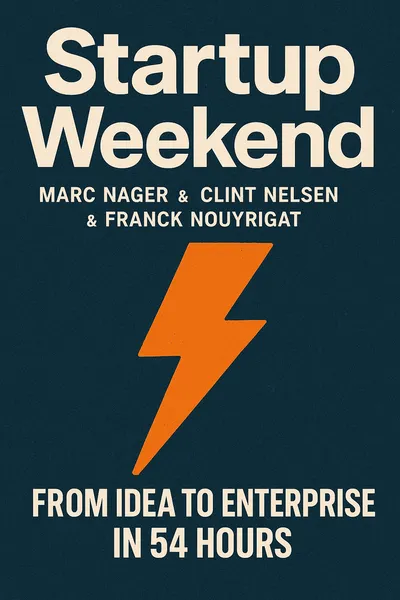
Startup weekend
From idea to enterprise in 54 hours
Description
Startup weekend is a dynamic and immersive event where entrepreneurs transform an idea into a business within just 54 hours. It emphasizes experiential learning, where participants pitch ideas, form teams, and work on creating a minimum viable product, receiving guidance from mentors along the way.
The focus is on collaboration, innovation, and community building, offering a unique opportunity for learning by doing. This fast-paced environment encourages taking action, testing concepts, and iterating based on feedback, all aimed at launching a viable startup by the event's conclusion.
Table of contents
01 Philosophical foundation: execution over ideas
The idea of transforming a vague concept into a viable business over a single weekend has become increasingly feasible, thanks to a range of interconnected technological advancements.
This approach, epitomized by Startup Weekend events, encourages participants to choose an idea and immediately start working on it, rather than getting stuck in the planning phase. This method of rapid development and continuous improvement based on feedback represents a significant shift from the traditional entrepreneurial mindset, which emphasized detailed business planning before taking any concrete steps.
The success and global spread of Startup Weekends underscore the potential of this approach to foster a new era of entrepreneurship.
Startup Weekend's origins trace back to 2008, when a private company first hosted such an event, charging participants and offering them stock options, a move that drew regulatory scrutiny. The concept was later acquired and transformed by Startup Weekends, LLC, a nonprofit founded by Marc Nager, Clint Nelsen, and Franck Nouyrigat, who revamped the format and expanded its reach globally.

02 Networking through actions
Startup weekends are dynamic events that focus on action-based networking, where the emphasis is on collaboration and tapping into the diverse skill sets of participants rather than just making the right impression.
Unlike traditional networking events where attendees may prioritize appearance and eloquence, startup weekends require every participant to join a team and contribute meaningfully. This creates a high-energy, low-risk environment conducive to nurturing ideas.
At a startup weekend, if you have a business idea, you get the chance to pitch it during an open mic session on Friday evening. Each pitch is limited to 60 seconds, and following this session, the top 20 ideas are selected. If your idea is chosen, you then have the opportunity to build a team from those who show interest. If not, you can choose which of the selected teams you'd like to join.
The core of the startup weekend experience is the practical networking that occurs as you work alongside others to develop a project. This hands-on approach contrasts with the theoretical learning offered by most business schools. Over the course of the weekend, you'll gain a deep understanding of your team members' skills, strengths, weaknesses, energy, competencies, passions, and talents. The tight deadline of the weekend forces people to reveal their true capabilities.
03 Seeking skilled individuals
Good ideas need great teams to flourish. At the heart of every startup weekend lies the opportunity for every participant to make a 60-second pitch. This initial pitch is not about seeking funding but about attracting the right talent and energy to turn an idea into reality. With over 34,000 attendees' experiences at startup weekends, the optimal use of these 60 seconds is crucial.
The common mistake is to spend too much time introducing oneself. While a brief introduction is necessary, the focus should quickly shift to the main point: the problem identified and the proposed solution. This approach forces conciseness, requiring the solution to be summarized in a single sentence. A well-articulated problem naturally leads to the solution, which should be logical, worthwhile, and, importantly, catchy and memorable to stand out among numerous pitches. Examples of memorable taglines from past startup weekends include "Giant Thinkwell: Fast, fun and addicting gameplay," "LaunchRock: Create a viral 'Coming Soon' page in minutes," "123DressMe: Style with a smile," "Foodspotting: The best foods and where to find them," and "Task Ave.: Remember what you need to do when you need to do it." Rising above the noise to attract the necessary talent is a challenge. Some excel naturally, while others may struggle. According to Nick Seguin, Manager of Entrepreneurship at the Kauffman Foundation, passion alone is insufficient. Entrepreneurs must either communicate their vision more clearly or evolve their vision to align others with their idea.
04 Building the core team
Working together as a team over a weekend can be an intense educational experience. The best way to learn is by doing, rather than just talking or thinking about it. When you tap into the talents of your team and work on real-world solutions, you get a clear sense of direction. It's about prioritizing your limited time and simplifying tasks.
Startup weekends are a prime example of learning by doing. You're immersed in a startup environment, building a team that must create solutions, tackle challenges, and ideally prepare to meet actual market demands. This hands-on approach is far more effective than reading a case study. You learn by stepping out of your comfort zone, doing what's necessary, and benefiting from immediate feedback. The fact that a startup weekend lasts only a weekend means there's a strict deadline. This is beneficial as it compels participants to focus solely on the most critical tasks. To have something to present by Sunday night, you need to cut back on your ambitions and concentrate on the key tasks. Most teams end up adopting a project management approach that looks something like this:
Projects usually begin with a brain dump where everyone shares their ideas freely. Each team member contributes suggestions to the discussion, and a bit of online research helps to see what similar offerings exist. After the brain dump, the team settles on a viable idea. Next, you prioritize the tasks needed to develop that idea into something you can present at the Sunday night competition. The goal is to build a minimum viable product (MVP) over the weekend. You must determine what you can achieve with the time, resources, and talent at your disposal and get to work.
05 Crafting the business framework
Crafting a business model over a weekend avoids the pitfall of unrealistic growth projections, focusing instead on engaging with potential customers to discover their needs and devising systems to meet those needs.
This process is about validating your idea, maintaining flexibility, and being ready to pivot based on customer feedback. Startup Weekend champions experiential learning across various activities, emphasizing that the success of a startup hinges more on its business model than its location.
Steve Blank's customer development theory, born from observing patterns in startup successes and failures, underscores the importance of direct customer engagement to avoid mistaking founder passion for market demand.
The essence of Startup Weekend is forming a team around an idea, refining the vision through customer interaction, and securing genuine buy-in for the concept.
To understand customer desires in a short timeframe, methods like quick surveys or conversations with people in casual settings can be invaluable. These interactions should aim to gather insights rather than sell a product, welcoming honest feedback to refine the idea early on.
06 Evolving towards success
Becoming an entrepreneur is a process that unfolds over time, not overnight. However, laying the foundation for entrepreneurial success can begin in as little as 54 hours.
The journey involves identifying what you're passionate about, what you excel at, and finding a way to monetize this. It requires planning, creativity, and a willingness to take risks.
The entrepreneurial path can be visualized as a ladder, with each rung representing a different stage of growth and development. Some individuals start as accidental entrepreneurs, turning a hobby or side project into a full-time job. Others take a more deliberate approach, identifying a problem and committing to solving it.
This commitment often leads to forming or joining a team focused on a shared goal, developing a minimum viable product (MVP), and iterating it until it meets customer needs. Securing funding and committing to work full-time on the startup marks the next phase, followed by attracting investors, scaling the business, and possibly even going public or being acquired. Each step up the ladder presents new challenges and opportunities for growth.
Related books