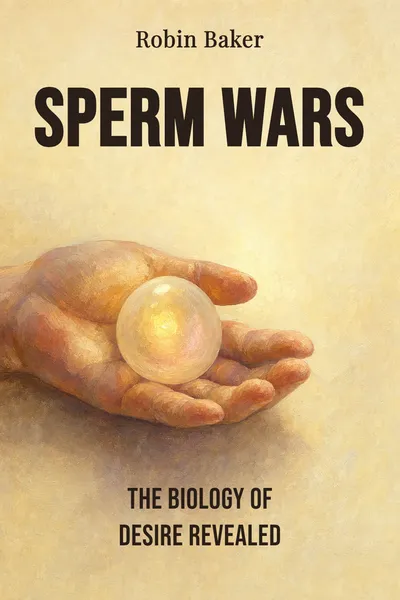
Sperm Wars
The biology of desire revealed
Description
In the mid-1990s, a British reproductive biologist named Robin Baker published a book that opened not with a data table but with a scene: a couple, a bedroom, an ordinary night, described in almost clinical detail. Then the twist — every gesture, every hesitation, every moment of arousal was recast as a move in a contest neither person knew they were playing. Sperm Wars arrived in 1996 and did something popular science rarely manages. It made people uncomfortable at the dinner table. It also sold, translated widely, and lodged a handful of startling claims into the culture where they still circulate.
Baker's argument, built partly on his own research with the physiologist Mark Bellis, was that human sexual behaviour is choreographed by a competition happening below the threshold of awareness. Not between men and women, exactly, but between the sperm of different men, inside a single woman's body, over a window of days. Around one in ten children, he claimed, is not the biological child of the man who thinks he is the father. Most of a man's sperm, he argued, cannot fertilize anything at all — it has another job. And a woman's body, without her knowing, is quietly running its own selection process.
The book has been celebrated as a classic of the genre and picked apart by later researchers who found some of its figures shakier than the confident prose suggested. Both things can be true. What made it land was less the individual numbers than the frame: the idea that desire itself is an evolved instrument, and that the people using it are not the ones holding the plans.
The question we’re asking : What is actually being contested in Baker's account of sex, and who — or what — is doing the contesting?What we’ll see : How a biologist reframed intimacy as a hidden competition, the mechanics he claimed to find, and what it costs to read human wanting as a strategy nobody chose.
Table of contents
01Chapter 1 — The scenes behind the scenes
Sperm Wars is structured as a series of vignettes. Baker opens each chapter with a short narrative — a one-night stand, a long marriage, an affair, a moment of jealousy — written like fiction, then spends the rest of the chapter explaining the biology he says is running underneath. The device is deliberate. He wants the reader to recognize the behaviour first, feel that it is familiar and human, and only then be told that it is also, in his reading, an evolved routine with a purpose the participants never registered.
The governing idea is borrowed from evolutionary biology and pushed hard. Genes that build bodies inclined to reproduce successfully get copied; genes that build bodies inclined to reproduce less successfully do not. Over enough generations, that filter installs preferences, urges, and physical machinery tuned to one thing: getting genes into the next generation. Baker's move is to apply this relentlessly to the intimate details — not just who we are drawn to, but the timing of desire, the intensity of orgasm, the impulse to stray and the impulse to guard.

02Chapter 2 — One percent fertilizes, the rest goes to war
The book's most memorable claim concerns the sperm themselves. A typical ejaculate contains hundreds of millions of them, and common sense assumes they are all trying to reach and fertilize an egg. Baker argues that only a small fraction — he suggests well under one percent — are even capable of doing so. The rest, on his account, have a different assignment. They are there to fight.
This is the kipper-hypothesis, sometimes called the theory of sperm competition applied to humans. Baker and Bellis proposed that human sperm come in functional types. Some are "egg-getters," built to swim fast and fertilize. Others are "blockers," which coil around the neck of the cervix and form a barrier. Others still are "killers," supposedly designed to attack and disable the sperm of a rival male. In a world where a woman might carry the sperm of two men at once, the logic runs, a man's reproductive success depends not only on reaching the egg first but on stopping the other man's sperm from getting there at all. The ejaculate becomes an army, most of it deployed against a competitor rather than toward a goal.
03Chapter 3 — The body that keeps its own counsel
If the male side of Baker's story is about volume and combat, the female side is about selection — and it is here that the book becomes most provocative. His claim is that a woman's body is not a neutral vessel in which sperm compete on equal terms. It is an active participant that favours some sperm and obstructs others, and it does so without the woman having any conscious say in the matter.
The mechanism he points to is cervical mucus, which changes across the menstrual cycle. Baker argues that this mucus behaves like a filter with preferences — dense and hostile at some moments, welcoming and channel-like at others, and responsive to which man's sperm has arrived. The female orgasm gets folded into the same story. Baker and Bellis proposed that the timing of a woman's orgasm relative to a man's affects how much sperm is retained rather than expelled — an "upsuck" effect they claimed could bias conception toward one partner over another. Orgasm, in this reading, is not just pleasure but a piece of covert machinery for choosing whose genes get through.
04Chapter 4 — When biology writes the script, who is the author?
Step back from the individual claims and the deeper argument of Sperm Wars comes into view: that human intimacy is best understood as a set of strategies executed by genes, with the conscious person reduced to something like a spectator of their own desire. This is where the book is most powerful and most vulnerable at once. Powerful, because it takes experiences we treat as purely personal — jealousy, attraction, the pull toward an affair — and shows how they might have been shaped by selection pressures over an enormous span of time. Vulnerable, because it slides easily from could have been shaped to is, in fact, doing precisely this right now.
The trouble with reading every bedroom scene as a genetic manoeuvre is that the story becomes hard to disprove. If a couple is faithful, that is a strategy; if one strays, that is also a strategy; if a woman conceives with her partner, biology chose stability; if she conceives elsewhere, biology chose genes. A frame that explains all outcomes equally well explains none of them in particular. Baker writes with the confidence of settled science, and much of what he presents was, and remains, contested conjecture — the sperm types, the retaining orgasm, the ten-percent figure inflated past what the data support.
05Conclusion
Baker opened his book with a couple in a bedroom and asked us to see a battlefield. Whether or not the sperm are really at war, the reframing did something lasting: it made a generation of readers glance sideways at their own attractions and wonder how much of the wanting was theirs. The book endures less as a settled account of the facts of life than as a provocation about where those facts might come from — and several of its headline numbers have not survived the two decades of research since.
Related books