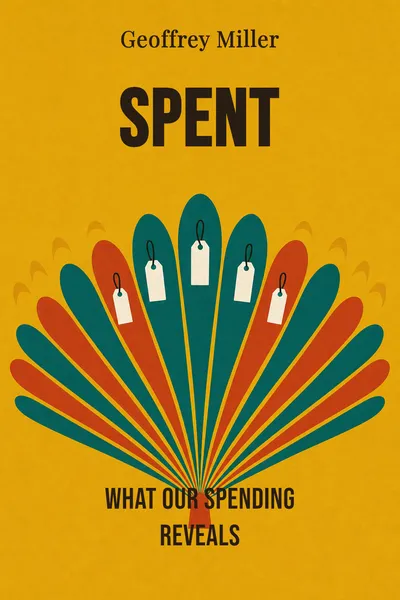
Spent
What our spending reveals
Description
There is a moment in every car showroom that the salesperson knows better than the buyer does. A man in his thirties runs his hand along the hood of something with too much horsepower for a commute, and somewhere behind his own eyes a calculation is running that he would never say out loud. Not miles per gallon. Not resale value. Something older and less flattering: who will see me in this, and what will they think I am. Geoffrey Miller, an evolutionary psychologist, built an entire book around that flicker of self-deception, and around the uncomfortable idea that most of what we buy is aimed at an audience we barely admit exists.
His argument in Spent, published in 2009, is deceptively plain. The goods and services we chase are not really about the goods. A sports car, a designer bag, a Rolex, a degree from the right school — Miller reads them as advertisements. Not for the product, but for us: signals broadcasting our intelligence, our health, our conscientiousness, our warmth, to the mates and friends and rivals whose regard we're wired to want. Marketing, in his telling, isn't manipulating some blank consumer. It's hijacking display instincts that were shaped long before shopping malls, and that we mostly can't see working.
What makes the book more than a clever debunking is where it lands. If consumption is a courtship display running on ancient hardware, then it's spectacularly bad at its own job — expensive, wasteful, and easy to fake. Miller isn't content to explain the trap. He wants to know why such smart animals fell into it, and whether naming the instinct lets us climb back out.
The question we’re asking : If most of what we buy is a signal to other people, what exactly are we trying to say — and why do we so rarely notice?What we’ll see : How an evolutionary psychologist reads the shopping cart as a courtship display, and where that reading leaves us.
Table of contents
01Chapter 1 — The peacock at the dealership
Miller starts from a biological puzzle that has nothing to do with money. The peacock's tail is a disaster of survival engineering — heavy, conspicuous, a gift to predators. It persists because it is honest advertising. Only a genuinely healthy, well-fed bird can afford to grow and drag around something that useless. The cost is the point. A signal that cheats can afford to send is a signal nobody trusts. Biologists call this the handicap principle, and Miller's move is to walk it straight into the parking lot of a luxury dealership.
A high-end car, he argues, works exactly like the tail. It's expensive precisely because expense is the message. Anyone can claim to be successful, disciplined, and sexually desirable; far fewer can burn forty thousand dollars proving it. The purchase becomes a costly signal — a way of saying something about oneself that would be worthless if it were free to say. And because it's aimed at other humans, its real value lives entirely in their eyes. Park the car in a garage nobody visits and most of its point evaporates.

02Chapter 2 — Six numbers under every purchase
If our purchases are signals, the next question is what, specifically, they're signaling. Here Miller leans on one of the more durable findings in personality psychology: that human variation sorts fairly cleanly along a handful of dimensions. There's general intelligence, and then the five broad traits researchers call openness, conscientiousness, extraversion, agreeableness, and stability. Six numbers, roughly, that capture much of what makes one person different from another — and, Miller argues, much of what we're desperate to advertise to potential mates and allies.
The trick marketers have stumbled onto, in his account, is selling products as proxies for these traits. A stack of unread literary novels signals openness. A relentlessly tidy, gadget-optimized kitchen signals conscientiousness. Loud clothes and a convertible signal extraversion; charity galas and fair-trade coffee signal agreeableness. We buy the object hoping to transmit the trait — hoping the audience will infer the invisible quality from the visible purchase. The bag stands in for the intelligence, the running shoes for the discipline.
03Chapter 3 — The self we can't actually buy
Once the display machinery is exposed, Spent turns to the emotional residue it leaves behind. If a purchase is a bid for others' regard, and if the regard it wins is thinner than promised, then the familiar deflation after a big buy isn't a personal failing. It's structural. The object delivered a jolt of anticipated status and then quietly failed to convert into the recognition we were actually hungry for. We wanted to be seen a certain way; we got a possession instead.
Miller reads the treadmill of consumer dissatisfaction through this gap. Advertising, he argues, works by promising the trait rather than the object — not a fragrance but the confidence and desirability the fragrance implies. What arrives is the fragrance. The trait was never in the bottle, because traits live in behavior and character, not in packaging. So we return to the market for the next fix, chasing a self-image that no product can deliver because no product was ever the right vehicle for it.
04Chapter 4 — Naming what we're really shopping for
Step back from the individual shopper and Spent starts to look like a critique of an entire economic logic. If a huge slice of consumer spending is fitness display in disguise, then a large fraction of the modern economy is devoted to helping people signal traits they may not have, to audiences who increasingly distrust the signals. That's an enormous machine running at low honesty and high cost. Miller's evolutionary lens turns waste from a moral complaint into a design flaw — a mismatch between ancient display instincts and an environment built to exploit them.
The provocative part is his suggestion that we could signal the same things far more cheaply. If what we're broadcasting is intelligence, openness, warmth, and conscientiousness, there are honest channels for all of them that require no purchases at all — conversation, creativity, generosity, sustained attention to the people around us. Miller floats deliberately radical ideas, including taxing conspicuous consumption rather than income and letting people display their qualities directly, on the reasoning that the display arms race, like the peacock's tail, imposes real costs while producing no net gain in who ends up admired.
05Conclusion
Return to the showroom, and the flicker behind the buyer's eyes reads differently now. It was never really about the car. It was a social animal trying to say something true about itself — that it's healthy, capable, worth choosing — using the only vocabulary the surrounding culture handed it. Miller's achievement in Spent is to make that vocabulary visible without sneering at the speaker. The desire underneath is old, honest, and shared by everyone who has ever wanted to be admired.
Related books