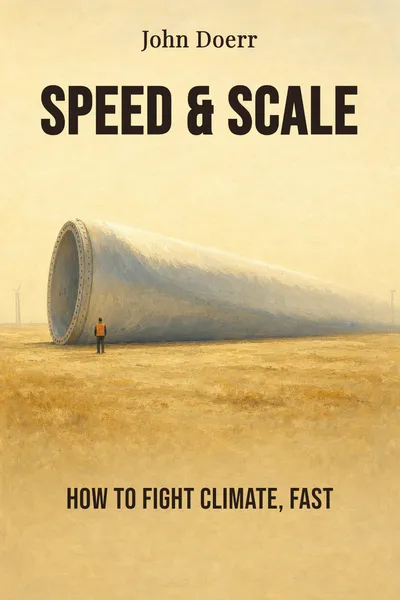
Speed & Scale
How to fight climate, fast
Description
In 2006, John Doerr's teenage daughter came home from a dinner where he'd been talking about climate change with friends, and told him something that stuck. Her generation, she said, was going to inherit this mess — and it was on his to fix it. Doerr is a venture capitalist at Kleiner Perkins, the man who wrote early checks to Google and Amazon, and he had spent his career backing the kind of bets that reshape industries. He took the comment as a brief. Over the next fifteen years he poured money into clean tech, watched much of it burn, learned hard lessons about why good technology alone doesn't win, and eventually distilled the whole effort into a single method.
That method arrived in 2021 as a book called Speed & Scale. It is not a lament and not a manifesto. It is closer to an operating plan — the same tool Doerr had used to help companies grow, now aimed at the atmosphere. The world emits roughly 59 gigatons of greenhouse gases a year. The plan sets out to drive that to net zero by 2050, and it does so with an unfashionable insistence on numbers: what to cut, by how much, by when, and who is on the hook. There is no comfort in it, but there is a strange calm in seeing a problem this large broken into things a person can actually track.
What makes the book worth sitting with is less any single technology and more the temperament behind it. Doerr treats the climate crisis the way an investor treats a portfolio in trouble — coldly, urgently, without pretending the deadline is negotiable. He talked to scientists, founders, and heads of state, and came back with a framework rather than a sermon.
The question we’re asking : Can the management logic that scaled the internet be turned on a warming planet — and reach net zero in time?What we’ll see : How Doerr converts an overwhelming crisis into measurable targets, the levers that make them move, and what it means to run the atmosphere like a company in trouble.
Table of contents
01 Chapter 1 — The engineer's instinct: measure, then move
Doerr trained as an electrical engineer before he became an investor, and the reflex never left him. Early in his career at Intel he learned a management system from Andy Grove that would shape everything after: OKRs, or objectives and key results. An objective is what you want to achieve. Key results are the measurable milestones that tell you, honestly, whether you're getting there. Doerr later carried the method into the startups he funded — it's the discipline behind much of what Google became. Speed & Scale is, at bottom, the climate crisis rewritten as one enormous OKR.
The appeal of the approach is that it refuses vagueness. Pledges to "do better" or "go green" are exactly the kind of soft commitment the method is built to expose. A key result has a number and a date attached, or it isn't one. So the book opens not with imagery of melting ice but with arithmetic: roughly 59 gigatons of greenhouse gas emitted each year, and a single overarching objective — get to net zero by 2050, with emissions roughly halved by 2030 to stay on track. Everything else in the book hangs off that spine.

02 Chapter 2 — Six objectives that redraw the emissions map
To make 59 gigatons legible, Doerr breaks total emissions into six sectors, each with its own objective and its own hard number. The first is how we move: transportation accounts for something like 8 gigatons a year. The key results here are the ones most people already sense — electrifying cars, trucks, buses, and eventually the harder cases of shipping and aviation, alongside the price parity that makes an electric vehicle the obvious buy rather than the virtuous one.
The largest single chunk is electrifying the grid, responsible for roughly 24 gigatons — by far the biggest slice, because so much else depends on it. Clean up how electricity is generated, shifting from coal and gas to solar, wind, storage, and firm low-carbon sources, and you also clean up every car and heat pump that plugs into it. Doerr sets targets for retiring coal, scaling renewables, and building the storage that makes an intermittent grid reliable. The third objective, fixing food, is the one people underestimate: agriculture and land use emit around 9 gigatons, from cattle, fertilizer, food waste, and deforestation.
03 Chapter 3 — The accelerants that decide whether it works
The six objectives describe what has to change. But Doerr's harder-won insight, paid for in the clean-tech losses of the late 2000s, is that good targets don't move on their own. So the plan adds four accelerants — the forces that determine whether the six objectives happen fast enough to matter. The first is policy and politics. Governments set the rules, and the single most powerful lever, in Doerr's telling, is pricing carbon so that the damage it does shows up in its cost. Add subsidies for clean alternatives, an end to fossil-fuel supports, and mandates with real deadlines, and the market starts pulling in the right direction rather than against it.
The second accelerant is movements. Voters, workers, and especially the young change what is politically possible; the pressure that makes a government act rarely originates inside the government. Doerr, whose own daughter set him on this path, treats public will not as a nice-to-have but as a mechanism — the thing that moves policy, which moves everything else. Corporate behavior sits here too, since employees and customers now push companies toward commitments they wouldn't make unprompted.
04 Chapter 4 — When management thinking meets a planetary problem
Strip Speed & Scale down and what remains is a wager: that a problem which has resisted decades of appeals to conscience might yield to a problem-solving culture that scaled the internet. Doerr is importing the operating logic of Silicon Valley — measurable goals, radical accountability, ambitious targets held to hard dates — into a domain that has mostly been addressed through treaties, warnings, and moral pressure. The bet is that the atmosphere doesn't respond to sermons, but it might respond to a plan that names numbers and asks, bluntly, who is behind on theirs.
There's real force in that move. Much climate discourse drifts into fatalism or vague virtue, and the OKR discipline cuts against both — it makes falling short visible rather than deniable, and it turns paralysis into a task list. Doerr's insistence that we've been solving the wrong-sized problem, fussing over individual habits while the grid and heavy industry emit the bulk of the carbon, is exactly the kind of clarity the framework is built to produce.
05 Conclusion
The book that grew out of a teenager's challenge to her father ends where it began: with a deadline and a demand to be honest about whether we're meeting it. Doerr never promises the plan will work. He offers something narrower and more useful — a way to know, at any given moment, whether the world is on track or falling behind, sector by sector, year by year. The numbers he lays out are large enough to frighten and specific enough to act on, which is the whole point.
Related books