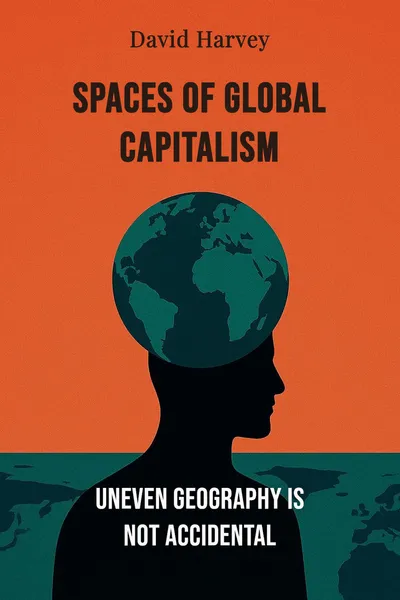
Spaces of Global Capitalism
Uneven geography is not accidental
Description
Stand at almost any border in the world and the ground itself seems to change. On one side, gleaming logistics parks and highways; on the other, a few miles away, wages a fraction as high and roads that give out at the edge of town. We tend to explain this the way development economists once did: some places got a head start, others are catching up, and given enough time and the right policies, the gap will close. David Harvey, the geographer who spent decades reading Marx through the lens of space, argues something colder and more interesting. The gap doesn't close because it isn't supposed to. In the essays collected as Spaces of Global Capitalism, he treats the world's jagged geography not as a leftover from the past but as something the present keeps producing, on purpose, all the time.
Harvey came to this through a specific problem. He'd trained as a geographer, then spent years trying to figure out why capital keeps building cities, freeways, factories, and then abandoning them — why Baltimore hollows out while Shenzhen explodes, why the same money that flees one region floods another. The standard economics had no good language for this. It treated space as a container things happened inside. Harvey's move was to put space at the center: capitalism, he says, doesn't just happen in a landscape, it produces its own.
That reframing turns a lot of familiar intuitions inside out. If uneven geography is a product rather than an accident, then the poverty of one region and the wealth of another aren't separate stories that happen to sit next to each other. They're the same story, told from two ends. And the constant churn — the boom towns, the rust belts, the special economic zones that appear from nothing — starts to look less like chaos and more like a machine doing exactly what it was built to do.
The question we’re asking : If poor and rich regions are two ends of one process, what is that process actually doing when it makes the world uneven?What we’ll see : How a geographer reading Marx came to see the map of global wealth as something capital draws, wrecks, and draws again.
Table of contents
01Chapter 1 — The fix that keeps moving
Harvey's starting point is a puzzle he calls the problem of surplus absorption. Capitalism, to keep going, has to reinvest its profits — money that just sits still stops being capital. But there's only so much you can plow back into making more of the same thing before the market chokes on it. So the system is under permanent pressure to find new outlets: new products, new markets, and above all new places. This is where geography stops being background and becomes the answer to an economic question.
One of the main outlets, in Harvey's account, is the built environment itself — roads, ports, rail, office towers, whole cities. When there's too much capital and nowhere profitable to put it, it gets poured into concrete and steel. He calls this the spatial fix, a phrase that carries a deliberate double meaning. Fix as in solution: the surplus finds a home. And fix as in fixed in place: that money is now locked into a bridge or a factory that can't be picked up and moved.

02Chapter 2 — Money looking for a place to land
To understand why the fix keeps moving, Harvey borrows and extends Marx's idea of the circulation of capital — the loop where money buys labor and materials, makes commodities, sells them for more money, and starts over. In a purely local economy that loop runs in one place. But the loop generates surpluses faster than any single place can absorb, and it produces bottlenecks: a glut of goods here, a shortage of investment there, capital piling up in one region with nowhere useful to go.
The release valve is geographical expansion. Surplus capital in a saturated market can be sent abroad, lent to build infrastructure in a poorer country, invested in a region where labor is cheaper and returns are higher. Harvey reads much of the history of imperialism and globalization through this lens — not as national ambition alone, but as the system's need to export its overaccumulation before it turns into a domestic crisis. The money isn't just seeking adventure. It's fleeing a corner it painted itself into.
03Chapter 3 — The map capital draws and redraws
Put the pieces together and you get Harvey's central concept: uneven geographical development. The world's map of wealth and poverty is not a snapshot of who ran the race well and who ran it badly. It's the living output of capital continuously investing in some places and withdrawing from others, building up and tearing down, in a rhythm that never settles.
Crucially, the winners and losers aren't fixed. A region that draws capital in and booms becomes, over time, expensive — its land, its wages, its infrastructure all cost more. That very success eventually makes it less profitable than somewhere cheaper and hungrier. So capital starts eyeing the exit even as the boomtown celebrates. Meanwhile the region that was drained sits there with cheap labor and cheap land, which is exactly what makes it attractive for the next wave. Decline, in this system, is what prepares a place to be developed again.
04Chapter 4 — Difference isn't a flaw, it's fuel
Step back from the mechanics and the deeper claim comes into view: capital doesn't tolerate geographical difference, it requires it. A world that was uniformly rich, with the same wages and the same costs and the same regulations everywhere, would offer capital nowhere better to go. The higher return that draws investment across a border only exists because the two sides of that border are unequal. Erase the difference and you erase the motive to move.
So the system is constantly manufacturing the very unevenness that development is supposed to be curing. It needs a low-wage frontier, a place with looser rules, a region desperate enough to compete for the factory nobody else wants — and when one such place develops and its advantages evaporate, capital doesn't celebrate the convergence. It goes looking for, or actively producing, the next cheap frontier. Harvey's uncomfortable conclusion is that global capitalism doesn't drift toward equality and stall. It produces inequality as a working condition, and reproduces it as fast as any given gap starts to close.
05Conclusion
Return to that border, and the miles between the logistics park and the failing road. Harvey's argument is that we've been reading the scene backwards. We saw two places, one ahead and one behind, and assumed the second was simply waiting its turn. What he offers instead is a single process with two faces: the wealth on one side drawing on the cheapness of the other, the boom and the bust cut from the same cloth, the frontier forever moving on once a place has grown too expensive to exploit.
Related books