

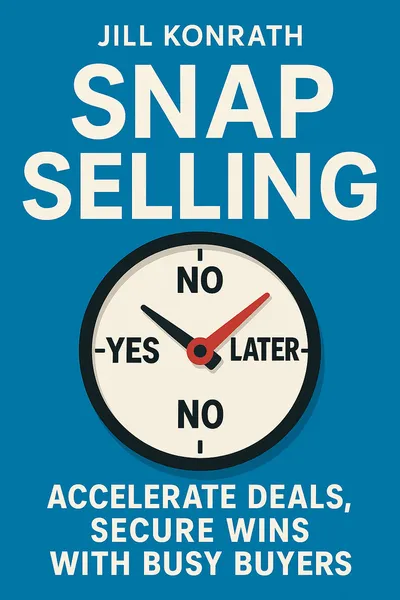
Snap selling
Accelerate deals, secure wins with busy buyers
Description
In today's fast-paced world, selling requires adapting to the decision-making processes of busy individuals. The SNAP approach focuses on simplifying choices, being invaluable by offering unique solutions, aligning closely with the prospect's needs, and emphasizing the urgency of your product or service. This method aims to make your proposition stand out as the best choice for their company, considering the potential disruption and time investment.
Sales success hinges on these principles, guiding prospects from initial contact to deal closure.
Table of contents
01Snap toolkit essentials
In the current fast-paced business environment, achieving success in sales requires a comprehensive and professional sales toolkit. This toolkit must consist of four critical elements to effectively cater to the needs of today's overburdened individuals. These individuals are constantly attempting to squeeze an increasing number of tasks into their finite schedules, which leads to a state of being perpetually frazzled.
As a result, they exhibit a range of behaviors: - They are eager to quickly grasp the essence of any information to determine its worthiness of their time. - They are prone to distractions, often multitasking during conversations. - They are cautious of anything that appears overly complicated or risky to make a swift decision on. - They feel inundated by the plethora of similar options available in the market. - They have high expectations, showing little patience for incompetence or imprudent actions from sellers.
To thrive in the realm of sales today, one must view the challenges faced by potential clients as opportunities for learning. It is crucial to understand the effective strategies when dealing with pressured and frazzled individuals. Additionally, it is imperative to facilitate the decision-making process for customers, enabling them to make prompt decisions and progress. Failure to do so may result in being relegated to the "D-Zone," a state where decisions are indefinitely delayed or postponed, leading to the seller being dismissed and forgotten.
When engaging with a prospective client who is under stress, they will internally pose four questions regarding the information presented to them: 1. Is the proposition simple, or will it require a significant amount of time and effort? 2. Does the individual or company offering the product or service provide added value? 3. Is the offering in line with the company's goals? 4. How urgent is the proposition, and where does it rank in terms of priority?

02Blueprint for snap sales
In the initial stages of engagement, the individual you are attempting to connect with will likely be under the impression that the interaction is proceeding smoothly. Throughout the course of your communication, they will be evaluating whether it is worthwhile to engage in a more substantial dialogue with you. To persuade them to take this step, you must transition them from a state of unawareness to one of intrigue.
It is a reasonable assumption that most people will enter any initial interaction with you harboring three fundamental preconceptions: they do not require any disruptions, they must safeguard their time at all costs, and they view salespeople as an utter waste of time. In practical terms, this means you are vying for their attention against a backdrop of pressing deadlines, urgent problems they are attempting to resolve, and a myriad of other commitments. If you present yourself as a self-interested seller whose sole focus is on securing an order, they will have no interest in engaging with you. To gain access to their valuable time, you must spark their curiosity and stimulate their thought processes. To add to the challenge, you must accomplish this within the confines of brief interactions—be it a twenty- to thirty-second conversation, a ninety-word email, or a one-page letter.
Jill Konrath emphasizes that every few seconds, your prospects are internally questioning whether the information presented is of interest to them. If it fails to capture their attention, you risk being dismissed. Prospects are known to sift through emails with their fingers poised over the delete button and their skepticism at full alert. The moment you come across as irrelevant or self-serving, you risk being disregarded.
The four SNAP factors can significantly influence this initial decision in the following ways: If you do not encapsulate a straightforward and focused message within your communications, you will be summarily rejected. Prospects are actively searching for reasons to decline right from the outset, and any material that is overly complex will prompt that reaction every time.
You will not gain access to individuals unless your message is imbued with value—it must resonate with the prospect's needs, challenges, or goals. If you demonstrate an understanding of their situation, they may be inclined to engage further. Conversely, if you resort to a generic sales pitch, you will be deemed unworthy of their time.
It is imperative to align your message with the concerns of the prospect. Failure to remain ruthlessly relevant will result in your dismissal. The key to gaining access lies in your ability to connect with the priorities of the individual or their organization from the outset, thereby significantly increasing your chances of securing their time.
Overall, gaining access is about crafting the perfect thirty-second conversation, ninety-word email, or one-page letter. It is not about devising a generic speech filled with boastful self-promotion, technical jargon, or creative nonsense. If you inundate your initial approach with the type of excessive language and verbosity typical of traditional salespeople, access will be denied.
Keep in mind that these prospects are overwhelmed with more responsibilities than they wish to handle. To gain access to their time, you must present a compelling value proposition. "Frazzled customers are indifferent to your sales pitch. They are resistant to change because change represents additional work. To gain access, you must highlight a gap between the prospect's current situation and potential improvements. Your targeted prospects need to realize that there are alternatives they have yet to consider—options that could simplify their lives, save them money, or help them achieve seemingly unattainable goals."
In practice, this is not the moment to boast about your capabilities. To gain access, you must articulate a value proposition that aligns with the prospect's objectives. When your value proposition is on point, everything else falls into place. Regrettably, there is no "universal" value proposition that appeals to all. However, there is a formula that is worth employing: Value Proposition = Business Driver + Movement + Metrics For example, "We assist data centers in reducing their power and cooling energy consumption by 13 to 79 percent," or "We aid companies in boosting their lead conversion rates while optimizing their marketing expenditures." Effective value propositions concentrate on business drivers that prospective customers recognize as significant and then illustrate achievable shifts from the status quo. Incorporating verifiable figures enhances credibility and underscores potential improvements, particularly when supplemented with case studies and examples. By interviewing your existing customers to determine the tangible differences you can claim, you can incorporate these into your value proposition and utilize it in every email, phone call, and voicemail you leave. The real impetus for gaining access to decision-makers will be trigger events—both internal and external: An internal trigger event might include disappointing quarterly or annual financial reports, the introduction of a new product, changes in ownership, significant acquisitions, or new contracts, among others. External trigger events could encompass natural disasters, legislative changes, the emergence of a formidable new competitor in the market, general economic conditions, and so on.
As you analyze your customer base, you can identify trigger events that are pertinent to other companies who may seek your product, service, or solution as a result of those events. There are various information services available that can automate your search for trigger events, such as: RSS feeds from websites. Google alerts for newly posted information. Subscription alert services like InsideView.