
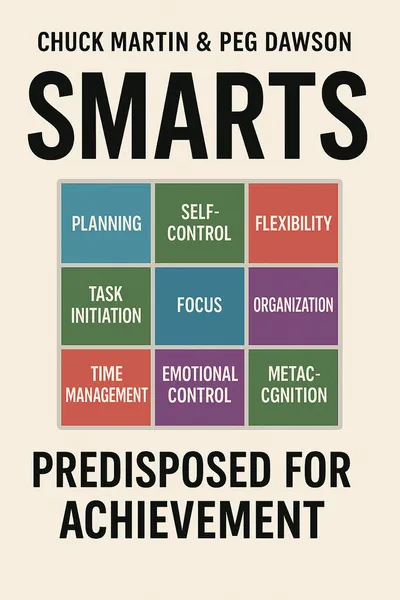
Smarts
Predisposed for achievement
Description
When individuals understand their executive skill strengths and weaknesses, they can better align their abilities with suitable jobs and tasks. This increases productivity, quality, employee retention, and overall success.
Organizations that evaluate executive skills when hiring and assembling teams gain a competitive edge. They have more efficient meetings and smoother execution of ideas.
Overall, matching people's natural strengths to job roles reduces workplace stress. The effects are enormous for both individuals and entire companies. With this knowledge, people can leverage their talents fully. And organizations can build effective, collaborative teams.
Table of contents
01 Exploration - assess your own executive skills profile and those around you
To optimize your executive skills, it's essential to evaluate yourself to understand where you excel and where you may need improvement. This self-awareness can guide your career development and enhance your collaboration with colleagues.
By assessing your proficiency in twelve key areas, you can identify your primary strengths and weaknesses. Rate each statement on a scale from one to five, where one means you strongly disagree and five means you strongly agree. After evaluating five statements per skill, calculate your score out of a maximum of 25 for each area.
Focus on the two or three highest and lowest scores to create your executive skill profile, which can inform how you approach your job, plan your career, and consider new directions.
Self-Restraint involves thinking before you act, avoiding impulsiveness. If you're methodical and not hasty, you likely score high in this area. Consider how often you take time making decisions, act tactfully, think before speaking, verify facts before acting, and avoid making others uncomfortable.
Working Memory is the ability to retain information while managing multiple tasks. If you can remember details without needing lists, your working memory is likely strong. Reflect on how well you remember facts, commitments, and tasks, maintain focus on goals, and keep the big picture in mind when busy.
Emotion Control is about keeping emotions from interfering with work. High emotion control means staying positive and not succumbing to self-doubt, while low control may indicate sensitivity to criticism. Assess how well you manage emotions at work, handle confrontations, stay focused despite frustrations, control anger, and set aside personal feelings until tasks are completed.

02 Application - strategy #1 - leverage your strengths and ignore your weaknesses
Strong leadership capabilities are essential for executives aiming for the C-suite, as organizations value leaders who can motivate, understand people, and make sound decisions in uncertain times. Reflecting on one's leadership journey, identifying strengths and areas for development is crucial. Taking on leadership projects, volunteering, or pursuing leadership courses or an executive MBA can enhance these skills.
Communication and presentation skills are also vital, with effective communicators seeking feedback and observing admired leaders to improve. Change management is another critical skill, focusing not only on personal advancement but also on developing team members to strengthen the organization.
03 Application - strategy #2 - use profiles to better manage others
Understanding the strengths and limitations of individuals within your organization is crucial for setting realistic goals and achieving success. By recognizing these capabilities, you can implement programs to enhance executive skills, focusing on amplifying strengths rather than overcoming weaknesses.
To improve someone's weakest executive skill, there are two main approaches. The first involves changing the individual's behavior, which requires significant effort on their part. Although major changes are unlikely, even small improvements can be enough to address immediate concerns. This behavioral change typically follows a five-step process:
1. Pinpointing a specific weakness and understanding its significance. 2. Developing a detailed action plan with clear steps. 3. Identifying additional resources or support. 4. Setting a start date and review schedule for the changes. 5. Evaluating progress at a predetermined time, potentially with consequences for non-compliance to add weight to the assessment.
04 Application - strategy #3 - match tasks to appropriate profiles
Creating a skills profile for a project or assignment is similar to developing one for an individual. It helps us understand the necessary skills for success in a given task. This approach allows us to identify the most suitable candidates for specific projects by aligning their strongest executive skills with the project requirements. This, in turn, enhances productivity and job satisfaction.
For example, a project that requires observation, emotion control, and stress tolerance in a competitive environment needs candidates with these specific strengths.
When considering a candidate for a project, it's crucial to assess whether their executive skills align with the project's needs. For instance, Candidate A, who thrives in dynamic environments with short-term goals, may not be the best fit for a project requiring strong time management and self-restraint. This mismatch could lead to challenges despite the candidate's suitability for high-pressure, fast-paced roles.
05 Application - strategy #4 - align your skills with marketplace values
Companies often have an official set of values that may differ from the unofficial values that actually drive decisions on compensation and promotions. To position yourself for career success, pay attention to what your company truly rewards, even if it contradicts the official messaging. Then develop strategies to align your strengths with those core values.
For example, a company may claim to prioritize work-life balance while routinely promoting those working 60-70 hours per week. This reveals that, despite public statements, productivity is highly valued. Likewise, examine budget allocations and executive reactions to understand what your company really values.
Once you identify the truly valued skills, you can tailor your approach. For a company focused on creativity and innovation, flexibility and observation will be key. Research and development roles will be prominent, as will new business development. In a production and delivery oriented company, the emphasis is on execution and timely finished products. Here, task initiation, achieving goals, and time management are critical.
06 Application - strategy #5 - address cognitive bandwidth limitations
Managing cognitive overload is essential for maintaining productivity and achieving success in the workplace. When overwhelmed by competing demands, our ability to plan, prioritize, and manage distractions is compromised. However, there are effective strategies to counteract this.
One approach is to discuss with your manager the possibility of adjusting deadlines and spacing out intensive projects. It's also beneficial to alternate between challenging and lighter tasks when feasible.
Creating a schedule for interruptions and informing others of your need for focus time can significantly improve concentration. Blocking off periods for deep work is another effective strategy. It's crucial to avoid pursuing conflicting goals and to ensure that your priorities align with those of leadership. Setting realistic expectations and negotiating for the necessary time and resources to deliver quality work can also alleviate pressure.
Implementing filters and delegating communication tasks can help manage incoming messages, reducing the need to respond instantly and eliminating unnecessary emails. Setting limits on commitments and focusing on doing fewer tasks well, without overpromising, can enhance the quality of work. Incorporating regular breaks and scheduling low-effort tasks can serve as a mental reset, aiding in rejuvenation.
Related books