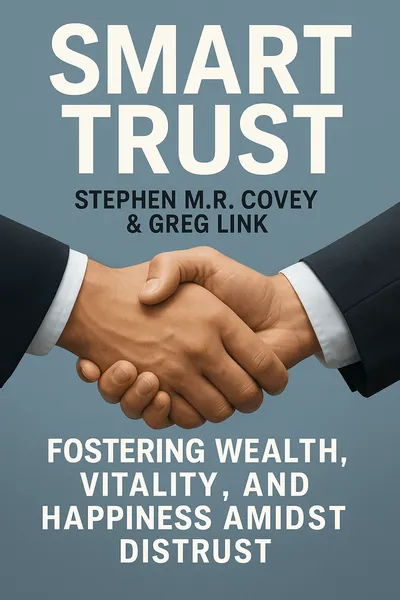
Smart trust
Fostering wealth, vitality, and happiness amidst distrust
Description
Trust is essential for efficient commerce, enabling more achievements with less risk. In a world where trust is scarce, "Smart Trust" offers a solution by combining a willingness to trust with thorough analysis to ensure it's justified.
This approach allows for the extension of trust in business relationships, fostering a cycle of prosperity, energy, and joy. Smart Trust, advocated by Stephen Covey and Greg Link, is crucial for leaders in any field to initiate, promising significant benefits through the cultivation of trust.
Table of contents
01Understanding smart trust significance
In the contemporary landscape, the concept of Smart Trust emerges as a beacon of strategic wisdom, advocating for a deliberate and thoughtful decision to place trust in others, thereby acting in accordance with this trust.
This approach necessitates the optimization of two pivotal factors: firstly, a pronounced propensity and inclination towards trusting others, and secondly, a rigorous analysis that substantiates the trustworthiness of the other party.
As eloquently articulated by Warren Buffett, trust operates much like the air we breathe—its presence often goes unnoticed, yet its absence is keenly felt by all.
In today's world, marked by a pervasive low-trust environment, the findings of numerous Gallup surveys consistently reveal a declining trend in the public's trust in their counterparts to act ethically and responsibly. This alarming trend underscores a broader crisis of trust within society at large.
Such a crisis is particularly lamentable given the critical role of trust as the new currency in the global economy. Trust serves as the foundational principle that facilitates market operations. When trust diminishes, the cost of conducting business escalates, individuals become disengaged and less inclined towards innovation, and relationships across various domains suffer a decline in dynamism.
Trust, therefore, emerges as a potent principle of power, with a direct correlation between the level of trust and the degree of influence one possesses.
Despite the prevailing crisis of trust, certain organizations and individuals have managed to thrive by consciously choosing to cultivate a high-trust environment. Notable examples include Zappos and Muhammad Yunus, the visionary founder of Grameen Bank, who have demonstrated the liberating and financially rewarding nature of operating within a trust-centric framework. Similarly, corporations such as Wipro and Lego are actively endeavoring to foster cultures of high trust.

02Five steps to foster smart trust
The decision to place one's trust in others, whether on a personal or organizational level, marks the commencement of a significant journey. For some individuals, this act comes naturally, while others find it to be a challenging endeavor.
A common preconception exists that trust is an idealistic notion, particularly within the context of the modern business landscape, which often seems incompatible with such values. However, upon examining individuals, teams, and organizations that operate with a high level of trust and productivity, it becomes evident that trust is underpinned by three fundamental beliefs.
Firstly, there is the conviction that being deemed trustworthy is beneficial and adds value to one's endeavors. Secondly, there is the understanding that the majority of people are inherently trustworthy, and it is unjust to let a small untrustworthy minority define the overall perception of trustworthiness. This perspective is exemplified by companies like Google, which empowers its employees to allocate 20 percent of their time to personal projects, and Netflix, which operates on the belief that its subscribers will return DVDs after watching them. Lastly, there is the belief that leading with trust yields superior outcomes, as demonstrated by BestBuy.com's significant increase in productivity following the implementation of flexible working hours for its employees.
03Crafting a personal trust renaissance
Margaret Mead, a renowned cultural anthropologist, once said: "Never doubt that a small group of thoughtful, committed citizens can change the world. Indeed, it is the only thing that ever has." This statement highlights a fundamental reality: revolutions start with just a few individuals. These small groups have the power to bring about significant social transformations and alter the course of history.
Consider, for example, an event that took place around thirty years ago in Xiaogang, China. In this secluded village, eighteen destitute farmers secretly gathered and made a pact. They divided the communal land into individual parcels, allowing each household to benefit from their own labor and success. This was a revolutionary act that challenged established rules and communal culture. The participants risked severe consequences, including persecution and even execution. However, their initiative succeeded and caught the attention of Deng Xiaoping, the Communist Party leader. His subsequent economic reforms changed the course of Chinese history.
Today, what we urgently need is a revival of trust, and it starts with each individual. Once initiated, the impact of trust is unpredictable, but fostering Smart Trust leads to positive outcomes.
Related books