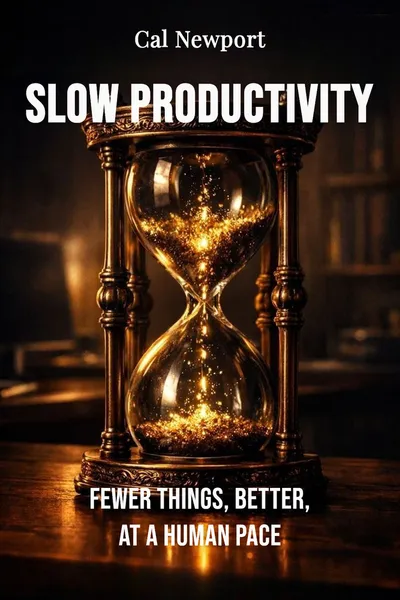
Slow Productivity
Fewer things, better, at a human pace
Description
Sometime in the early days of remote work, a lot of us noticed a strange new pressure: the green dot. On Slack, on Teams, on Microsoft's little status light, a circle turned green when we were online and grey when we weren't — and staying green became, quietly, a full-time job. Cal Newport, a computer science professor at Georgetown who has spent fifteen years writing about focus and attention, watched knowledge workers organize their days around looking available rather than around producing anything. He gave the habit a name in his 2024 book, Slow Productivity: pseudo-productivity. Activity as a stand-in for accomplishment. Motion mistaken for progress.
His argument starts from an awkward observation. For most of history, work had a visible output — bushels harvested, cars assembled, words typeset — and you could measure a person by what came off the line. Knowledge work broke that. When the product is a strategy, a report, a piece of code, there is no obvious way to tell who is contributing and who is coasting. So around the middle of the twentieth century, offices reached for the only crude proxy available: visible effort. Be at the desk. Answer the email. Attend the meeting. Keep the dot green.
Newport thinks that proxy has quietly become a disaster — for output, and for the people producing it. Slow Productivity is his attempt to replace it, not with a hack or a morning routine, but with a different definition of what productive knowledge work even looks like. It is a small book with a stubborn thesis: the way we've been working isn't just exhausting, it's also, by its own measure, not very good.
The question we’re asking : If busyness is a fake measure of knowledge work, what would a real one look like?What we’ll see : Newport's case against pseudo-productivity and the three principles he offers to replace it — drawn from how accomplished people have actually worked.
Table of contents
01Chapter 1 — The invention we mistake for work
Newport's central move is to show that our idea of productivity is younger and shakier than it feels. On a factory floor, productivity has a clean definition: units produced per hour of labor. It's countable, and improving it is the whole science of industrial management. Knowledge work inherited the word without inheriting the arithmetic. There is no unit. A marketer, an editor, a software engineer produces things that resist being tallied by the hour, and much of the value arrives in unpredictable bursts after long stretches of apparently doing nothing.
Faced with a metric they couldn't compute, organizations improvised. If we can't see the output, Newport argues, we'll settle for seeing the effort — and effort, in an office, means visible activity. This is pseudo-productivity: the use of visible busyness as a proxy for useful work. It explains an enormous amount of modern office life. The performative reply-all. The meeting that exists to demonstrate that a project is alive. The instinct to answer a message within minutes so that no one wonders what we're doing.

02Chapter 2 — Do fewer things
The first principle is the one people resist most, because it sounds like an excuse to slack. Do fewer things. Newport is careful about what he means. He is not arguing for accomplishing less over a career — he is arguing for doing fewer things at once. The distinction is everything. Every project we take on carries an overhead cost: the emails, the check-ins, the context-switching, the mental tab left open. Pile up enough of those and the overhead alone consumes the day, leaving no room to actually execute anything.
He borrows a striking example from the history of science. Isaac Newton spent roughly two decades circling the ideas that became the Principia, working in long, uninterrupted stretches, largely left alone. That kind of concentration is impossible if you're juggling nine active commitments and a full inbox. Newport's point isn't that we should all be Newton; it's that meaningful output has always required protecting a small number of important efforts from the swarm of small ones.
03Chapter 3 — Work at a natural pace
The second principle attacks the timeline itself. Pseudo-productivity assumes work should be relentless and uniform — the same steady output, every day, indefinitely. Newport argues this is not how any craft or intellectual tradition has ever actually produced its best results. Real accomplishment tends to be seasonal, uneven, punctuated by intensity and rest. The natural pace of good knowledge work is closer to a farmer's year than to an assembly line.
He reaches again into history to make the case feel less like self-indulgence. Georgia O'Keeffe spent long, quiet stretches in the New Mexico landscape before the productive bursts of painting. Newton's decades were mostly slow. Scientists and writers across centuries worked in rhythms that included fallow periods, and the fallow periods were not wasted — they were where the important ideas quietly assembled. The demand that every hour show measurable progress is a modern imposition, and a counterproductive one.
04Chapter 4 — Obsess over quality
The third principle is where Newport quietly ties the knot, and where the book steps back into a bigger claim about knowledge work itself. Obsess over quality. His argument is that the surest way out of the busyness trap is to care intensely about the caliber of what you produce — because quality, unlike busyness, is a thing you can genuinely stake a reputation on. And a reputation for quality is the only thing that buys a knowledge worker the leverage to do fewer things, more slowly, without fear.
This is the deeper structure of the whole book. The reason pseudo-productivity took hold, Newport insists, is that knowledge work never had an honest measure of effort, so it counterfeited one. Busyness filled a vacuum. But quality can fill that same vacuum with something real. When your work is unmistakably good, no one needs to watch the green dot to know you're contributing. The output speaks, and it speaks louder than any amount of visible activity ever could.
05Conclusion
The green dot, in Newport's telling, was never really about work. It was about a nagging anxiety unique to knowledge jobs: the fear that, since no one can see the output, we'd better make sure they can at least see us. Slow Productivity is his attempt to dissolve that anxiety at the root — not by working harder at looking busy, but by refusing the whole premise. Do fewer things, at a natural pace, and obsess over how good they are. Three principles, each of them a deliberate reversal of the instincts that pseudo-productivity trained into us.
Related books