Shadow Divers
Two divers, one deep mystery
Description
On September 2, 1991, a charter boat called the Seeker motored sixty miles off the New Jersey coast, following coordinates a fisherman had handed over almost as a favor. There was supposed to be nothing out there but sand and cold Atlantic water two hundred and thirty feet down — a depth where nitrogen turns the mind slippery and a diver has minutes, not hours. Captain Bill Nagle had chased leads like this for years. Most turned out to be rock piles or old barges. This one did not. When the divers reached the bottom, they found the unmistakable shape of a submarine, intact, sitting in the dark where the records said no submarine had any business being.
It was German — the hull, the layout, the torpedo tubes left no doubt. But no German U-boat was recorded as lost anywhere near that spot. The wartime archives, the meticulous German logs, the American Navy's own accounts all agreed: nothing sank here. And yet here it was, a steel tomb with the bodies of its crew still inside, sixty miles from a coast where families had spent summers swimming, unaware that the war lay just offshore, unmarked and unclaimed.
What followed was a six-year effort by a handful of amateur divers — men with day jobs, not historians — to answer a question the world's official records could not. It would cost some of them their lives, and others their marriages, their savings, and years they never got back. It turned an afternoon's dive into one of the strangest detective stories of the postwar era.
The question we’re asking : How could a German submarine end up on the floor of the Atlantic with no record, and who were the men still inside it?What we’ll see : A discovery no archive could explain, the brutal price of chasing it into the deep, and a years-long hunt to give the dead their names back.
Table of contents
01Chapter 1 — A wreck where no wreck should be
Bill Nagle was the kind of captain wreck divers followed and worried about in equal measure. He had a reputation, a drinking problem, and an instinct for the sea floor that verged on uncanny. When a scallop fisherman gave him coordinates for something snagging his nets far offshore, Nagle filed it away with dozens of other leads. Then, in late summer 1991, he loaded the Seeker with experienced divers and went to look.
The dive was near the edge of what the human body can survive. At two hundred and thirty feet on compressed air, nitrogen narcosis dulls judgment exactly when it matters most. Bottom time is measured in minutes, each of which must be repaid with long decompression stops hanging in open water while the body sheds dissolved gas. This was not sightseeing — it was a hostile environment that punished mistakes with paralysis or death.

02Chapter 2 — The cost of going down
Deep wreck diving in the early 1990s was closer to experiment than sport. The techniques for surviving beyond two hundred feet were being worked out by the divers themselves, often the hard way. Mixed gases, redundant tanks, penetration lines run into dark interiors — each was a solution to a way people had already died. The men on the Seeker knew this. They had seen it. And still they went, weekend after weekend, into a wreck that seemed determined to keep them out.
The submarine's interior was a maze of collapsed steel, silt, and tangled wiring, black beyond any light and narrow enough to trap a diver who lost his bearings. Recovering anything useful meant swimming inside — past the point where a straight ascent was possible, where a jammed line or a cloud of stirred silt could mean not finding the way out. Chatterton pushed deeper into the hull than most were willing to go, convinced that identifying evidence lay in the officers' quarters or control room, where names and papers might have survived.
03Chapter 3 — Naming the dead
The identification became a research project as demanding as the diving. Chatterton and Kohler could not simply consult a list, because the list said the wreck should not exist. So they went backward through the archives, testing every U-boat that might have ended up off New Jersey and ruling each out by where and how it was recorded lost. It was slow, frustrating work — libraries, correspondence, trips overseas, a world away from the ocean floor.
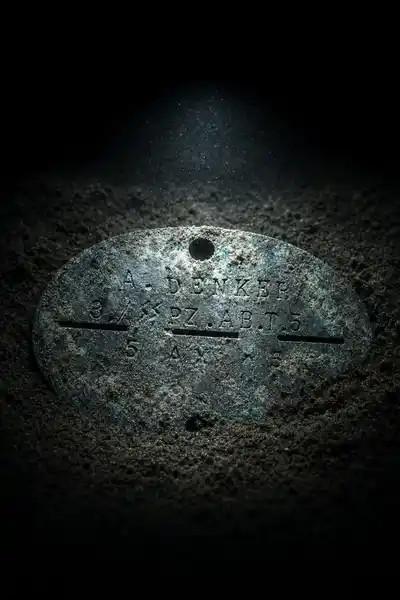
Physical evidence trickled up one artifact at a time: a knife with initials, equipment with a maker's stamp, a tag. Each item had to be matched against records, and each match narrowed the field without closing it. For years the divers accumulated pieces that suggested an answer but proved nothing conclusive. The German records they most needed had been damaged or destroyed, and surviving documents contradicted the very existence of the wreck they were standing on.
04Chapter 4 — What a mystery does to the people who chase it
Strip away the depth and the danger, and what remains is a story about the strange power a single unanswered question holds over people who cannot let it go. Chatterton and Kohler were not paid to solve U-869. No one asked them to. There was no reward beyond the answer itself. And yet the mystery organized years of their lives, cost them relationships and money, and repeatedly placed them somewhere they might not come back from. That kind of obsession is hard to justify from the outside — and it is also, the story suggests, what pushes difficult truths into the light.
The obligation they felt to the dead is the quietest and most durable part of the book. The men in the submarine had been misremembered, filed under the wrong ending. To the divers, that was not an abstraction; they had swum past the bones, seen the personal objects, understood that each set of remains belonged to someone. Identification was not a trophy. It was the act of correcting the record for people who could no longer correct it themselves — and of giving living families a truth they had been denied for half a century.
05Conclusion
The Seeker's coordinates had promised nothing but sand, and instead they led to U-869, a submarine misplaced by the very records built to track it. What began as an ordinary charter dive became a six-year descent into a question the world's archives could not answer — and it ended where such things rarely do: with a name, a place, and families told the truth at last.
Related books