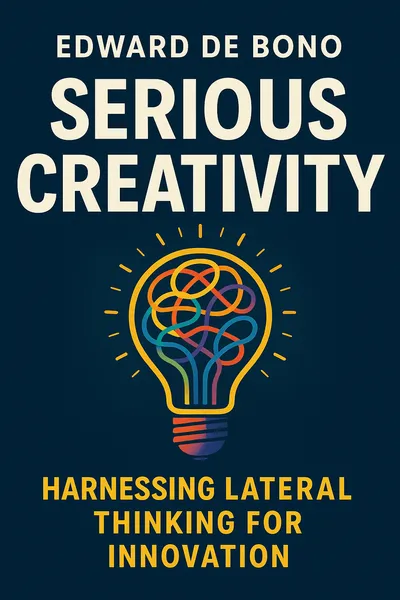
Serious creativity
Harnessing lateral thinking for innovation
Description
As the business landscape becomes more competitive, creativity emerges as a crucial element for companies to derive additional value from their existing resources.
Contrary to the common belief that creativity is an innate, almost mystical ability, or that individuals are either born creative or not, it is actually possible to cultivate creativity through lateral thinking. This approach to creative thinking, which can be learned and practiced by anyone, involves systematic methodologies, tools, and techniques.
Embracing serious creativity involves adopting a rational and logical method to foster innovative thinking. By mastering basic lateral thinking tools and techniques, anyone can generate fresh ideas.
In the future, the ability to think differently from competitors will be a key differentiator for successful individuals and companies, as serious creative thinking can lead to a lasting competitive edge.
Table of contents
01 Cultivating creative thought
Serious creativity is based on the idea that lateral or creative thinking is a deliberate and systematic technique for finding logical solutions to common business problems that have not been tried before. This type of thinking is a unique way of processing information. Many people mistakenly believe that being creative means disregarding structure or societal norms, suggesting that a creative person must be completely different from everyone else to come up with truly innovative ideas. However, serious creativity argues that lateral thinking techniques are a legitimate and systematic approach to solving business challenges, showing that creative thinking can thrive without the eccentricity often associated with a "mad scientist" or a "rogue element".
The world can be seen as a self-organizing system of information, where most people use the same patterns over and over again. The essence of creativity lies in the logic of these recurring patterns. The tools of creative thinking are designed to help individuals systematically develop new patterns of logic. Lateral thinking, which is synonymous with creative thinking, offers opportunities, competitive advantages, and benefits. Creativity is based on the concept of a hypothesis - an initial idea or speculation that needs to be evaluated against available data to determine if it is valid and applicable. A hypothesis introduces possibilities, but it should not be seen as the only correct pattern, as it may limit other creative possibilities.
Creativity can come from various sources, including innocence, where someone's lack of familiarity with standard approaches can lead to the discovery of better methods. Experience also plays a crucial role, as it allows individuals to build on past successes by incorporating additional features into known effective strategies. Motivation can be a source of creativity in fields where the status quo is widely accepted, potentially leading to unexpected innovative ideas. Tuned judgement enables individuals to recognize the potential of a project early on and contribute as needed to maximize its benefits. Chance, accidents, or mistakes can push us beyond our usual boundaries, leading to entirely new and often superior lines of reasoning. By using the systematic techniques and tools of lateral thinking, we can consistently generate new creative ideas.

02 Techniques for divergent thinking
Creative thinking is not solely the product of serendipity; rather, it can be systematically fostered through the application of specific, well-established techniques designed to enhance lateral thinking.
Among these methods, the concept of the Six Thinking Hats stands out as a particularly innovative approach. This method involves imagining six hats of different colors, each representing a distinct type of thinking that should be employed when the hat is metaphorically donned.
The white hat symbolizes neutrality, focusing solely on the dissemination of information without passing judgment. When wearing the red hat, one delves into the realm of emotions, discussing feelings, intuitions, and personal reactions without restraint. The black hat, symbolizing authority, encourages a cautious approach, scrutinizing every potential action for legal issues and logical inconsistencies. In contrast, the yellow hat radiates optimism, seeking out potential benefits and positive outcomes. The green hat, reminiscent of lush vegetation, signifies the growth of creative ideas and the exploration of new possibilities. Lastly, the blue hat offers a comprehensive overview of the thinking process, guiding and organizing the discussion.
This system not only facilitates creative thinking within corporate environments but also ensures a structured approach to problem-solving, allowing for the exploration of diverse perspectives in a non-confrontational manner.
Another pivotal technique in the arsenal of creative thinking tools is the practice of Focus. This involves zeroing in on a specific area that has been overlooked or neglected, with the aim of achieving a breakthrough by introducing innovative ideas.
Focusing entails directing attention towards aspects that typically do not require contemplation, pondering their purpose, potential improvements, and underlying assumptions. For instance, contemplating ways to simplify the programming of a video recorder, enhancing pedestrian safety at night, or improving customer service could all benefit from this focused approach.
03 Implementing creative strategies
In today's fiercely competitive landscape, the significance of creativity cannot be overstated for individuals and corporations alike. This truth is poised to become even more pronounced in the future, where innovative ideas will form the cornerstone of economic triumph.
Creativity finds its application in two primary domains: the everyday creativity that infuses creative thinking into the routine business approach, applicable across all scenarios, and the specific situation creativity that seeks a creative resolution to a particular challenge, necessitating a formal or deliberate ideation process.
When an organization is propelled by a genuine openness to novel ideas, creativity can thrive and become woven into the company's very essence.
Conversely, creativity tailored to specific situations demands a structured approach to yield practical creative solutions. This involves clearly defining the creative process's objective, establishing a company framework that allows the application of formal creativity techniques by individuals or groups, and devising a strategy for the evaluation and implementation of the generated ideas by the company.
Most businesses are capable of developing a Creative Hit List, which delineates the business areas in need of creative input. This list, a structured tool, fosters original and creative thought within any organization by including a variety of item types such as problems that, if resolved, could significantly enhance the company's operations, improvement tasks aimed at elevating operational efficiency or quality, major projects that the company is set to embark on, and whims/opportunities that focus on enhancing employee quality of life or capitalizing on untapped potential benefits.
Related books