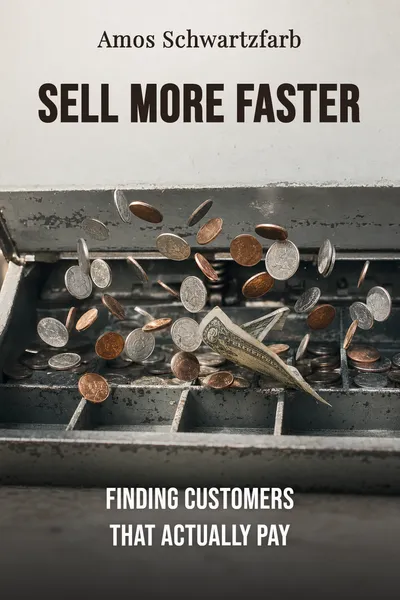
Sell More Faster
Finding customers that actually pay
Description
There is a moment every startup founder knows, even if nobody warns them about it. The product works. The demo goes well. A few people even sign up. And then the growth chart flattens into something that looks less like a hockey stick and more like a heartbeat that has decided to stop. The money runs out faster than the learning arrives. According to most post-mortems founders give about their own dead companies, the culprit is almost always the same: they never grew revenue early enough, or fast enough, to earn the right to keep going.
Amos Schwartzfarb has watched this happen more times than he can count. As Managing Director of Techstars Austin — part of the mentorship-driven accelerator that has invested in and coached thousands of companies — he sits across the table from founders who are brilliant about their technology and strangely vague about their customer. They can describe the feature roadmap for an hour. Ask them who pays, what those people actually buy, and why, and the room goes quiet. His book, Sell More Faster, is his attempt to make that quiet impossible.
The wager is almost stubbornly simple. Selling is not the thing you do after you've found product-market fit. Selling is how you find it. Every dollar a real customer hands over is a signal, and the founders who survive are the ones who learn to read those signals early, honestly, and on purpose — before the runway disappears underneath them.
The question we’re asking : Why do so many startups with working products still fail to find customers who actually pay — and what would it take to change that?What we’ll see : How one Techstars veteran turns selling from a late-stage afterthought into the earliest, sharpest way a company learns who it's really for.
Table of contents
01Chapter 1 — The revenue problem hiding behind product-market fit
"Product-market fit" is one of those phrases everyone in startups repeats and few can define. It floats around pitch decks like a spell. Schwartzfarb's discomfort with it is practical: the term is usually treated as a destination you arrive at one morning, when in reality it's something you grope toward, wrong turn after wrong turn, usually while burning money. His preferred framing is more useful — product-market direction. You don't need certainty. You need a compass, and the compass is revenue.
The trouble is that founders confuse activity with progress. They ship features. They collect sign-ups. They point at a growing list of free users as evidence that the market wants them. But free interest is a notoriously bad signal. People will happily accept anything that costs them nothing, and their enthusiasm evaporates the moment a price appears. What separates a curious visitor from a customer is the willingness to pay, and until someone pays, a founder is essentially reading tea leaves.

02Chapter 2 — WHO, WHAT, WHY — the three questions before the pitch
At the center of the book sits a deceptively small framework: WHO, WHAT, WHY. Who is your customer, what do they buy, and why do they buy it. Founders assume they know all three. Schwartzfarb's experience is that most know one at best, and are quietly guessing at the other two while pretending otherwise. The framework's value is that it refuses to let you fudge.
Take WHO. It's not a demographic sketch or a market-size slide. It's the specific person who feels the pain sharply enough to pay to make it stop. A company selling to "small businesses" hasn't answered the question — small businesses don't buy anything, particular people inside them do, and those people have titles, budgets, and bosses. The founders who get unstuck are usually the ones who narrow WHO until it's almost embarrassingly precise, then discover that precision is what makes the pitch land.
03Chapter 3 — Building a team that can actually sell
There comes a point when the founder can no longer be the only person selling. This transition wrecks more companies than it should. A founder sells on conviction and intimate knowledge; nobody understands the product like the person who built it. So the instinct is to hire a proven, expensive senior salesperson and hand them the keys. Schwartzfarb watches this backfire again and again, because a great enterprise closer from a mature company often has no idea how to sell something undefined into a market that doesn't know it exists yet.
The first sales hires, he argues, are less about pedigree than about temperament. Early-stage selling is closer to exploration than execution. You want people comfortable with ambiguity, willing to learn in public, and honest enough to bring back bad news rather than hide it. The founder isn't hiring someone to run a finished machine — the machine doesn't exist. They're hiring someone to help build it, which is a fundamentally different job from working a well-oiled funnel at a large firm.
04Chapter 4 — Pricing, funnels, and the machine that repeats
Founders treat pricing as a decision to be made later, once things settle. Schwartzfarb treats it as one of the loudest signals available. What you charge, and whether people pay it without flinching, tells you where you actually sit in the customer's mind. Price too low and you may be signaling that the problem isn't serious. Price without conviction and you've admitted you don't know what your value is. The number is not an afterthought; it's part of the experiment, and it should be tested with the same honesty as everything else.
The sales funnel is where the whole method becomes measurable. It's the founder's instrument panel — how many prospects enter, how many convert at each stage, where they stall, and why. The value isn't in the diagram but in the diagnosis. When deals die at a particular step, that's not a failure, it's information about which of the three questions is still wrong. A funnel that leaks in the same place every time is telling you that your WHO or your WHY needs revision, and the numbers point straight at the leak.
05Conclusion
That flattening growth chart from the beginning — the heartbeat that threatens to stop — turns out to be a diagnosis, not a verdict. It's the market saying the company hasn't yet answered its three questions honestly enough. Schwartzfarb's method doesn't promise to make selling easy; it promises to make it early, specific, and measurable, so the answers arrive while there's still runway to act on them. The founder who sells from day one isn't being pushy. They're refusing to fly blind.
Related books