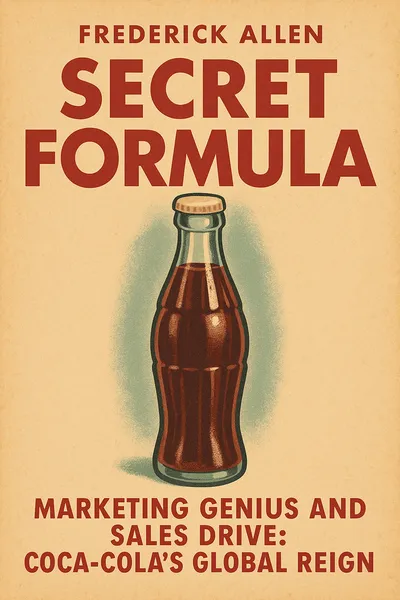
Secret formula
Marketing genius and sales drive: coca-cola's global reign
Description
Coca-Cola, the brainchild of Doc Pemberton and Frank Robinson, evolved from a syrup into a global soft drink phenomenon. Pemberton, a self-styled doctor, and Robinson, a marketing guru, navigated the company through its early struggles.
The drink's unique formula, containing caffeine and coca leaf extract, was a closely guarded secret, contributing to its mystique. Asa Candler and Robinson's aggressive marketing and legal strategies propelled Coca-Cola to success, despite challenges like the U.S. government's lawsuit over its ingredients. The company's focus on its trademark and product consistency, along with innovative advertising, solidified its market dominance.
Table of contents
01Coca-cola's origins
Coca-Cola, the world's most iconic soft drink, owes its inception to two distinct individuals: Doc Pemberton and Frank Robinson. Pemberton, not a real doctor but someone who dabbled in concocting potions and elixirs, created the original syrup in 1886. This syrup, a mix of sugar, caffeine, caramel, and various extracts and oils, including the notable addition of coca leaf extract, laid the foundation for Coca-Cola.
Robinson, on the other hand, was instrumental in naming the beverage and developing its trademark, playing a crucial role in the brand's marketing and financial management.

02Trademark and growth
In the late 19th century, as Coca-Cola emerged as a growing company, its trademark name became its most valuable intellectual capital asset. The company, under Asa Candler and Frank Robinson, focused on removing cocaine from its formula due to emerging medical concerns and also sought alternatives to kola nuts. By 1901, Coca-Cola's sales soared to over 500,000 gallons of syrup annually, nearing $1 million in revenues, and expanded its operations across major U.S. cities.
03Leadership and advertising
Asa Candler, growing weary of his role at Coca-Cola, faced succession interest from two directors: Frank Robinson and his nephew, Samuel Candler Dobbs, the advertising director. Dobbs, having collaborated with William Cheever D’Arcy, revolutionized Coca-Cola's advertising by promoting its universal appeal and introducing celebrity endorsements, notably with baseball star Ty Cobb. Their innovative strategies included animated billboards and high-quality magazine ads.
Meanwhile, Dobbs secured Coca-Cola's trademarks with the help of attorney Harold Hirsh, bolstered by the Trade-Mark Act of 1905.
04Global expansion and challenges
Following the conclusion of the First World War, the lifting of price controls allowed commodities, including sugar, to be traded at free market prices for the first time in years. This shift had a significant impact on Coca-Cola, which by 1919 was consuming 100 million pounds of sugar annually.
As sugar prices surged from 4-5 cents to 20 cents a pound, Coca-Cola secured a $1 million line of credit using the only written copy of its secret formula as collateral. This move was unprecedented, as previously, the formula was memorized by Howard Candler under his father's guidance, due to its immense value. With the line of credit, Sam Dobbs and Howard Candler secured forward supply contracts, fixing the sugar price at 20 cents a pound. However, this decision backfired when sugar prices dropped to around 10 cents, forcing Coca-Cola to purchase 16 million pounds of sugar at the inflated rate.
05Marketing mastery
In the early 1920s, Coca-Cola embarked on a transformative journey to establish a formidable marketing organization, a vision spearheaded by new executives like Harrison Jones and under the leadership of Robert Woodruff, who succeeded Sam Dobbs as president.
Woodruff, leveraging his experience in commercial motor vehicle sales, revitalized the sales department, dividing the U.S. into four zones, each managed by a hand-picked leader, and emphasized the uniform quality of Coca-Cola. A significant move to protect the brand's mystique involved securing the secret formula in an Atlanta bank, accessible only under strict conditions, thereby enhancing its allure and setting Coca-Cola apart from competitors.
06Financial success and rivalries
In the late 1920s, Coca-Cola, under the leadership of Robert Woodruff, faced significant challenges including the stock market crash of 1929 and the Great Depression.
Despite these hardships, Woodruff maintained a singular focus on Coca-Cola, resisting suggestions to diversify into other products. This period also saw innovative marketing campaigns, such as "The Pause That Refreshes," which significantly embedded Coca-Cola into public consciousness.
07American icon
In the early 20th century, Coca-Cola's executives, including company secretary and treasurer Ralph Hayes, envisioned the beverage as the quintessential American drink. Journalist William Allen White echoed this sentiment, describing Coca-Cola as a symbol of American values.
By 1935, the company's market value neared $500 million, with syrup sales doubling from 1933 to 1937 and annual revenues surpassing $50 million, steadily climbing toward $100 million by decade's end. Coca-Cola's stock also underwent a four-for-one split in 1935.
Despite the success, Coca-Cola's president Robert Woodruff maintained a cautious outlook, aware of the challenges ahead and never content with the status quo. The company's strategy focused on protecting its trademark rather than engaging in advertising battles with competitors.
08War and innovation
By the time World War II began, Coca-Cola had found significant success in Nazi Germany, with sales exceeding a million cases by 1936. However, profit repatriation became challenging due to Germany's restrictive currency regulations. As the war commenced, Coca-Cola's leadership anticipated difficulties similar to those experienced during World War I, such as sourcing raw materials and market restrictions. However, Ben Oehlert, a newer executive, proposed a novel approach, suggesting Coca-Cola could contribute to the nation's wartime economy and morale. In 1941, following the U.S. War Department's request, Coca-Cola began supplying its products to overseas armed forces, aligning with Oehlert's strategy.
09Post-war stagnation and revival
At the end of World War II, Coca-Cola was thriving with 63 overseas bottling plants and a booming domestic demand. Despite this success, Robert Woodruff, the company's leader, was resistant to innovation. He attempted to delegate leadership by appointing Bill Hobbs as president in 1946, but Hobbs's tenure was short-lived.
Meanwhile, Al Steele left Coca-Cola for Pepsi-Cola, which was struggling post-war. Steele revamped Pepsi's marketing and product, emphasizing quality over quantity, and introduced a new, less sugary formula alongside a vibrant logo. His efforts began to challenge Coca-Cola's market dominance.
10Modern era and legacy
In the 1960s and 1970s, Coca-Cola aimed to attract younger consumers, but internal power struggles, led by Robert Woodruff, limited new initiatives. J. Paul Austin's presidency in 1962 saw Woodruff's continued influence, despite Austin's efforts to innovate. The "Cola Wars" with Pepsi became prominent, with Pepsi's "Pepsi Challenge" ads gaining traction. Coca-Cola's response was lackluster, leading to a disappointing campaign shift. In 1980, Roberto Goizueta succeeded Austin, marking a significant leadership change. Goizueta, a Cuban chemist with a unique background, was chosen as a compromise but vowed to lead independently.
Related books