
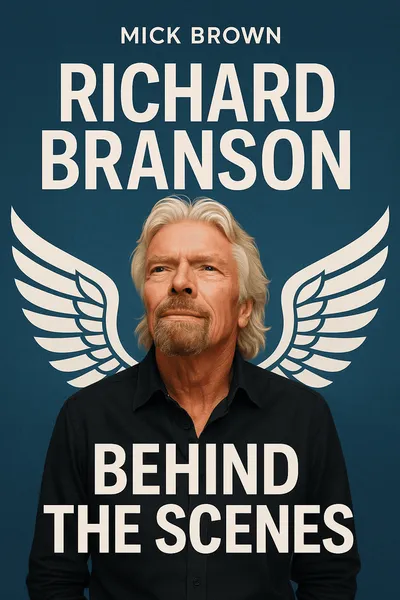
Richard branson
Behind the scenes
Description
Richard Charles Nicholas Branson was born on 18th July 1950, in a hospital that practiced natural childbirth, making his arrival into the world a challenging one. His mother, Eve Branson, described him as a handful from the start, a trait he carried into his later life. His father, Edward, was a third-generation lawyer, establishing the family's reputation in the legal field.
Despite their upper-middle-class status, the Bransons were not financially affluent. Eve, a former air stewardess and an entrepreneurial spirit, instilled in her children the belief that nothing is impossible with self-reliance. Richard's childhood was filled with activities aimed at building character, as his parents encouraged him to be independent and resourceful.
Table of contents
01Childhood beginnings
Richard Charles Nicholas Branson, born on July 18, 1950, had a challenging entry into the world, arriving three weeks late without any medical interventions. His mother, Eve, described him as a handful from the start, a trait he carried throughout his life. His father, Edward, was a lawyer, continuing a family tradition of legal excellence.
Despite their upper-middle-class status, the Bransons were not financially affluent. Eve, a pioneering air stewardess, instilled independence and entrepreneurial spirit in her children, emphasizing self-belief and the importance of personal effort. Richard grew up active and mischievous, disinterested in academics but excelling in sports until an injury at 11 ended his athletic pursuits.

02Stowe school days
Richard Branson's time at Stowe School was marked by his indifference towards the established norms and a penchant for doing what interested him, often leading to mischief rather than making a statement against the system. His disinterest in academics and fashion was overshadowed by his zest for life and knack for engaging others in his ventures, including money-making schemes with Nik Powell during holidays.
03Launching student magazine
In January 1968, the first issue of Student magazine was published, featuring contributions from notable figures like Vanessa Redgrave and Henry Moore, with a cover by Peter Blake. Founded by Richard Branson and Jonathon Holland-Gems from a makeshift office in London, the magazine was a creative but chaotic venture.
Despite Branson's youth and inexperience, his persuasive skills over the phone helped secure significant advertising revenue and a printing contract for 60,000 copies. However, distribution challenges persisted, relying on an informal network that often failed to return profits.
04Virgin's early ventures
Virgin's mail-order advertisement in the final issue of Student magazine offered discounts on records, leading to a surge in orders and a shift from magazine production to a mail-order business.
Richard Branson, along with his team including Nik Powell, John Varnom, Tony Mellor, Simon Draper, and his girlfriend Mundy Ellis, became the core of the Virgin empire. The business moved to larger premises, and Branson lived on a houseboat named Alberta. Virgin thrived by selling to the hippie market, with the founders posing as hippies themselves. Branson, recognizing a solid business opportunity, was a catalyst in assembling a skilled team.
05Legal troubles and growth
Facing a hefty fine that threatened the young Virgin business, Richard Branson and Nik Powell chose to expand rather than sell off their assets. This strategy led to the opening of fifteen shops by 1971, with Virgin's turnover reaching around £1.0 million annually.
However, it was soon discovered that the company had not been paying PAYE tax, as all employees were receiving a flat £20 weekly wage without tax deductions. This issue was promptly rectified with a proper wage system.
06Virgin's music breakthrough
In the early 1970s, Richard Branson's Virgin Group was rapidly expanding, promoting individuals from within to key positions. Simon Draper evolved from handling orders to directing music policy, while Jumbo Van Rennen and Chris Stylianou took charge of the international division and exports, respectively. Ken Berry rose from the accounts department to become managing director. Branson's leadership style was to empower his team, fostering a culture of autonomy and innovation.
Despite his self-consciousness about his lack of formal education, Branson excelled in deal-making, leveraging his intuitive business acumen. The Virgin workplace was known for its fun and informal atmosphere, with Branson often instigating practical jokes. Despite his unfamiliarity with music personalities, Branson had a keen sense for the business side of the industry, focusing on long-term contracts and copyright control. His personal indifference to possessions and unconventional habits underscored his unique approach to life and business.
07The sex pistols era
In 1976, Richard Branson's Virgin Records found its next big opportunity when Malcolm McLaren formed the Sex Pistols, a group with no musical talent but immense shock value. Despite initial reluctance due to past grievances, McLaren and Branson eventually agreed, and the band signed with Virgin in May 1977.
Their debut single, a controversial punk rendition of "God Save the Queen," was released during Queen Elizabeth's Jubilee celebrations, selling over 100,000 copies despite being banned from major media and retailers. Their album "Never Mind the Bollocks, Here’s the Sex Pistols" sparked further controversy and debate.
08Virgin's expansion and challenges
By the early 1980s, Virgin had become a prominent business entity, boasting a large record-shop chain, three state-of-the-art recording studios, and ventures in music publishing, book publishing, and film production, among others.
The record company was the main profit generator, despite the recording industry's recession in 1980. Facing financial challenges, Nik Powell sought to strengthen ties with the company's skeptical bankers, Coutts, while Richard Branson advocated for expansion over retrenchment. This strategy led to tension and eventually, in 1981, Branson bought out Powell's 40% stake in Virgin for £1 million, video editing facilities, and a cinema.
09Virgin atlantic takes flight
Despite the failure of Event magazine, Virgin Group thrived in 1982 with successes like the Human League and Phil Collins. The launch of MTV in the USA that year revolutionized the music industry, making music videos a lucrative asset. Virgin signed Culture Club, who were on the brink of becoming the world's leading pop group.
Richard Branson expanded Virgin's reach by setting up foreign offices, a move that paid off as nearly three-quarters of the group's business came from its own subsidiaries by 1986. By the end of 1982, Virgin's turnover hit £48.6 million with profits of £2 million, and these figures nearly doubled by the end of 1983.
10Virgin's entertainment ventures
Richard Branson, initially unfamiliar with the airline industry, was intrigued by Randolph Fields' proposal for a new airline, British Atlantic, aiming to succeed where Laker Airways had failed. Despite his lack of experience, Branson saw potential in the idea and, after a weekend of consideration, decided to partner with Fields, shifting the focus to a budget airline.
Virgin Atlantic was launched with ambitious plans, including a tight three-month deadline to start operations and a financial strategy that balanced risk and reward. Branson's innovative approach extended to marketing and service concepts, although some ideas, like unconventional class names, were eventually dropped.
11Adventures on the high seas
While Virgin Atlantic was being established, Richard Branson and the Virgin Group were expanding into the record and film industries. They produced their first feature films, "Secret Places" and "Electric Dreams," followed by an adaptation of George Orwell's famous novel, "Nineteen Eighty-Four." This move allowed Virgin to not only produce movies but also profit from the soundtracks, featuring many Virgin artists.
12Virgin goes public
Richard Branson's adventurous spirit and penchant for publicity stunts are well-documented. Among his exploits, he's had a series of close calls, including a near-disastrous microlight flight and a ski slope incident saved by a rabbit hole. His love for speed extended to the road and even to Virgin's annual Goodwood track day, where his driving was critiqued by Grand Prix driver Stefan Johansson for being bold yet unskilled. Branson's motorsport interest led to a partnership with Ted Toleman, who sought a sponsor for the Blue Riband transatlantic challenge. Branson, seeing an opportunity to promote his new airline, invested £1.5 million and joined the crew, overshadowing Toleman's team in the media.
13Aerial adventures and publicity
In 1984, recognizing the need for accelerated growth beyond what Virgin's cash flow could support, Richard Branson decided to take the company public. This move required professionalizing the company's financial management, leading to the appointments of Don Cruickshank as managing director and Trevor Abbott as finance director. Their efforts transformed Virgin from a "cottage industry" into a streamlined operation, focusing on Music, Vision, and Retail divisions while setting aside riskier ventures.
14Virgin's continued growth
Per Lindstrand, an esteemed aeronautical engineer, proposed to Richard Branson an adventurous business venture: to cross the Atlantic in a hot-air balloon, a feat considered impossible due to the challenges of maintaining temperature at high altitudes. Lindstrand's innovative double-skinned balloon, capable of harnessing sunlight for heat, made the idea feasible. Despite a near-fatal training incident and a significant drop in Virgin's share price following a documentary, the project moved forward.