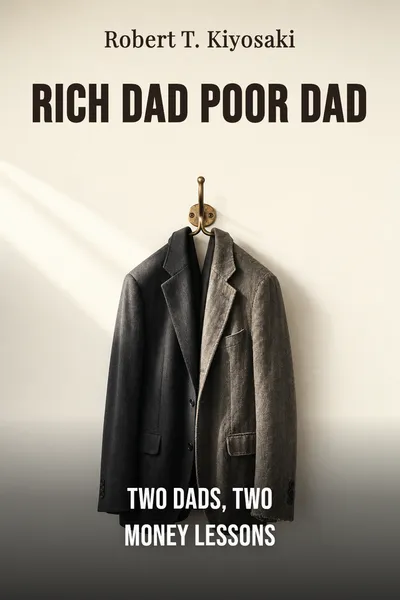
Rich Dad Poor Dad
Two dads, two money lessons
Description
In 1997, a former marine and Xerox salesman named Robert Kiyosaki self-published a slim personal-finance book after publishers turned it down. He pushed it through the car wash and small-business networks he could reach, and then it caught. Oprah put him on her show in 2000. Within a few years, Rich Dad Poor Dad had become one of the best-selling personal-finance books ever written, translated into dozens of languages and moving, by most counts, well over thirty million copies. For a book with almost no numbers, no spreadsheets and no formulas, that is a strange kind of success.
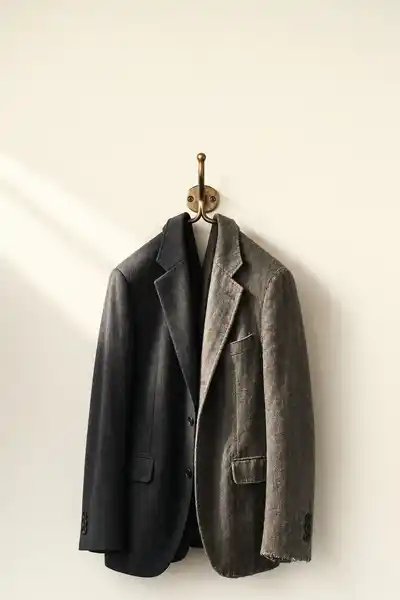
The premise is disarmingly simple. Kiyosaki says he grew up with two fathers. One was his biological dad — a highly educated man with a PhD and a secure government job in Hawaii, the sort of father who did everything society tells you to do, and who nonetheless struggled with money his whole life. The other was the father of his childhood best friend, a businessman who never finished eighth grade and became one of the richest men in the state. Kiyosaki calls them his poor dad and his rich dad, and the whole book is built on the collision between what these two men believed about money.
The friction is the point. Poor dad said "I can't afford it." Rich dad banned that phrase and made the boy ask "how can I afford it?" instead. One saw the family home as the biggest investment of a lifetime; the other called it a liability. The book is less a set of instructions than a fight between two mindsets — and Kiyosaki wants us to notice which one we absorbed without ever choosing it.
The question we’re asking : If working hard and getting educated is supposed to make us financially secure, why do so many people who do both still end up trapped by money?What we’ll see : How two father figures taught one boy opposite lessons about work, ownership and fear — and why the book built on that clash still sells decades later.
Table of contents
01 Chapter 1 — Two men, two scripts for money
Both fathers were smart, hard-working and generous. That is what makes the contrast land. Kiyosaki's poor dad believed in the path most of us were handed: study hard, get good grades, find a stable job, climb the ladder, and the money will follow. He earned a decent salary his whole life and still died with bills to pay. Rich dad believed something close to the opposite. He thought school prepared you to work for people who already had money, and that the game itself was never explained in any classroom.
The clash showed up in small phrases the young Kiyosaki heard again and again. Poor dad said the love of money was the root of all evil; rich dad said the lack of money was. Poor dad said "I'm not interested in money"; rich dad said money is power, and refusing to learn about it only hands that power to someone else. One treated financial struggle as a private embarrassment best not discussed at the table. The other treated it as a subject you study, argue about and practice, the way you would any other skill.

02 Chapter 2 — Your house is not an asset
The book's most quoted idea is also its simplest, and the one that gets people arguing. Kiyosaki says most adults never learn the difference between an asset and a liability, and that this single confusion keeps them poor no matter how much they earn. His definition is deliberately blunt. An asset puts money in your pocket. A liability takes money out. That's the whole test, and he insists on keeping it that crude because the crudeness is what makes it usable.
Run your own home through it and you get the line that made the book famous: your house is not an asset. The family home takes money out of your pocket every month — mortgage, taxes, insurance, upkeep, repairs — so by his rough definition it sits on the liability side of the ledger, whatever the bank statement says. Poor dad saw the house as the cornerstone of a life's wealth. Rich dad saw a beautiful money drain that keeps ambitious people working harder to fund it. Kiyosaki isn't saying never own a home; he's saying stop mistaking it for the engine of your wealth.
03 Chapter 3 — The rat race, and the way out
Kiyosaki has a name for the loop most people live inside: the rat race. You earn more, so you spend more, so you owe more, so you need to earn more — a wheel that speeds up with every promotion. Taxes take a cut, the mortgage takes another, the credit card takes the rest, and the fear of missing a payment keeps you showing up. The cruel joke, he says, is that a raise often makes it worse, because it funds a lifestyle that then demands the raise to sustain it. Working harder inside the wheel just makes the wheel turn faster.
The way out is not a bigger paycheck but a shift in what you do with the one you have. He tells us to pay ourselves first — to buy assets before paying the bills, using the pressure of the unpaid bills as motivation to find more income rather than as a reason to skip investing. He wants us to treat financial education as a lifelong subject: read, take courses, learn accounting, learn markets, learn the tax and legal machinery the wealthy use routinely. And he wants us to see work differently, arguing that the point of a job early on is less the salary than the skills it teaches — sales, management, communication — the toolkit of someone who will eventually build things of their own.
04 Chapter 4 — Why the book keeps selling
Strip away the anecdotes and Rich Dad Poor Dad is less an investing manual than a permission slip. Its real subject isn't real estate or stocks; it's the quiet argument that the script most of us inherited — study, work, save, retire — was never designed to make us wealthy, and that nobody ever sat us down to explain the alternative. That claim is what has kept the book alive on shelves for a quarter of a century. It named a gap people felt but couldn't articulate: years of schooling and not one hour spent on how money actually works.
The book has taken its share of criticism, and fairly. Skeptics have never been able to confirm that rich dad existed as a single real person, and Kiyosaki has at times treated him as a composite or a teaching device. The concrete advice can be thin, occasionally reckless — the enthusiasm for debt and for get-rich speculation has aged badly for readers who followed it literally. As a how-to, it leaves a lot unsaid. As a wake-up, it has been extraordinarily effective, which tells us something about what readers were actually missing.
05 Conclusion
Kiyosaki went on to build a franchise on the back of that slim 1997 book — sequels, board games, seminars, an entire brand called Rich Dad. The empire has outgrown the story that started it, and much of its investing advice remains contested. But the original book still does the one thing it set out to do: it makes a reader stop and look at the money beliefs they never realized they were holding.
Related books