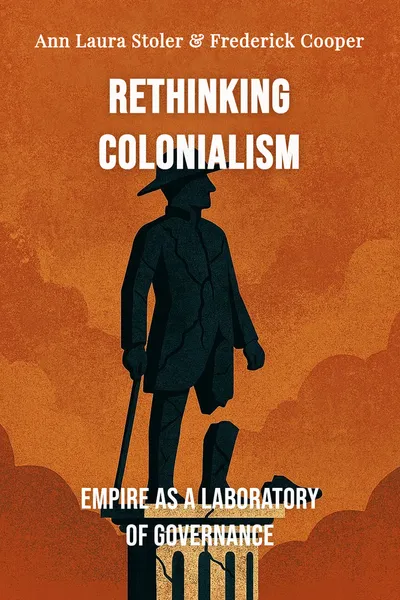
Rethinking Colonialism
Empire as a laboratory of governance
Description
In the 1990s, two scholars who had spent their careers inside colonial archives — Ann Laura Stoler, an anthropologist, and Frederick Cooper, a historian of Africa — kept running into the same frustration. The archives of the Dutch East Indies, of French West Africa, of British India were not, as they had expected, orderly monuments to European confidence. They were nervous documents: memos fretting over who counted as a citizen, reports agonizing over mixed marriages, endless correspondence about how to school, tax, count and discipline populations the empire could not quite figure out how to hold. The administrators sounded less like conquerors than like anxious managers improvising rules for a system nobody fully controlled.
Out of that shared frustration came a body of work, gathered in essays and in their jointly edited volume Tensions of Empire, that proposed a different way of reading the colonial record. Colonialism, they argued, should not be treated as a footnote to European history or a morality tale with the verdict already in. It should be read as a place where the modern state learned some of its most important tricks — how to classify people, how to manage populations, how to draw the line between those who belonged and those who merely lived under rule. The colony, in this reading, was a laboratory.
That word matters. A laboratory is where things are tested that cannot yet be tried at home, where methods are improvised under pressure, where failures teach as much as successes. Stoler and Cooper wanted to know what was actually being experimented on out there, and what happened to the results.
The question we’re asking : What did European empires actually practice out in the colonies, and why should we read that as a rehearsal for the modern state rather than its opposite?What we’ll see : How two archive-obsessed scholars turned the paperwork of empire into a story about how power learned to govern.
Table of contents
01Chapter 1 — The colony as workshop
The older picture of empire was tidy. A confident Europe exported its finished institutions — law courts, census forms, schools, sanitary codes — to territories that received them passively. Colonialism was the application abroad of a modernity already assembled at home. Stoler and Cooper found the archive telling a stranger story. The institutions were not finished when they arrived. They were being built on the spot, revised in response to resistance, disease, budget crises and the sheer difficulty of ruling millions of people with a handful of officials.
This is what makes the laboratory metaphor more than a flourish. In the colony, administrators could try things that domestic politics at home would have blocked. They could experiment with identity documents, with forced labor dressed up as development, with segregated cities, with legal systems that ran one code for Europeans and another for the ruled. The stakes felt lower — the subjects had no vote, no press, no standing — so the room for improvisation was wider. Techniques got tested there first.

02Chapter 2 — The tensions of rule
The title Stoler and Cooper gave their collaborative volume — Tensions of Empire — was chosen with care. They did not think the interesting thing about colonial rule was its brutality, which was hardly in dispute. The interesting thing was its incoherence: the way European powers wanted contradictory things at once and could never resolve the contradiction.
Empire promised to civilize and it promised to keep its subjects permanently subordinate. It preached universal values — reason, progress, the rights of man — while building a system founded on the denial of those rights to most of the people living under it. An administrator was supposed to lift the colonized toward European standards and, at the same time, ensure they never actually arrived, because arrival would dissolve the difference on which the whole enterprise depended. The archive is thick with officials caught in exactly this bind.
03Chapter 3 — Categories that had to be manufactured
To govern a population, a state first has to imagine it as a knowable object — countable, sortable, filed. Stoler and Cooper argued that the categories we now take as natural facts about human societies were, in large part, colonial manufactures, assembled by officials who needed lines to administer.
Race is the sharpest example. The colonial project required a durable distinction between rulers and ruled, but the distinction kept proving slippery. Children of European fathers and local mothers, converts, the educated, the wealthy — each blurred the line the whole system rested on. So the line had to be produced and policed through law, schooling, dress codes, residence rules and endless documentation. Race was not a given the colonizers found; it was an administrative achievement they had to keep working at.
04Chapter 4 — The metropole was in the colony too
It would be tempting to file all this under the history of distant places and let Europe off the hook. Stoler and Cooper's most pointed argument runs the other way. The techniques rehearsed in the colony did not stay overseas. They flowed back, quietly, into the making of the modern European state itself. Metropole and colony, they insisted, have to be studied in a single analytic field, because they were built by the same hands out of the same experiments.
Consider what the colonial workshop produced: systems for classifying populations by origin, methods of surveillance and identification, the fingerprint and the identity paper, models of welfare and public health administered to whole populations, the census as an instrument of rule. Many of these were tried on colonized subjects before they were normalized on citizens at home. The distance between the sanitary cordon in a colonial city and the machinery of the modern administrative state is shorter than the comfortable version of European history suggests.
05Conclusion
Stoler and Cooper set out to read the colonial archive against its own confident surface, and what they found was a nervous, unfinished project rather than a monument. Empire, in their account, was a place where the modern state improvised its methods under pressure — inventing the categories, the paperwork and the population techniques it could not have tested so freely at home. The brutality was never in question; what they added was the recognition that brutality came braided with experiment, and that the experiments had a future.
Related books