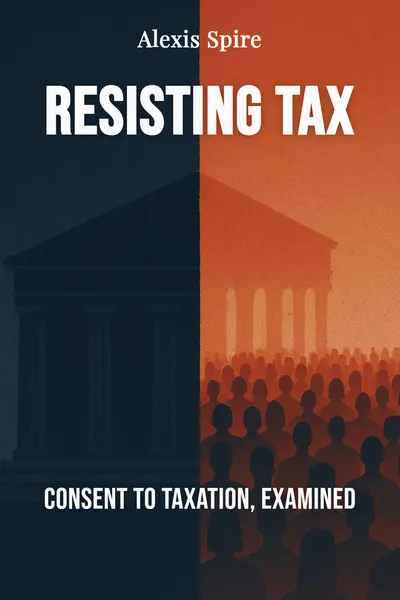
Resisting Tax
Consent to taxation, examined
Description
Nobody frames it as politics when it happens at a kitchen table in early spring, a shoebox of receipts open, someone muttering that they pay too much and get too little back. The French sociologist Alexis Spire spent years taking that muttering seriously — interviewing taxpayers across the income scale, sitting in the waiting rooms of tax offices, reading the letters people send to the administration when they want a figure revised. In his book Resisting Tax, he treats the ordinary grievance not as noise but as data: a window into what people will accept from the state, and what they quietly refuse.
The result cuts against the easy story. We tend to imagine tax resistance as either high-minded protest or plain selfishness — the conscientious objector who won't fund a war, or the millionaire with an offshore account. Spire finds something messier and more revealing underneath. Resistance runs through every bracket, it takes forms most people would never call cheating, and it tracks less with how much someone earns than with whether they believe the burden is being shared honestly. The feeling that matters is not "I pay too much." It is "I pay more than my share while others get away with it."
That shifts the whole question. If consent to taxation rests on a sense of fairness rather than on the raw size of the bill, then the fiscal contract is more fragile, and more psychological, than any budget spreadsheet suggests. Spire's fieldwork lets us watch that contract hold, bend, and sometimes quietly break — not in parliaments, but at counters and in correspondence.
The question we’re asking : What actually makes people accept, or quietly refuse, the taxes they're asked to pay?What we’ll see : A sociologist's fieldwork turns the familiar grumble about taxes into a map of how consent to the state is won, strained, and lost.
Table of contents
01Chapter 1 — The grumble nobody admits to studying
Taxation gets studied plenty — by economists modeling rates, by lawyers parsing codes, by historians tracing revolts. What Spire noticed was a gap in the middle. Almost nobody had looked at the everyday, low-grade friction between ordinary people and the tax they owe: the small evasions, the strategic silences, the letters of complaint, the sense of grievance that never quite becomes a movement. It is the most common relationship citizens have with the state, and it was sitting there largely unexamined.
So he went looking for it where it lives. Spire's method is sociological in the plainest sense — he talks to people and watches them. He interviewed taxpayers from very different worlds: wage earners whose tax is deducted before they ever see the money, small shopkeepers who fill in their own returns, wealthy households with accountants and room to maneuver. And crucially, he spent time inside the administration itself, observing the agents who process the claims, grant the delays, and decide whose explanation sounds credible.

02Chapter 2 — A ladder of refusals, from the quiet to the loud
One of Spire's most useful moves is to stop treating tax resistance as a single thing. It isn't a line you either cross or don't. It is a ladder, with many rungs between full compliance and open refusal, and most people spend their lives somewhere in the middle, climbing up or down depending on circumstance.
At the lowest rung sits what he calls the resistance of the resigned — people, often wage earners, who have no practical way to avoid the tax because it is withheld at source before the money reaches them. Their resistance is verbal, emotional, a steady background complaint, but their behavior conforms because the system leaves them no slack. One rung up are the small adjustments: rounding an expense generously, declaring a little late, claiming a deduction that is defensible but flattering. These are the gestures of people who feel they are merely recovering what the rules unfairly take.
03Chapter 3 — Fairness, not greed, is the trigger
If resistance were simply greed, it would rise cleanly with the tax bill: the more you pay, the harder you'd push back. Spire's material doesn't behave that way. The decisive variable isn't the amount. It is the perception of fairness — whether people believe the burden is distributed honestly and the proceeds spent legitimately.
Two beliefs do most of the work. The first is horizontal: am I being treated like others in my situation? A shopkeeper doesn't measure the state against an abstract ideal; they measure it against the shopkeeper down the street who seems to declare less and get away with it. The sense that others cheat successfully is corrosive, because it reframes your own honesty as naivety. Paying becomes the behavior of the sucker who didn't know the game. The second belief is vertical: are those above me paying their share? When taxpayers suspect the wealthy escape through loopholes the ordinary person can't reach, the whole arrangement reads as rigged, and consent drains away.
04Chapter 4 — What the office counter knows about the state
Step back from the receipts and the complaint letters, and Spire's fieldwork is really about something larger than tax: the daily, unglamorous way a citizen and a state decide whether they trust each other. Taxation is where that relationship becomes concrete. It is the one transaction nearly everyone has with the state in which real money changes hands and real demands are made, and so it is where consent to being governed gets tested most honestly.
Seen this way, the tax office counter is a small theater of the social contract. Every negotiated delay, every waived penalty, every grievance filed and judged is a renegotiation of the terms on which the state asks and the citizen gives. The contract isn't signed once and filed away. It is re-enacted constantly, in thousands of mundane encounters, and its strength depends on whether each side keeps finding the other credible. When a taxpayer believes the system is even-handed, they extend it the benefit of the doubt. When they don't, they start keeping score, and compliance becomes grudging, minimal, strategic.
05Conclusion
Return to the kitchen table and the open shoebox. The person muttering there is not, in the end, simply counting their losses. They are asking a question about everyone else — whether the neighbor, the boss, the millionaire, and the state itself are keeping their part of a bargain nobody ever quite spelled out. Spire's achievement is to show that this private arithmetic is where the fiscal contract actually lives, far more than in any statute or rate schedule.
Related books