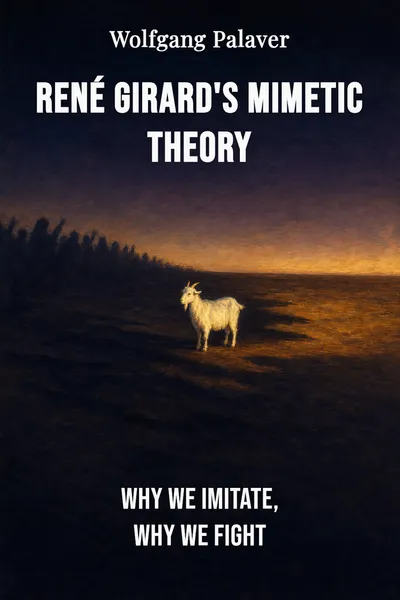
René Girard's Mimetic Theory
Why we imitate, why we fight
Description
René Girard was a French historian who spent most of his career teaching literature in American universities — Indiana, Johns Hopkins, and finally Stanford, where he stayed until his death in 2015. He never trained as an anthropologist or a psychologist, which is part of what makes his career strange. He arrived at a single idea while reading novels in the late 1950s, kept pulling on the thread for the next half-century, and ended up with a theory that tried to explain desire, violence, religion, and the origins of human culture all at once. Ambitious to the point of recklessness, and hard to dismiss.
The starting point is almost embarrassingly simple. We think we want things on our own — a car, a job, a person, a life. Girard's claim is that we don't. We want them because someone else wants them first. Desire is borrowed, copied from a model we admire, and that copying is where the trouble starts. Two people who want the same thing don't stay friends for long. In the book René Girard's Mimetic Theory, the political theorist Wolfgang Palaver lays out how that one observation grows, step by step, into a full account of why human groups turn violent — and how they've always managed to calm themselves down.
What makes the theory unsettling is that it doesn't leave room for a heroic exception. It applies to the reader as much as to the mob, to admiration as much as to hatred. And it insists that the peace we enjoy has usually been paid for by someone — a victim the group agreed, without quite deciding, to blame.
The question we’re asking : Why do humans imitate each other's desires, and why does that imitation so reliably end in conflict — and then in a strange, restored calm?What we’ll see : How a single idea about borrowed wanting unfolds into an account of rivalry, sacrifice, and the machinery cultures use to survive themselves.
Table of contents
01 Chapter 1 — We want what others want
Girard's first book, published in 1961, was a study of five novelists — Cervantes, Stendhal, Flaubert, Proust, Dostoevsky. Reading them side by side, he noticed something none of them said outright but all of them showed. Their characters never desire directly. There's always a third figure in the picture: a model, a mediator, someone whose wanting teaches the hero what to want. Don Quixote doesn't decide on his own to become a knight; he copies the fictional Amadis. Emma Bovary wants the romantic life she read about in other people's books. Desire, Girard concluded, is triangular — never a straight line from a person to an object, always routed through someone else.
He called this mimetic desire, from the Greek for imitation. The word matters, because Girard wasn't talking about copying gestures or fashions, the obvious kind of mimicry. He meant something deeper and less visible: we imitate what other people value. A child doesn't want the toy on the floor until another child picks it up. Then, suddenly, it's the only toy that matters. The object hasn't changed. What changed is that someone else's attention has landed on it, and attention is contagious.

02 Chapter 2 — From rivalry to the war of all against all
The model I imitate is, at first, someone above me — admired, ahead, worth copying. But if I want what they want, and there's only one of it, my model turns into my rival. The person who taught me to desire now stands between me and the thing desired. Girard's term for this is the double bind: the mediator says, in effect, imitate me, and then, don't take what's mine. The closer the two people are — in status, in proximity, in likeness — the sharper the collision.
What happens next is the heart of the theory. As the rivalry heats up, the original object starts to matter less and the rival starts to matter more. The two combatants become obsessed with each other, mirror each other's moves, escalate in lockstep. Girard calls this the movement toward the double — two people who began as different and end up nearly identical, each a reflection of the other's hostility. The prize is half-forgotten. What remains is pure antagonism, two people who can no longer tell where one desire ends and the other begins.
03 Chapter 3 — The victim who buys back the peace
The mechanism is the scapegoat. When a community is boiling with mimetic violence, everyone against everyone, the tension can suddenly collapse onto a single figure. The crowd, still imitating each other, converges on one victim who is blamed for the whole crisis. All against all becomes all against one. And here is the strange part: it works. Once the victim is expelled or killed, the violence has nowhere left to go. The community, exhausted and united for the first time in its shared act, falls quiet. Peace returns.
Because the peace is so total and so sudden, the group can't believe it caused this itself. The victim who brought such disorder, then such calm, must have been extraordinary — cursed, then somehow blessed. Girard argues this is the origin of the sacred. The scapegoat becomes a god: first a monster who deserved to die, then a divine figure whose death saved everyone. Myths, in his reading, are the stories the persecutors tell afterward, written from the point of view of the crowd that never sees its victim as innocent. The lie is baked in at the source.
04 Chapter 4 — Reading the crowd we're already in
Strip away the archaic villages and the founding murders, and the reason Girard keeps being read is that the machinery hasn't gone anywhere. Consumer culture is mimetic desire industrialized: advertising rarely tells us what a product does, it shows us who already wants it and invites us to catch the wanting. We don't buy the thing so much as the model's relation to the thing. Girard would say the whole apparatus runs on the fact that our desires are borrowed and we'd rather not know it.
Social media is where his theory looks almost too accurate. A platform is a machine for making other people's desires visible at scale — likes, follows, the constant display of what everyone is reaching for. It accelerates imitation, and with it, rivalry. Palaver points to the pile-on as a recognizable modern shape: a crisis of scattered online anger suddenly converging on one person who is blamed, shamed, and expelled, after which the crowd feels briefly cleansed and moves on. The vocabulary is new. The structure is old.
05 Conclusion
Girard spent fifty years defending an idea most people find implausible the first time they hear it: that they do not, in any deep sense, choose what they desire. He built it out of novels, then anthropology, then the Bible, and he never softened the claim to make it easier to accept. The theory asks us to see imitation where we felt originality, and a victim where we felt justice — to read our own peace as something that may have been purchased at someone's expense.
Related books