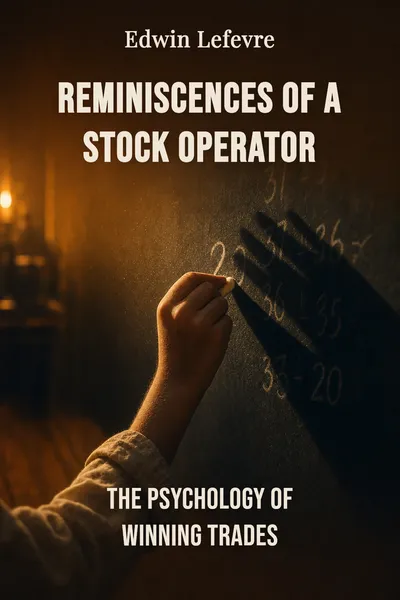
Reminiscences of a Stock Operator
The psychology of winning trades
Description
In 1923, a financial journalist named Edwin Lefevre published a book that pretended to be a memoir. Its narrator was Larry Livingston, a speculator who told his own story in the first person — how he started as a fourteen-year-old boy chalking quotes in a Boston brokerage, how he made and lost fortunes several times over, how he got wiped out and clawed back. Almost everyone knew the character was a thin disguise for Jesse Livermore, the most famous market operator of the era. Lefevre had interviewed him, then turned the real man into a narrator who could talk freely. The result reads less like reporting than like a long confession over a drink.
A century later, the book has not aged the way financial writing usually ages. The tickers are gone, the bucket shops are gone, the specific stocks mean nothing to us now. And yet traders still hand the book to each other, still quote its lines, still recognize themselves in Livingston's mistakes. Something in it survived the disappearance of the world it described. That something is not a method for picking winners. Lefevre barely gives us one.
What he gives us instead is a portrait of a mind under pressure — the specific ways a person who is right about a market still manages to lose money, and the slow, expensive process by which Livingston learns to stop doing that to himself. The winning, in this book, turns out to be mostly about not losing to yourself.
The question we’re asking : If Livingston kept being right about the market, why did he keep losing his money — and what finally changed?What we’ll see : How a boy who could read the tape spent decades learning that the hardest opponent in trading is the person placing the order.
Table of contents
01 Chapter 1 — The boy who read the tape
Livingston begins his story in a Boston brokerage office, where his first job at fourteen was to post stock prices on a big board as the quotations came off the ticker. He was quick with numbers, and the work put a river of figures in front of him all day. Without quite intending to, he started noticing that prices moved in patterns — that a stock climbing steadily behaved differently from one drifting sideways, that certain movements tended to be followed by certain others. He kept a little notebook of these observations and checked his predictions against what actually happened. He was, in effect, teaching himself to read the tape before he had a dollar at stake.
The first place he put this to work was the bucket shops — establishments that took bets on stock prices without ever buying the actual shares. A customer put down a margin, named a stock, and won or lost on the price swing. Livingston was so consistently right that the bucket shops began to bar him. He was, in his own telling, a phenomenon: a teenager who could look at a string of quotes and sense which way a price wanted to go. By his twenties he had built up a stake, been thrown out of nearly every bucket shop in New England, and decided to move to New York to trade in a real brokerage against the real market.

02 Chapter 2 — Being right and sitting tight
The answer arrived slowly, and Livingston attributes the sharpest version of it to an old trader he calls Mr. Partridge — nicknamed Old Turkey — who annoyed the younger men by responding to every hot tip with the same maddening line: "It's a bull market, you know." When someone urged him to sell a stock and buy it back cheaper, he refused, explaining that he could not afford to lose his position. He did not mean he lacked the money. He meant that if he sold, he might not have the nerve to get back in, and would miss the larger move he was actually right about. The point lodged in Livingston's mind and eventually reorganized how he thought.
The realization he built on it became the book's most quoted idea: the money is not made in the buying or the selling, it is made in the sitting. Anyone can be right about which way a stock is headed. What separates the people who keep their winnings is the ability to take a correct position and then do nothing — to sit through the boredom, the small reversals, the constant itch to book a quick profit — until the whole move has played out. Livingston had been right about direction his entire life and had repeatedly traded himself out of his own good calls, cashing tiny gains and missing the fortunes underneath them.
03 Chapter 3 — The costliest lessons were paid in cash
What keeps the book honest is that Livingston never presents these lessons as things he read and adopted. He paid for every one of them, usually more than once, and often after he already knew better. He describes making a large fortune, growing confident, loosening his own rules, and losing most of it — then having to rebuild from debt with the discipline he had temporarily abandoned. The wisdom in the book is not the wisdom of a man who solved the problem. It is the wisdom of a man who kept relapsing and kept noticing, with painful clarity, exactly which weakness had cost him this time.
The weaknesses are recognizably human. He acts on tips against his own judgment. He trades out of boredom when there is nothing worth doing, because inaction feels intolerable. He lets a friend or a persuasive insider talk him into a position he has no independent reason to hold. He gets greedy near a top and stubborn near a bottom. Repeatedly he watches himself do the wrong thing while a cooler part of his mind narrates the mistake in progress. The market, he concludes, does not beat him. He beats himself, and the market simply collects.
04 Chapter 4 — Larry Livingston is still trading
The reason the book outlived its ticker tape is that Lefevre was never really writing about stocks. He was writing about a particular collision between a person and uncertainty, and that collision has not changed. Livingston's enemies — impatience, hope, fear, the need to feel active, the pull of other people's opinions — are not features of the 1900s market. They are features of the human nervous system under money and doubt. The specific instruments have been replaced many times over; the trader placing the order has not been upgraded at all.
This is why the book reads today less like financial history and more like a study in behavior that happens to use markets as its laboratory. When Livingston describes selling too early to lock in a small sure thing, or averaging down on a loser because admitting the loss feels worse than deepening it, he is describing impulses that later researchers would name and catalog. Lefevre had no vocabulary of cognitive bias, but he had something arguably more useful: a narrator watching his own mind sabotage a perfectly good decision, and reporting it without excuse.
05 Conclusion
The book closes not on a triumph but on a working truce. Livingston has learned his rules, knows precisely why they matter, and knows equally well that he will keep being tempted to break them. Mastery, in his telling, is not a state he reaches and holds. It is a discipline he has to renew every day against a mind that never fully stops looking for shortcuts. The winning trades come from the same place the losing ones did: himself, managed better on the good days than the bad.
Related books