
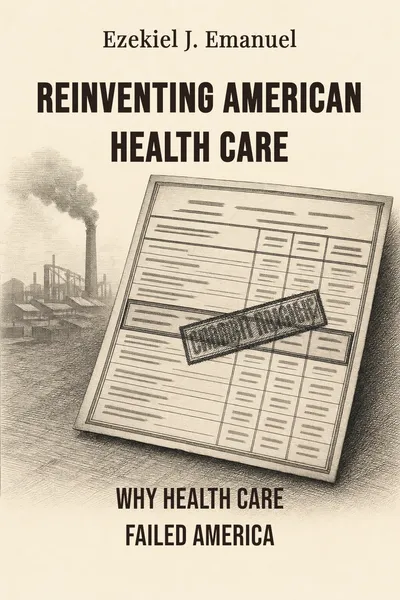
Reinventing American Health Care
Why health care failed America
Description
In 1943, a wartime tax ruling in the United States let employers deduct the cost of health insurance without counting it as taxable income for workers. It was a small technical decision, made to sidestep wage controls and keep factories staffed. Nobody thought they were building a national health system. Yet eighty years later, most working-age Americans still get their coverage through their job, for a reason that traces straight back to that accident of tax policy. Ezekiel Emanuel, an oncologist and bioethicist who helped shape the 2010 health reform, opens his history of American health care with this kind of detail: the system feels permanent, but almost none of it was chosen on purpose.
The numbers are the part everyone knows. The United States spends far more on health care than any comparable country — close to a fifth of its entire economy — and yet, before 2010, tens of millions of people had no coverage at all. It is the only wealthy nation that never built a universal system, and the results show up in shorter lives, crushing medical bills, and a bureaucracy so tangled that even doctors struggle to explain what anything costs. Spending the most and covering the fewest is a strange place for a rich country to land.
Emanuel's book is an attempt to make that strangeness legible: not a polemic, but a diagnosis. He wants to explain how the pieces fit together, why every attempt at reform runs into the same walls, and what the Affordable Care Act was actually trying to fix. Rather than assign blame to villains, he treats the whole thing as a machine assembled over a century, one improvised part at a time.
The question we’re asking : How did the richest country in the world end up with a health-care system that costs the most and covers the least — and can it be rebuilt?What we’ll see : How a patchwork built by accident hardened into a system, the problems that resist every fix, and what makes medicine refuse to behave like an ordinary market.
Table of contents
01Chapter 1 — A system nobody designed
The first thing Emanuel wants us to understand is that American health care was never designed. There was no founding blueprint, no moment when a government sat down and decided how citizens would pay for medicine. Instead there was a series of accidents and compromises, each one solving a short-term problem and leaving a permanent structure behind. The employer-based insurance most Americans rely on came out of that 1940s tax quirk. Because insurance attached to jobs got a tax break that buying it yourself did not, the workplace became the default place to get covered — a habit that then proved almost impossible to unwind.
The gaps in that arrangement got patched, not closed. People too old to work, and people too poor to be insured, fell outside the employer system entirely. So in 1965, Medicare and Medicaid were created — one federal program for those over sixty-five, one shared with the states for the poor. They were huge, genuinely transformative programs, but they were also add-ons: two more pieces bolted onto a structure that already existed, rather than a decision to start over. Everyone left in the cracks between them simply stayed uncovered.

02Chapter 2 — The three problems that never go away
Beneath the patchwork, Emanuel argues, sit three problems that every serious conversation about American health care circles back to: cost, access, and quality. They are tangled together, but he insists on pulling them apart, because reforms that fix one often make another worse, and confusing them is how debates go in circles.
Cost is the loudest. The United States spends roughly twice as much per person as other rich nations, without living longer or getting healthier for it. Emanuel is careful about where the money actually goes. It is not mainly waste in the cartoonish sense; a great deal of it is prices — the same procedure, the same drug, the same hospital stay simply costs more in America than anywhere else. Add administrative overhead from thousands of insurers each with their own rules and billing codes, and a striking share of the spending never touches a patient at all. It disappears into the machinery of paying for care.
03Chapter 3 — What the Affordable Care Act tried to do
The Affordable Care Act, signed in 2010, is the center of gravity in Emanuel's account, partly because he watched it being built from inside the White House. He is honest that it was not the system anyone would design from scratch. It was a reform that had to work with the patchwork rather than replace it — keeping employer coverage, keeping Medicare and Medicaid, and trying to close the gaps between them without blowing the whole thing up.
Its logic rested on a few interlocking moves. It banned insurers from refusing people or charging more because they were already sick — the single most popular piece of the law. But that rule only works if healthy people buy in too; otherwise insurers collect the sick and nobody else. So the law also required most people to carry coverage, and offered subsidies and new online marketplaces to make that affordable. Cover the sick, bring in the healthy, help pay the premiums: the three moves were designed to hold each other up, and pulling one loose weakens the rest.
04Chapter 4 — A market unlike any other
Step back from the political fight and a deeper question surfaces in Emanuel's book: why is health care so uniquely resistant to the ordinary logic of markets? In most of the economy, we trust supply, demand and price to sort things out. A buyer compares options, weighs cost against value, and walks away if the price is wrong. Health care breaks nearly every assumption that story depends on, and that is why reform there is harder than in almost any other field.
Start with the buyer. A person having a heart attack does not shop around. They cannot compare prices, cannot judge whether the recommended procedure is necessary, and cannot walk away. The knowledge gap between patient and provider is enormous, and the moments when care matters most are precisely the moments when the patient has the least power to behave like a rational consumer. The doctor recommends, and the patient, frightened and uninformed, mostly agrees.
05Conclusion
Emanuel ends where the story began: with a system built by accident, held together by the interests that grew up around it, and improved at the edges by a law that never claimed to be the last word. The Affordable Care Act narrowed the gaps in the patchwork without redesigning it, and the three old problems — cost, access, quality — remain locked together, still refusing to be solved one at a time. His account is less a verdict than a map, drawn by someone who helped build part of the terrain.
Related books