
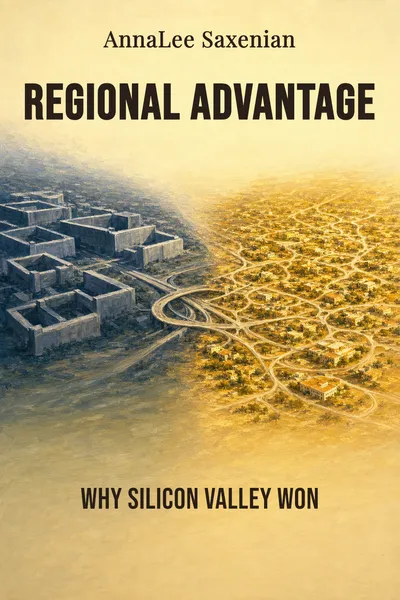
Regional Advantage
Why Silicon Valley won
Description
In 1975, if you had to bet on which American region would dominate the coming electronics age, the smart money went to Massachusetts. Route 128, the highway curling around Boston, was lined with the giants of the minicomputer era — Digital Equipment Corporation, Data General, Wang Laboratories — companies born out of MIT with decades of federal contracts behind them. Northern California had its startups and its defense money too, but it looked scrappier, younger, less sure of itself. Both places had the same raw ingredients: elite universities, Cold War funding, brilliant engineers, a head start on the rest of the world.
Fifteen years later the bet had gone badly wrong. Through the 1980s and into the 1990s, Silicon Valley kept reinventing itself — semiconductors, then personal computers, then software and networking — spinning off new firms faster than the old ones could fail. Route 128, meanwhile, stalled. Its proud minicomputer companies missed the shift to smaller, cheaper machines, and one by one they shrank, sold themselves off, or vanished. Same technology, same starting line, opposite destinies. Something other than luck or talent was doing the sorting.
AnnaLee Saxenian, an economic geographer, spent years and more than a hundred interviews chasing that something. Her answer, laid out in Regional Advantage in 1994, is not about tax rates, weather, or heroic founders. It is about how the two regions were wired — how firms related to one another, how information moved, how people changed jobs and carried knowledge with them. The difference, she argues, was cultural and structural, baked into the way each place organized work itself.
The question we’re asking : If two regions start with the same universities, the same funding, and the same technology, why does one keep reinventing itself while the other stalls?What we’ll see : How two nearly identical electronics hubs drifted into opposite fates, and what that drift reveals about where economic strength really lives.
Table of contents
01 Chapter 1 — Two regions that started from the same place
The symmetry is almost eerie, and Saxenian leans on it hard, because it strips away the easy explanations. Both Route 128 and Silicon Valley grew out of world-class engineering schools — MIT in Cambridge, Stanford in Palo Alto — and both were nourished by the same river of Cold War military spending. In the postwar decades, defense and aerospace contracts poured into radar, guidance systems, and early computing on both coasts. The federal government was, in effect, the first big customer for both regions, and it treated them evenhandedly.
If anything, Massachusetts held the stronger hand at the outset. Route 128 was the older cluster, with an industrial pedigree stretching back to the nineteenth century and a dense concentration of established firms by the 1950s. Journalists called it America's Technology Highway. Digital Equipment Corporation, founded in 1957, would become one of the most admired companies in the country, and by the early 1980s Route 128 was widely seen as the epicenter of the computer business.

02 Chapter 2 — The company as a fortress
Route 128, Saxenian argues, organized itself around the independent, self-sufficient firm. The dominant companies were vertically integrated: they tried to do everything in-house, from designing chips to manufacturing components to writing software to selling finished machines. Digital and its peers were proud of this self-reliance. It felt like strength — a company that controlled its whole production chain answered to no one and kept its secrets close.
The culture that grew around this model was one of secrecy and loyalty. Employees were expected to spend their careers inside a single firm, and the firm returned that loyalty with stability and clear hierarchies. Information stayed behind company walls. Engineers signed agreements that discouraged them from carrying ideas to competitors, and moving between rival firms was seen as something close to betrayal. The boundary between the inside of a company and everything outside it was thick and heavily defended.
03 Chapter 3 — The valley as a network
Silicon Valley had drifted into an almost opposite arrangement. Instead of a few fortress firms, it grew a dense web of smaller, specialized companies that depended on one another. A chip designer, a manufacturer, a software house, a testing outfit — each did one thing well and relied on the others for the rest. The boundary between firms was porous rather than defended, and the whole region behaved less like a set of rivals and more like a single, loosely coupled system that happened to be split across many payrolls.
The engine of this system was the movement of people. Job-hopping in the Valley was not treason; it was normal, even respectable. An engineer might work at three companies in five years, and California law made non-compete agreements largely unenforceable, so knowledge traveled with workers wherever they went. Ideas leaked constantly — over dinner, at industry gatherings, in the famous informality of the place. What a fortress firm would have guarded as a secret, the Valley circulated as common currency, and the circulation made everyone smarter faster.
04 Chapter 4 — What a region actually is
The deeper claim in Regional Advantage is that we have been looking at competitive advantage in the wrong place. For decades, economists and managers treated the firm as the natural unit of analysis: strategy, culture, and success all belonged to the company. Saxenian's comparison suggests that the real unit is often the region — the surrounding fabric of firms, workers, universities, and social ties that no single company controls but that every company draws on. Silicon Valley's advantage was never fully inside any of its companies. It lived in the space between them.
That reframing has teeth. It means a brilliant firm planted in the wrong industrial culture may wither, while a mediocre one embedded in a rich network can be carried along by the whole. It means the informal things economists tend to ignore — how freely people switch jobs, whether failure is stigmatized, whether engineers talk to rivals over dinner — can matter more than tax incentives or R and D budgets. The Route 128 firms did nothing obviously wrong by the logic of their own model; they were simply embedded in a fabric that could not adapt as fast as the technology demanded.
05 Conclusion
By the mid-1990s, when Saxenian published her account, the verdict was hard to argue with. The Route 128 giants that had once defined the American computer industry were fading; Digital Equipment, the proudest of them, would be absorbed by a rival before the decade was out. Silicon Valley, meanwhile, was rolling into the internet era with the same restless energy that had carried it through semiconductors and personal computers. The two regions had begun with the same tools and ended in different worlds, and the fork in the road was not talent or money but the way each place had chosen to organize itself.
Related books