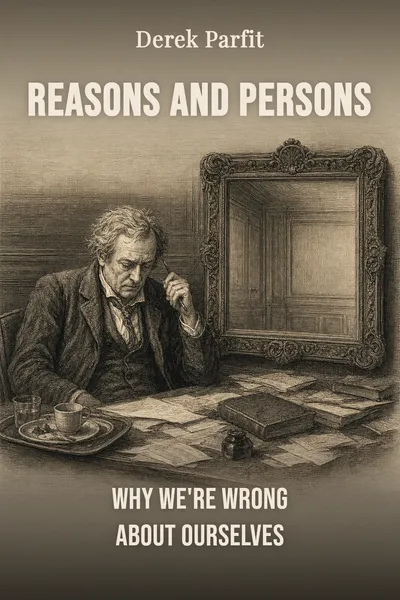
Reasons and Persons
Why we're wrong about ourselves
Description
In 1984, an Oxford philosopher named Derek Parfit published a book called Reasons and Persons. He had spent most of the previous decade on it, working at All Souls College, a place with no students and no teaching duties, which suited a man who reportedly wore the same clothes every day and ate the same meals so he could think about harder things. The book runs to more than four hundred pages, and it does something unusual for a work of moral philosophy: it argues, patiently and with a battery of invented scenarios, that we are wrong about almost everything that matters most to us — how we should act, what morality asks of us, and what we ourselves actually are.
That last claim is the one that unsettles people. Most of us walk around assuming there is a definite fact about our own continued existence: the person who wakes up tomorrow will be me, fully and simply, the same self that went to sleep. Parfit spent a large stretch of the book taking that assumption apart. He built cases involving teleporters, split brains and gradual replacement, not to be clever, but to show that the belief in a deep, all-or-nothing self does not survive contact with the cases. And once it goes, a surprising amount of what we feel about our own future starts to loosen with it.
Reasons and Persons was received as one of the most important works of moral philosophy of its century, and it has kept that reputation. What makes it strange to read is that it does not comfort. Parfit follows his arguments wherever they lead, including to conclusions he himself calls disturbing, and he does not soften them so we feel better. He seemed to believe that getting the picture right mattered more than keeping it pleasant.
The question we’re asking : What if our deepest convictions about our own nature, our reasons, and our duties turn out to be self-defeating — and following the logic leaves us somewhere we'd rather not be?What we’ll see : How one philosopher used invented cases and relentless argument to loosen our grip on the self, on self-interest, and on what we owe the people who don't yet exist.
Table of contents
01 Chapter 1 — The theory that undermines itself
Parfit opens not with the self but with a subtler problem: the theories we live by can quietly work against their own aims. He calls a theory self-defeating when following it faithfully produces worse results, by its own standard, than not following it would. This sounds like a technicality. It turns out to reach into how we think about our own lives and how whole societies coordinate.
Take the simplest version, the one about self-interest. Common sense says a rational person should do whatever best serves their own long-term good. Parfit shows that people who reason this way, together, can end up worse off — each by their own measure — than people who don't. Think of everyone driving somewhere because it's individually quicker, and everyone arriving late in the traffic they jointly created. Each did the locally rational thing. The result is a defeat for the very interest the reasoning was meant to protect. When a theory tells you to act in ways that predictably frustrate what the theory cares about, something has gone wrong with the theory, not just the day.

02 Chapter 2 — Teleportation and the person who steps out
The heart of the book is a question that sounds like science fiction and turns out to be about you. Imagine a teleporter that scans every cell in your body, records the information, destroys the original, and builds an exact copy on Mars from new matter. The copy wakes up with all your memories, your character, your sense of having just stepped into the booth. Is the person on Mars you? Parfit's answer, developed through case after case, is that the question has no deep answer — and that this is not a gap in our knowledge but a fact about how little there is to know.
He presses harder with cases drawn from real neuroscience. The two hemispheres of the brain can be surgically divided, and each can support something like consciousness. So imagine your brain split and the halves placed in two bodies. Which one is you? Neither answer works. Both can't be you, since they'll go on to lead separate lives. Yet there's no reason to pick one over the other. Parfit's conclusion is that personal identity is not what matters. What matters is something he calls Relation R: psychological continuity and connectedness — memory, intention, character carried forward — which can hold to varying degrees, can branch, and does not require a single further fact about whether some self persists.
03 Chapter 3 — When nobody has grounds to complain
Having loosened the self, Parfit turns to how we behave, and finds our moral intuitions failing in a different way. We tend to believe that an act is wrong mainly because it harms someone — someone with a face, who can point at us and say, you made my life worse. Parfit assembles cases where this picture breaks down completely, and where we still feel, correctly, that something wrong has been done.
Consider harmless torturers. A thousand torturers each turn a dial one notch on a thousand victims. Any single notch is imperceptible; no victim can feel the difference one torturer made. So no individual torturer harms any individual victim in a way that person could detect or complain about. And yet the victims are in agony, and each torturer has clearly done something monstrous. Ordinary morality, which asks who was harmed by whom, has nothing to say. The wrong is real but it cannot be assigned. Parfit uses this to show how badly our person-affecting intuitions handle the modern world, where harms come from thousands of tiny contributions — pollution, overfishing, collective neglect — none of which, taken alone, makes a difference anyone could notice.
04 Chapter 4 — The problem with the people who don't exist yet
The book's final movement is the one Parfit himself found hardest to accept, and it follows straight from the wreckage of person-affecting morality. Once we admit that we can act rightly or wrongly toward people who don't yet exist — and that our choices help decide who they'll be — we need a theory that ranks different possible futures, including futures with different numbers of people in them. Parfit went looking for such a theory and could not find one that didn't lead somewhere he called disturbing.
The trouble is now known by the name he gave it: the Repugnant Conclusion. Compare a world of ten billion people with lives of very high quality against a world with a vastly larger population whose lives are barely worth living — just above the line where existence is better than nothing. If what matters is the total amount of good, then the enormous, barely-tolerable world comes out ahead, because a tiny positive value multiplied across a huge number outweighs a high value across a smaller one. Almost everyone finds this appalling. Parfit found it appalling. But he showed, again and again, that the obvious ways of blocking it lead to conclusions just as bad or worse, and he left the book without a solution. He spent much of the rest of his life trying to find one.
05 Conclusion
Derek Parfit kept working on these problems until his death in early 2017, and the two volumes he published in the years before, On What Matters, were an attempt to build the positive theory that Reasons and Persons had left as an open wound. He never got the future-generations puzzle to a place he was satisfied with. Colleagues remember him as a man of unusual gentleness who nonetheless refused, on any point, to pretend an argument worked when it didn't — including his own.
Related books